


At 9:42 on Friday morning, Ms. Evelyn Hart held Jordan Carter’s paper between two fingers, as if the page itself had tracked mud into her classroom. The fourth graders in Room 18 had been restless all morning because Career Day always made ordinary school feel like a stage. Folding chairs lined the back wall. Parents in work badges, scrubs, suits, uniforms, and tired shoes sat shoulder to shoulder beneath a bulletin board that said, Our Families Help Our Community.
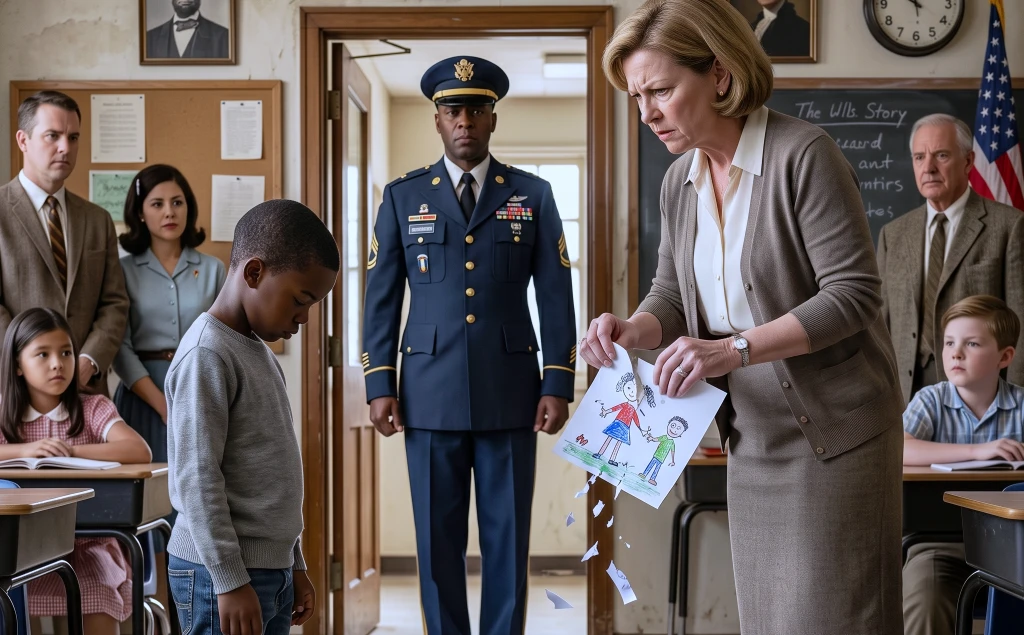
Jordan stood beside his desk with his hands locked behind his back. He had written three neat paragraphs in pencil, then drawn four careful stars in the corner because he had been proud and nervous and ten years old. Now his teacher was reading the first line out loud in a voice that made pride sound like a crime.
“My father is a four-star general in the United States Army.”
Ms. Hart looked at the paper again, then at Jordan’s scuffed black sneakers, then at the faded hoodie he wore over his collared shirt because the classroom was always cold before lunch. Her mouth tightened into a smile that wasn’t really a smile at all.
“Jordan,” she said, “I’m going to give you one chance to tell the truth before this becomes a bigger problem.”
The room shifted in that small, animal way children shift when they know an adult is about to be cruel but no one has given them permission to name it. In the back row, a woman in a gray pantsuit lowered her phone. A nurse still wearing her hospital badge looked up from her paper coffee cup. Jordan’s best friend, Miles Brooks, stopped tapping his pencil against his desk.
Jordan swallowed. “I did tell the truth.”
Ms. Hart gave a soft laugh, the kind meant to sound patient for the adults in the room. “Sweetheart, generals do not usually live in Riverbend Terrace Apartments. Their children are not usually enrolled here under a parent occupation listed as ‘federal employee.’ And they certainly don’t write reports like this without one single bit of proof.”
The word proof landed harder than the laughter.
Jordan had heard his father use that word before, but never like this. At home, proof meant doing the right thing when no one was watching. Proof meant showing up. Proof meant the polished shoes by the door, the folded flag his dad kept in a plain wooden box, and the phone calls that came at dinner and made his mother stop talking until the call ended.
At school, proof meant Jordan wasn’t enough.
That morning, before the shame and the paper and the eyes, he had eaten cereal at the small kitchen table while his mother packed a banana and a protein bar into the side pocket of her hospital bag. Dr. Naomi Carter had already been up for two hours. Her navy scrubs were fresh, her hair was pinned tight, and the smell of coffee filled the apartment.
Jordan’s father had called from a secure line just after seven.
The phone sat in the middle of the table on speaker, and General Isaiah Carter’s voice came through with the faint crackle Jordan recognized from airports, bases, and places he wasn’t allowed to ask too much about.
“Hey, champ,” his dad had said. “I’m stateside. Still moving through a few things, but I’m trying to make it before Career Day ends.”
Jordan had gripped his spoon so hard his knuckles paled. “In uniform?”
There had been a pause. Naomi had looked at the phone, then at her son.
“If I make it, yes,” his father said. “But listen to me. Your worth does not come from my uniform. You understand?”
Jordan had heard some version of that speech his whole life. His dad believed it with his whole chest. He believed every job mattered. He believed rank was responsibility, not decoration. He believed his son should never use four stars as a shield.
But Jordan had also watched kids brag about parents who owned restaurants, argued in courtrooms, designed bridges, and worked on Capitol Hill. He had watched teachers brighten for certain families and flatten for others. He had spent four years learning that some children got curiosity, while children like him got suspicion.
“I just want them to know,” Jordan had whispered.
His mother had reached across the table and touched his wrist. “Then tell the truth. Don’t decorate it. Don’t apologize for it either.”
So Jordan had written the assignment exactly as he understood it. His dad had served for more than thirty years. His dad had missed birthdays and holidays because of deployments. His dad helped make decisions that affected soldiers and their families. His dad said leadership meant carrying more, not standing higher.
He had not written about the Presidents. He had not written about the secure rooms, the late-night calls, or the way adults lowered their voices when his father entered certain places. He had kept it simple, the way he’d promised.
Simple had not saved him.
Ms. Hart turned the page toward the classroom now, letting the visitors see the blocky pencil writing and the uneven stars in the corner. “Class, this is why we talk about honesty. Sometimes children feel pressure to make their families seem more important than they are. But pretending is not the same thing as being proud.”
Jordan’s face burned. “I’m not pretending.”
“Enough.” The word came out clipped and sharp. Ms. Hart stepped closer, and Jordan caught the powdery scent of her perfume. “I checked your registration file after I saw what you wrote yesterday. Your father’s occupation says federal employee. Not general. Not military officer. Federal employee.”
“That’s what he puts on school forms,” Jordan said. His voice shook, and he hated that it shook. “For privacy.”
“For privacy,” she repeated, looking around as if inviting the room to hear how ridiculous he sounded. “Of course.”
A few kids laughed because they were uncomfortable and because laughter sometimes felt safer than silence. Miles didn’t laugh. Neither did the nurse in the back row. The woman in the gray suit sat forward, her face tightening.
“Ms. Hart,” the woman said carefully, “maybe his parents could clarify later. I’m not sure this needs to happen in front of—”
“Mrs. Delgado, I appreciate your concern,” Ms. Hart said without looking away from Jordan, “but I have managed this classroom for twenty-four years. This is a teachable moment.”
Then she tore the paper.
Not all at once. Not angrily, not with a dramatic yank that might have embarrassed her in front of the other adults. She folded it first, almost neatly, and ripped it down the crease. Then she stacked the halves and tore them again. The pieces dropped into the trash can beside her desk.
Jordan stared at the bin.
His father had signed promotion orders with steadier hands than Ms. Hart had used to destroy a fourth-grade assignment. Jordan did not think that because he wanted revenge. He thought it because his mind had gone strange and quiet, grabbing for details so the rest of him would not fall apart.
“Sit down,” Ms. Hart said. “You may rewrite it during recess with accurate information.”
Jordan did not move.
Miles pushed back from his desk. “Ms. Hart, I’ve seen his dad before. He came to pick him up last year, and—”
“Miles, sit down.”
“But he had soldiers with him.”
“Miles Brooks, this is not a group discussion.”
The back row of adults had gone still. Some stared at Jordan with pity. Some stared at Ms. Hart with discomfort. Others looked away, suddenly fascinated by backpacks and carpet squares and the paper cups in their hands.
Jordan felt all of it. The looking. The not-looking. The waiting for him to become smaller.
He picked up his backpack because his hands needed something to do. “My dad told me not to sign my name to a lie.”
Ms. Hart’s eyes widened. Color rose along her neck. “Excuse me?”
Jordan’s voice was quiet, but it carried. “If I rewrite it the way you want, that would be lying.”
The classroom held its breath.
Ms. Hart walked to her desk, lifted the phone, and pressed the office button with one hard finger. “This is Evelyn Hart in Room 18. I’m sending Jordan Carter to Mr. Phillips. He is refusing to correct false information and has chosen to be openly disrespectful in front of visitors.”
She hung up before anyone could answer, as if the decision itself had been enough.
Jordan moved toward the door. He did not cry until his fingers closed around the metal handle. Even then, he kept his face turned away so the class would not see. Before he stepped into the hallway, Ms. Hart’s voice followed him.
“Class, I hope you understand what just happened. Pride is one thing. Deception is another. We must learn the difference.”
The hallway outside Room 18 was bright and empty. Jordan walked past the laminated lunch menu, the lost-and-found table, and the mural of smiling children holding hands under a painted sun. His sneakers squeaked against the polished floor with every step. He wanted to text his mother, but she was in surgery. He wanted to call his father, but his father was always somewhere between duty and distance, and Jordan did not want to be the reason his voice changed.
By the time he reached the office, he had wiped his face with both sleeves.
Mr. Calvin Phillips, the assistant principal, sat behind a desk covered with discipline forms and coffee rings. He was a heavyset man with silver hair and glasses that rested low on his nose. He did not ask Jordan what happened. He opened the student file already on his desk.
“Ms. Hart tells me you’re having trouble being honest today.”
Jordan looked at the framed school mission statement on the wall behind him. Respect. Responsibility. Integrity. The words seemed to watch him from behind glass.
“My father is a general,” Jordan said.
Mr. Phillips sighed, not loudly, but with enough weight to make the room feel smaller. “Jordan, a lot of children exaggerate when they’re embarrassed. That doesn’t make you a bad kid. But doubling down after an adult corrects you is what turns a mistake into defiance.”
“I’m not embarrassed.”
“Your file says your father works for the federal government.”
“He does.”
“And your mother?”
“She’s a pediatric surgeon at Walter Reed.”
Mr. Phillips removed his glasses. “Jordan.”
That was all he said. Just Jordan, spoken the way adults said a child’s name when they had already decided the next words would be a lie.
Jordan reached into his pocket for his old phone. His parents only let him carry it for emergencies, and the screen had a crack shaped like lightning near the top corner. There was a new message from his dad.
Cleared the gate. Running later than I hoped. I’ll be there soon. Proud of you, son.
Jordan slid the phone across the desk. “Please. Look.”
Mr. Phillips glanced at the screen but did not pick it up. “A contact name doesn’t verify anything.”
Jordan took the phone back slowly. Something inside him folded in on itself, not broken exactly, but pressed down under too much weight.
Then the main office phone rang.
The secretary, Mrs. Lane, answered with her usual cheerful voice. “Jefferson Park Elementary, this is Denise.”
Jordan stared at the carpet. Mr. Phillips reached for a form.
Behind the counter, Mrs. Lane stopped typing. Her smile disappeared first. Then she straightened in her chair, one hand pressed against the headset.
“Yes, sir,” she said. “Yes, this is the main office. Principal Monroe is on campus. Could you repeat the name, please?”
Mr. Phillips looked up.
Mrs. Lane’s eyes moved to Jordan, then away. Her voice had dropped almost to a whisper.
“General Isaiah Carter,” she said carefully. “Yes, sir. His son is here.”
The pen slipped from Mr. Phillips’s hand and clicked once against the desk.
Mrs. Lane reached for the hold button with trembling fingers. “Mr. Phillips,” she said, “the United States Army Protocol Office is on line one. They’re asking us to clear the front entrance.” Jordan sat very still. For the first time that morning, an adult in the room looked frightened not because Jordan might be lying, but because he might not be…
To read the rest of the story – CLICK the NEXT button 👇👇👇