


The key looked too small to open anything that mattered. It sat in my palm under the yellow glare of a security light, scratched brass on wrinkled skin, while the wind pushed trash along the empty curb outside a row of old warehouses in South Boston. Somewhere behind me, a truck groaned over a pothole and kept going. Somewhere in the dark, the city I had lived in for forty years carried on without noticing that I had just turned sixty-eight, been handed a dead man’s joke of an inheritance, and been told by my only child to get out of my own home.
My suitcase stood beside me with one wheel cracked from the elevator threshold at Harbor Point Tower. It held two black dresses, a pair of flats, my blood pressure pills, and a framed photo of my husband, William, smiling at me from a vineyard patio ten years before his heart began betraying him.
I had driven to the address because I had nowhere else to go.
The building in front of me did not look like rescue. It looked like a place where things were abandoned because nobody wanted to pay to haul them away. The brick exterior was soot-stained. One corner of the gutter hung loose. The roll-up door had been painted a dull gray so many years ago that salt air and weather had stripped it down to patches. A faded sign above the side entrance read WHITAKER STORAGE, though William had never once told me he owned a storage garage.
Not once in forty-three years of marriage.
I tried the key in the side door and missed the lock twice because my hands would not stop shaking. Grant’s voice was still in my head, smooth and cruel in a way I kept trying not to recognize as my son’s.
“Mom, be honest. You’re an old woman who panics over online banking. What would you even do with anything real?”
I had heard him say impatient things before. I had excused them for years. He was under pressure. He worked with difficult people. He had his father’s ambition without his father’s softness. I had told myself every version of that story until I could almost believe it.
But earlier that evening, standing in the marble foyer of the condo William and I had shared, Grant had set my suitcase down as if delivering luggage to a hotel guest and told me he needed the space cleared by morning.
“The condo is mine now,” he’d said, checking his phone before looking at me. “Dad made that clear.”
Dad.
Not your father. Not my father. Dad, as if William’s will had become a weapon Grant had earned the right to use.
That morning had begun in a lawyer’s office that smelled like old wood, expensive coffee, and rain-soaked wool. Mr. Alden Pierce, who had handled our family papers for decades, sat behind his desk with both hands flat on a folder. He looked at me with the pained courtesy people use when they already know the news will damage you.
Grant sat beside me in a charcoal suit that had probably cost more than my first car. He had come from a meeting and made a point of saying so twice, as if grief were an errand he had squeezed between more valuable obligations. His wife had sent flowers to the funeral but had not attended the reading. “Too much, emotionally,” Grant had explained, though Bethany had never been known to avoid any room where money might be discussed.
Mr. Pierce cleared his throat before he began.
“Mrs. Whitaker. Grant. I want to say first that William was precise in his instructions. Unusually precise. Everything I’m about to read was drafted, reviewed, and reaffirmed within the last year of his life.”
I remember thinking that was a strange way to start. I remember touching my wedding band under the table and noticing how cold my fingers were.
The will itself passed in pieces. William’s voice was not there, only legal phrases arranged around his absence. To my son, Grant Whitaker, he left our harbor condo in Boston and the investment accounts everyone knew existed. To several charities, he left smaller bequests. To me, Nora Whitaker, his wife of more than four decades, he left one property at 18 Drydock Lane.
“The garage and all contents therein,” Mr. Pierce read.
Grant did not smile. He was too disciplined for that. But his mouth changed shape, just slightly, as if he had swallowed satisfaction and found it sweet.
I waited for Mr. Pierce to continue. There had to be more. A note, an explanation, a trust, anything. William was not careless. William was the man who labeled spare keys, filed appliance warranties by year, and still wrote reminders in the margins of cookbooks when he found a recipe I liked.
But Mr. Pierce closed the folder.
“That concludes the primary distribution.”
I stared at him. “There must be a mistake.”
“No,” he said quietly. “There is no mistake.”
Grant put his hand over mine. Anyone watching might have thought it was comfort, but his grip was firm enough to warn me not to make a scene. “We’ll figure it out, Mom.”
I turned toward him, desperate for the son who once crawled into my lap after thunderstorms, the boy who cried when our golden retriever died, the teenager who used to leave sticky notes on my coffee mug before early exams. I kept looking for that boy in the polished man beside me and finding only a stranger with his father’s cheekbones.
“Where am I supposed to live?” I whispered.
Grant’s eyes flicked toward Mr. Pierce, then back to me. “We’ll discuss it privately.”
Privately meant in the car, where he said he understood this was difficult but that the condo needed decisions fast. Privately meant in the elevator, where he told me a major redesign could add nearly a million dollars in value if he moved quickly. Privately meant in my own foyer, beneath the painting William and I bought on our thirtieth anniversary, where my son told me it would be easier if I stayed with my sister for a while.
“My sister lives in a one-bedroom condo in Worcester,” I said.
“Then a hotel. Or one of your church friends.” He sighed, already bored with the problem of me. “I’ll cover something modest for a few weeks.”
“A few weeks?” My voice sounded thin even to me. “Grant, this is my home.”
“It was Dad’s asset,” he said. “Now it’s mine.”
I looked around at the entry table William had sanded himself after we found it at an estate sale, the bowl where he dropped his keys, the umbrella still leaning by the closet because he had insisted every Boston spring was a trap. He had been gone only three weeks. His reading glasses were still on his nightstand.
“Your father would never want me pushed out like this.”
That was when Grant’s patience snapped.
“Don’t do that,” he said, turning on me. “Don’t hide behind him. Dad knew exactly what he was doing. He left you that garage because maybe he understood your limits better than you do.”
I felt the first clean crack inside me then.
“My limits?”
“You never handled the serious money. You never wanted to. You liked the pretty parts of life and let Dad carry everything else.” He took a breath, seeming to hear himself, but instead of stopping he hardened. “Mom, be honest. You’re an old woman who panics over online banking. What would you even do with anything real?”
For several seconds, I could not move. The foyer lights shone on his watch, on the polished floor, on the suitcase he had already packed badly from my closet. The humiliation did not come all at once. It arrived in small, precise injuries. My folded nightgown visible through the half-open zipper. William’s photo placed face down in the front pocket. My son’s hand on the door, waiting.
I picked up my purse, took the suitcase, and left without giving him the argument he wanted.
Now, hours later, the key finally turned in the warehouse lock with a reluctant metal scrape. The side door stuck against the concrete floor, and I had to press my shoulder to it. Cold air breathed out from inside, carrying not the heavy stink of oil and mice I expected, but something cleaner. Dry. Faintly metallic. Almost sterile.
I lifted my phone and turned on the flashlight.
The beam slid over a narrow hallway, then opened into a larger space beyond. At first, I saw only darkness arranged in angles. Then the light caught fabric. Smooth, fitted fabric, not tarps. Three long shapes sat in a line beneath covers the color of smoke.
I stopped breathing.
The garage was not empty. It was not full of broken furniture, forgotten files, or the sad leftovers of a life my husband had hidden from me. The floor beneath my shoes had a hard, glossy finish. Along one wall, small green lights blinked from a panel mounted beside a steel cabinet. The air hummed softly, as if the building itself were awake and waiting.
I took one step forward. Then another.
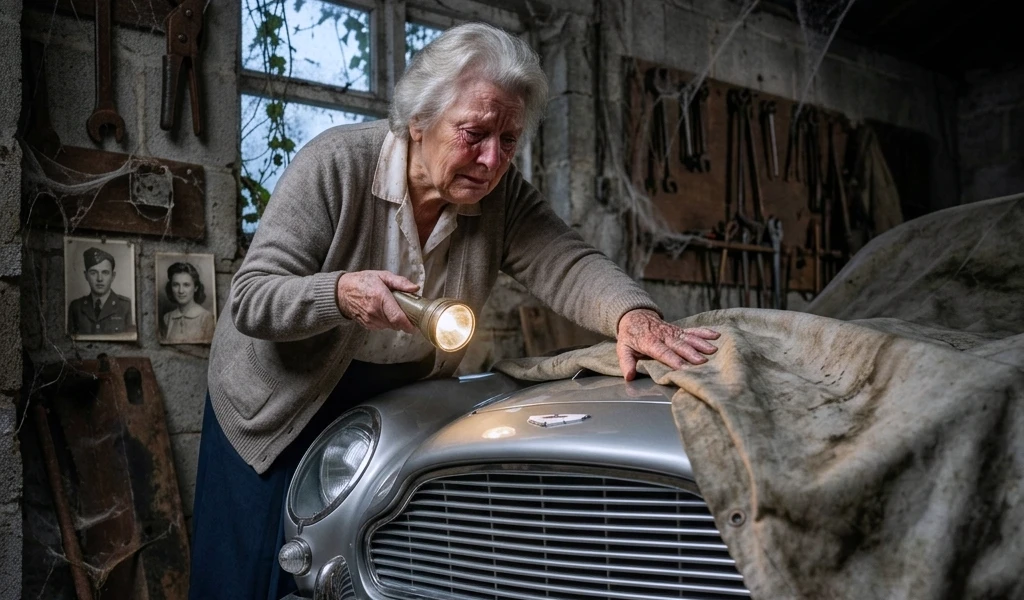
The nearest covered shape was low and elegant, its front end curved in a way no ordinary car had ever been curved. The cover had slipped near the grille, and my weak beam flashed over polished chrome. I knew nothing about collector cars, but I knew enough to understand that whatever sat beneath that cloth did not belong in a neglected industrial garage.
A ridiculous thought came to me: William would know what this is.
The thought nearly undid me.
I backed toward the wall, needing something solid, and my shoulder struck a switch plate. Beside it, taped neatly to the painted brick, was an ivory envelope.
My name was written across the front.
Nora.
Not in a lawyer’s hand. Not typed. William’s handwriting, with the N leaning forward as if in a hurry and the final a curling back on itself. Under my name, in smaller letters, he had written one sentence. Before you hate me, turn on the lights…
To read the rest of the story – CLICK the NEXT button 👇👇👇