


The cat heard them before anyone else did. At 5:12 on a wet June morning, Pepper planted both front paws on the back door and clawed hard enough to make the glass shake in its frame. Caleb Turner woke on the living room couch with a kink in his neck, one sock half off, and the sound of rain still dripping from the gutters outside. For a few confused seconds, he thought the old black cat was after a moth again.
Then Pepper yowled.
It was not the cranky little complaint she made when her food bowl was empty. It was not the sharp bark of a cat who had cornered a mouse behind the pantry. It was the sound she had made only once before, three years earlier, when Caleb’s daughter Lily had fallen from the hayloft and broken her wrist.
Caleb sat up.
“Pepper,” he muttered, rubbing his eyes. “What is it?”
The cat struck the door again. Her tail was puffed, her ears pinned back, and her yellow eyes were fixed not on Caleb, but on the darkness beyond the porch. The storm that had rolled through Cedar Ridge overnight had washed leaves across the yard and left the pasture shining under the gray dawn. Beyond the split-rail fence, the gravel access road dipped toward the old culvert near Miller Creek.
Pepper looked back once, as if to make sure he was following.
Caleb’s bare feet hit the floor before he had fully decided to move.
By the time he pulled on his boots and rain jacket, Rachel was standing in the hallway with her arms folded over one of his old T-shirts. Her hair was pulled into a loose knot, and sleep still softened her face, but her eyes were already alert.
“What’s going on?” she asked.
“I don’t know.” Caleb opened the back door, and Pepper slipped through like smoke. “She’s worked up about something by the creek.”
Rachel glanced toward the hallway where Lily’s bedroom door stood half-open. “A raccoon?”
“Maybe.”
The answer sounded weak even to him. Raccoons did not make Pepper tremble like that.
Caleb followed the cat across the wet yard. The morning smelled of mud, pine needles, and the metallic bite that came after lightning. Pepper ran ahead, stopped at the pasture gate, and turned back with a desperate flick of her tail. When Caleb fumbled with the latch, she squeezed beneath the lowest rail and kept going.
By the time they reached the low spot near the creek, Caleb heard it too.
A thin, ragged cry came from somewhere below the road.
He stopped in the rain.
For a moment, the sound seemed too small for the place around it. It came from beneath the concrete culvert where stormwater had torn a dirty channel through weeds and loose rock. The cry rose, broke, and came again. It had the helpless vibration of a kitten, but deeper in the throat, rougher at the edges.
Pepper crouched near the opening and made a sound Caleb had never heard from her before, a low, rolling murmur that seemed to come from her chest rather than her mouth.
“Stay there,” Caleb said, though he knew she would not listen.
He got down on one knee and aimed the flashlight from his phone into the culvert. Water still trickled along the bottom. A tangle of branches had wedged against the far side, packed with leaves, plastic, and pieces of splintered wood carried down by the storm. At first he saw nothing alive.
Then something moved behind the branches.
Caleb leaned closer. A small paw slid into the light, soaked and shaking, with claws no longer than a baby’s fingernails.
The paw was striped.
He forgot the rain on his neck. He forgot Rachel standing somewhere behind him, calling his name from the hill. He forgot, for one suspended second, every sensible thing he knew about distance, danger, law, and species.
“No,” he whispered.
The paw disappeared. The cry came again, weaker this time, and another shape pressed against the debris. Caleb could see part of a face now: a round, drenched head, dark ears flattened, blue-gray eyes barely open under a mask of mud.
It was not a kitten.
It was a tiger cub.
Rachel reached him just as he backed out of the culvert and dragged a hand across his mouth. “Caleb?”
He looked at her, then toward the house, where Lily’s window glowed faintly behind the curtains. He had built his adult life around animals. He had worked in wildlife rehabilitation, consulted for sanctuaries, helped move bears from roadside cages and bobcats from illegal backyard pens. He knew what panic made people do around wild animals. He knew what good intentions could ruin.
But he also knew the sound of an animal that would not survive another hour in cold water.
“There are cubs in there,” he said.
Rachel blinked once. “Cubs?”
“Tiger cubs.”
For a second, her face did not change. The words were too strange to land properly. Then she turned toward the culvert, heard the cry, and pressed a hand to her chest.
“How?”
“I don’t know.”
Pepper slipped past his boot and tried to push her head through the branches. Caleb caught her around the middle before she could wedge herself in.
“Absolutely not,” he said. “You are not going in there.”
Pepper twisted in his grip, furious and frightened, and made that low mother-sound again.
Rachel crouched beside the culvert, careful not to block the opening. “There’s more than one?”
“I saw one. I heard another.” Caleb’s mind had already begun dividing itself into tasks because that was the only way he knew how to stay calm. Towels. Gloves. Crate. Heat. Vet. Sheriff. State wildlife office. “Go wake Lily, but keep her back from here. Bring the dog crate from the mudroom and every clean towel we’ve got.”
Rachel did not argue. She ran.
Caleb lowered himself onto his stomach in the mud and began pulling branches away one by one. He worked slowly at first, afraid the pile would shift and crush whatever was behind it. The cub cried twice, then fell quiet. That scared him more than the sound had.
“Come on,” he murmured. “Stay with me.”
He cleared enough debris to reach inside. His fingers brushed wet fur. The cub flinched and made a tiny coughing growl that would have been almost funny if it had not been so weak. Caleb slid one hand under its chest and the other under its belly, then eased it out of the culvert.
It weighed almost nothing.
The little tiger fit against his jacket like a soaked stuffed animal, all head and paws and trembling ribs. Mud clung to its whiskers. Its belly was hollow. When Caleb tucked it against him, it stopped struggling and pressed its face into the warmth beneath his chin.
“Oh, my God,” Rachel said behind him.
Lily stood beside her in pink rain boots and a yellow slicker pulled over her pajamas. She was eight years old, with her mother’s dark hair and her father’s habit of going quiet when fear got too big. She held the folded towels to her chest like an offering.
“Dad,” she whispered, “is that real?”
Caleb did not answer right away. He placed the first cub into the crate Rachel had lined with towels, then reached back into the culvert. The second cub was farther in, wedged sideways against a bent piece of wire fencing. This one did not cry when Caleb touched it. Its head lolled, and for one terrible moment he thought he was too late.
Then Pepper hissed.
Not at the cub. At Caleb.
The old cat had climbed onto the road above him, rain beading on her black fur, and stared into the culvert with her whole body rigid. Caleb reached deeper, hooked two fingers gently behind the cub’s front legs, and slid it free. Its chest moved once under his palm, shallow as a breath through paper.
“Rachel,” he said, and his voice changed enough that she moved before he finished. “Car. Now.”
They drove to Dr. Maria Santos’s clinic with the heater blasting and Pepper in the back seat yowling like she had been betrayed. Caleb had tried to leave her at home. She had thrown herself against the mudroom door until Lily cried and begged him to take her.
So Pepper came, riding on Lily’s lap in a towel, glaring at the crate between Caleb’s boots.
Dr. Santos opened the clinic herself. Cedar Ridge had one full-time veterinarian, two exam rooms, a cracked parking lot, and a staff that knew not to ask too many questions when Caleb Turner called before sunrise. Maria had been his friend since college, back before he burned out of sanctuary work and moved his family into the mountains to “consult part time,” which everyone who loved him knew meant hide.
She took one look inside the crate and said, very softly, “Lock the front door.”
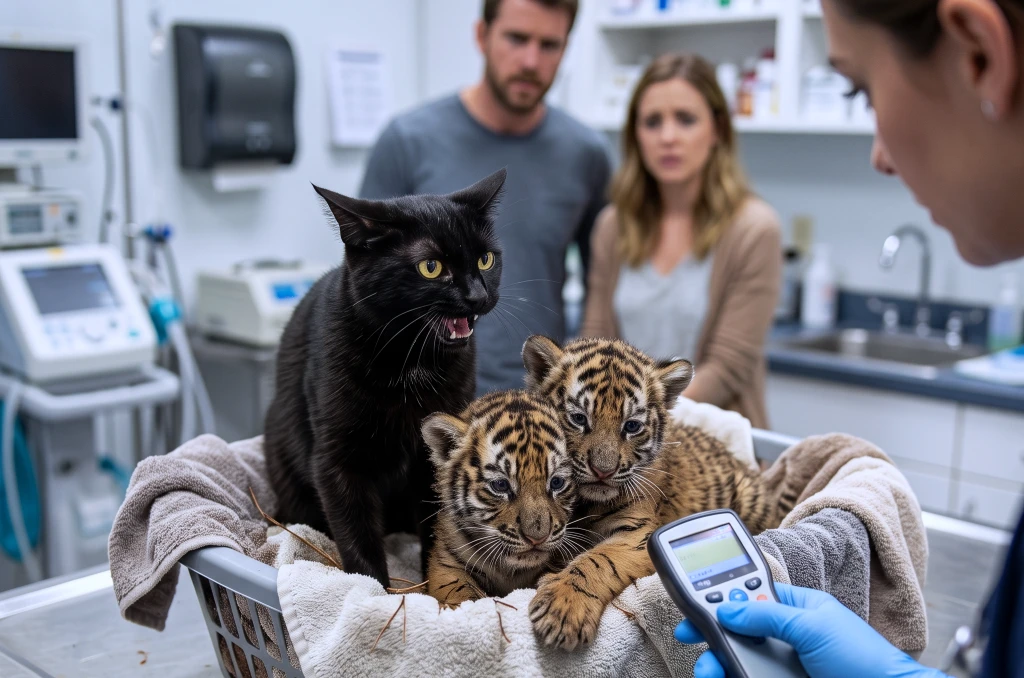
For the next two hours, the clinic moved with the quiet urgency of people refusing to waste fear. Maria warmed fluids. Caleb held the stronger cub while Rachel rubbed the second with heated towels. Lily sat against the wall with Pepper in her lap, her chin trembling, trying not to ask the question everybody else was carrying.
Are they going to die?
The smallest cub, a female, had a raw line around her neck where something had rubbed through the fur. The male had a swollen paw and a cough that rattled when he breathed. They were maybe three weeks old, Maria guessed, too young to survive without constant feeding, too stressed to be handled much, too dangerous in the long term for any home on earth.
But in that room, under the fluorescent lights, they were only babies.
Pepper broke free when Caleb shifted his grip.
“Pepper, no,” Rachel said.
The cat leaped onto the exam table before anyone could catch her. Caleb reached for her, but Maria held up one hand.
“Wait.”
Pepper approached the female cub slowly. Her whiskers trembled. The cub gave a weak, blind nudge toward her, mouth opening and closing, searching for milk that was not there. Pepper stood stiff as wire for three breaths.
Then she lowered her head and began to wash the mud from the cub’s face.
Nobody spoke.
Caleb watched Pepper’s tongue move over the tiny striped forehead with the same brisk authority she used on her own kittens. The cub’s shaking eased. The male lifted his head from the towels and made a hoarse sound. Pepper turned, sniffed him, and washed him too.
Lily slid down from the chair and came closer. “She thinks they’re hers.”
“She knows they’re babies,” Maria said. Her voice was careful, but her eyes had softened. “Sometimes that’s enough.”
Caleb should have been thinking about permits, phone calls, disease risk, quarantine, emergency placement, all the things that stood between compassion and catastrophe. Instead he found himself remembering another exam table in another county, another striped cat too far gone to save. Not a tiger cub then, but a mountain lion that had spent six years in a concrete cage behind a gas station tourist trap. Caleb had been twenty-nine and still believed expertise could undo cruelty if you arrived fast enough.
He had been wrong.
He looked down at the two cubs now, their small bodies tucked against a house cat who weighed less than one of their heads would someday weigh, and felt an old locked part of himself shift.
“We can’t keep them,” Rachel said quietly, not unkindly.
“I know.”
“I mean it, Caleb.”
“I know.”
But the female cub had stopped trembling under Pepper’s tongue, and the male had pressed himself against the cat’s side as if he had found the only safe thing left in the world.
By late morning, Maria had stabilized them enough to take X-rays and draw blood. Rachel drove Lily home to change and feed Pepper’s own two half-grown kittens, who were old enough to be confused and offended by all the attention their mother had suddenly given strangers. Caleb stayed at the clinic, making calls from the hallway with mud drying on his jeans.
County Animal Services put him on hold twice. The state wildlife office told him to document everything and not transport the cubs across county lines unless instructed. A sanctuary outside Asheville had no space but offered formula advice. Another in Kentucky said they might know someone. The sheriff’s office sent Deputy Mark Ellis, who arrived with coffee, a notebook, and the expression of a man who had heard Caleb say “tiger cubs” on the phone and hoped he had misunderstood.
He had not.
“Where exactly did you find them?” Mark asked.
Caleb showed him the photos on his phone: the culvert, the debris, the wire, the mud, the raw marks on the female’s neck.
Mark’s jaw tightened. “That old place past Miller Creek used to have cats.”
“Harlan’s?”
“Yeah. Roadside thing. Lions, tigers, a bear for a while. State shut him down last winter, from what I heard.” Mark looked through the exam room window, where Pepper was curled in a heated nest beside the cubs. “You think they came from there?”
“I think tiger cubs don’t wash into Tennessee creeks by themselves.”
Maria came out then, holding a small scanner in one hand. She did not look relieved.
“I found chips,” she said.
Caleb straightened. “Both of them?”
“Both.” She looked from Caleb to the deputy, then back again. “They’re registered.”
“To who?” Mark asked.
Maria hesitated, and that pause pulled the air from the hallway.
Then the scanner beeped again in her hand, as if the machine itself wanted to be heard.
Caleb looked through the glass at Pepper, who had one black paw resting over the smallest cub’s striped shoulder. The cat’s eyes were closed, but the cub beneath her paw was breathing steadily for the first time since dawn.
Maria lowered her voice.
“These babies weren’t lost,” she said. “They were registered to a man who lost his license to keep big cats six months ago.”
Mark’s phone rang before Caleb could answer. The deputy looked at the screen, and his face changed. He stepped toward the clinic door and said, “Caleb, don’t take them home yet. Harlan just called the sheriff’s office saying someone stole his property…”
To read the rest of the story – CLICK the NEXT button 👇👇👇