


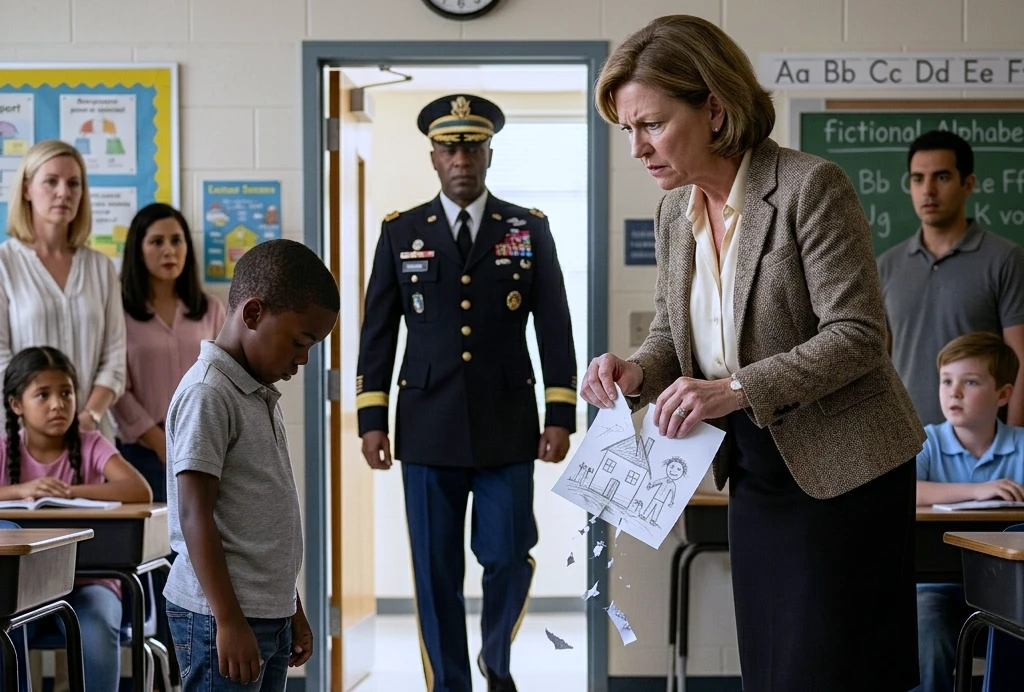
The sound of paper tearing should not have been loud enough to make twenty-six children stop breathing. But in Room 214 at Maple Run Elementary, it did. Mrs. Elaine Carver held Isaiah Brooks’s career-day essay between two manicured hands, her red reading glasses hanging from a chain against her chest. She had read only the first paragraph before her mouth tightened into the thin, disappointed line Isaiah had learned to fear. Then she lifted the page where everyone could see it and split it straight down the middle.
Isaiah’s pencil rolled off his desk and tapped against the floor.
A few kids turned around. Some looked away. His best friend, Malik Turner, froze with his hand still inside his backpack, like he had been caught stealing instead of watching something cruel happen to somebody else.
Mrs. Carver folded the torn halves together and tore them again.
“Isaiah,” she said, not quietly, not privately, not like a teacher correcting a child. “You are a fourth grader in a public school, not the son of a four-star general.”
The heat climbed up Isaiah’s neck so fast he felt dizzy.
“My dad is—”
“No.” She dropped the scraps on his desk as if she were discarding trash. “Your father is listed in the school system as a Department of Defense employee. That is not the same thing as a general. It is not even close.”
Isaiah stared at the pieces of his own handwriting. He had worked hard on that paper. He had written slowly, pressing too hard with his pencil because he wanted every letter to look neat when his father finally saw it.
“My mom filled out the forms that way,” he said. “For safety.”
Mrs. Carver gave a small laugh that made a few parents in the back of the classroom shift in their folding chairs. Career Day had not even officially begun, and the room already smelled like coffee, perfume, dry-erase markers, and adult embarrassment.
“For safety,” she repeated. “Of course.”
Then she leaned closer, close enough for Isaiah to see the powder collected at the edge of her nose. “Children who come from places like Oakwood Crossing sometimes feel the need to make themselves sound more important than they are. I understand why you would want to impress your classmates. But lying is not ambition. It is a character problem.”
Isaiah heard Malik whisper, “That’s not right,” but the words were too soft to save him.
To understand why Isaiah had written the essay in the first place, you had to go back to that morning, before the torn paper, before the parents, before Mrs. Carver turned a classroom assignment into a public trial.
At 6:12 a.m., Isaiah woke to the smell of toast and the low rumble of his father’s voice downstairs.
“Brooks family formation in eight minutes,” his father called. “Uniform of the day is school clothes and clean teeth.”
Isaiah smiled before his eyes were fully open.
The Brooks family lived in a three-bedroom apartment in Alexandria, Virginia, in a complex with tired brick walkways, dented mailboxes, and neighbors who knew one another by the sound of their footsteps. Their unit was clean and warm, but nothing about it looked impressive from the outside. The living room couch had survived three moves. The kitchen table had one chair that wobbled. A stack of Isaiah’s library books shared space with his mother’s medical journals and his father’s plain black briefcase.
There were no framed medals on the walls. No official portraits. No flags folded in triangular cases. The only hint of his father’s rank was a crayon drawing Isaiah had made in second grade: a tall stick figure in green with four enormous stars floating over each shoulder like crooked suns.
General Marcus Brooks kept his uniform at the base and most of his life out of view. Isaiah knew the rule because he had heard it since kindergarten: people did not need to know everything about your family to respect you.
That morning, though, respect felt complicated.
His mother, Dr. Talia Brooks, stood at the counter in blue scrubs, packing an apple into Isaiah’s lunch bag while reviewing a surgical schedule on her phone. She worked at a military medical center outside the city, where she repaired tiny hearts and came home with red marks on her face from her mask. His father sat at the table in jeans and an old Army sweatshirt, looking like any other tired dad with coffee in one hand and the sports section folded beside him.
On the refrigerator, a calendar square was circled in green marker.
Career Day.
Isaiah slid into his chair and tried not to grin too hard. “Are you still coming?”
His father looked up. For a second, the command in his face softened into something that belonged only at home. “I’m trying, bud. The schedule changed twice overnight.”
“You said maybe.”
“I said maybe because maybe is honest.”
Talia glanced at her husband over the rim of her travel mug. “Marcus.”
He exhaled through his nose. “I know.”
Isaiah kept his eyes on his plate. “Connor Hale’s dad is coming. He works with senators. Connor said he got a special parking pass at the Capitol once.”
“Good for Connor’s dad,” Marcus said. “Public service comes in a lot of forms.”
“But when I say what you do, people act like I’m making it up.”
His father set down his coffee. He was not in uniform, but when he became serious, the whole kitchen seemed to sit up straighter. “Listen to me. My rank is not your value. You don’t need my job to make you important.”
“I know that.”
“Do you?”
Isaiah did not answer right away. He knew he was supposed to say yes. He also knew what it felt like when Mrs. Carver praised Connor for his father’s connections, then barely nodded when Elena Reyes said her mother cleaned offices at night in a federal building. Some stories were treated like achievements. Others were treated like excuses.
Talia stepped closer and touched Isaiah’s shoulder. “You can be proud of your father without using him like a shield.”
“I’m not using him like a shield,” Isaiah said. “I just want to tell the truth.”
The words made the kitchen quiet. Marcus looked at his son for a long moment, then reached across the table and tapped two fingers lightly against Isaiah’s wrist, the way he did when he wanted his full attention.
“Then tell the truth carefully,” he said. “No details that don’t belong in school. No names of meetings. No travel specifics. Just service, leadership, and family sacrifice. Can you do that?”
Isaiah nodded, relief opening in his chest.
“And if anyone questions you,” his father added, “you don’t have to win an argument. You call us.”
Isaiah promised. He meant it at the time.
By 8:30, Room 214 was buzzing. Parents stood along the back wall with paper cups from the teacher’s lounge. A firefighter’s jacket hung over a chair. A graphic designer had brought a tablet. Connor Hale’s father wore a fitted navy suit and shook hands like he was already campaigning for something.
Mrs. Carver moved among them with the polished warmth she saved for people she considered important. She laughed at Mr. Hale’s jokes, asked the architect mother about her downtown projects, and told the firefighter that the children were “so lucky” to meet a real hero. When Mrs. Reyes arrived in her cleaning-company polo after a night shift, still smelling faintly of lemon disinfectant, Mrs. Carver gave her a polite smile and pointed toward the back row.
Isaiah noticed because children notice what adults think they are hiding.
The assignment came before the presentations. Mrs. Carver passed out lined paper and asked each student to write about a parent’s work: what the job was, why it mattered, and how it helped the community. Isaiah bent over his desk and wrote with the careful focus he used only for things that mattered.
My father serves in the United States Army. He is a four-star general. He has been deployed many times, and he helps make decisions that keep soldiers safe and protect our country. He says leadership means taking care of people before you take care of yourself.
He paused, chewing the inside of his cheek. Then he added the part that mattered more than the stars.
Sometimes he misses birthdays and holidays. Sometimes my mom has to be both parents when he is gone. I am proud of him, but I am also proud of my mom because she keeps our family together.
Malik leaned sideways, squinting at the page. “Your dad’s really that high up?”
Isaiah nodded. “Yeah. But he doesn’t like people talking about it.”
“My dad fixes elevators,” Malik whispered. “One time he got stuck in one for two hours.”
“That’s actually terrifying.”
Malik grinned. “He said the same thing.”
Mrs. Carver appeared behind Isaiah before he could smile back. She read over his shoulder without asking, her perfume drifting down in a sugary cloud. Isaiah felt her presence change before she spoke. Her silence became sharp.
She did not confront him immediately. That was almost worse. She walked back to her desk, opened a folder, and made a note with a hard scratch of her pen.
When students began sharing their essays, Connor went first. He stood with one hand in his pocket and talked about infrastructure bills, committee meetings, and how his father helped “shape public policy.” Mrs. Carver beamed as if every memorized phrase had been carved in marble.
Elena followed, her voice low but steady. She described how her mother cleaned federal offices before dawn so other people could work in clean spaces. Mrs. Reyes sat straighter in the back row, eyes shining.
“That’s lovely, Elena,” Mrs. Carver said, already looking at her clipboard. “Thank you.”
Then she called Isaiah.
He walked to the front with his paper in both hands. He could see his father’s empty chair near the door. For one second, disappointment pressed against his ribs, but he reminded himself that maybe was honest. He took a breath and began.
“My father serves in the United States Army. He is a four-star general.”
Mrs. Carver’s head snapped up.
Isaiah kept reading because stopping would have felt like admitting shame. “He has been deployed many times, and he helps make decisions that keep soldiers safe and protect our country. He says leadership means—”
“That’s enough.”
The classroom did not go silent all at once. It happened in pieces: one parent stopped stirring coffee, one child stopped whispering, one folding chair creaked and then held still. Isaiah lowered his paper.
Mrs. Carver crossed the room slowly, like she wanted everyone to understand that patience itself had run out. She took the essay from his hands.
“Class,” she said, “we have talked about imagination and honesty. They are both important, but they are not the same thing.”
Isaiah’s stomach tightened. “Mrs. Carver, it’s true.”
She smiled without kindness. “Isaiah, generals do not live in Oakwood Crossing. Their children do not arrive at school in scuffed sneakers and say their father is simply in ‘defense.’ There are records, community events, official introductions. You cannot expect adults to believe a story just because you want it to be true.”
“My dad doesn’t put everything on forms.”
“Because of safety,” she said again, and this time the sarcasm was clear enough that Connor looked down at his desk.
Malik’s hand shot up. “Mrs. Carver, he’s not lying.”
“Malik, this is not your turn.”
“But—”
“Enough.”
Isaiah felt the heat behind his eyes. He thought of his father’s words. If anyone questions you, you don’t have to win an argument. You call us.
But his phone was in his backpack. His mother was in surgery. His father was somewhere between a base, a meeting, and maybe the school, and Isaiah could not make himself reach for help in front of everyone. It felt too much like being weak.
Mrs. Carver tore the paper then. Twice. The pieces fluttered onto the floor, onto his shoes, against the leg of Connor Hale’s father’s polished briefcase.
“You will rewrite this,” she said. “You will write what your father actually does, and then you will apologize for wasting the class’s time.”
Isaiah looked at the scraps, then at her. His voice came out small, but it did not break.
“I’m not apologizing for my dad.”
Mrs. Carver’s face hardened. “Then you can explain your attitude to the office.”
The assistant principal, Mr. Grant Lowell, saw Isaiah ten minutes later. He did not ask for Isaiah’s version first. He opened Isaiah’s file, read the line that said Marcus Brooks, Department of Defense, and sighed like the matter was already settled.
“Your teacher is concerned about honesty,” he said.
“She called me a liar.”
“She asked you to correct an exaggeration.”
“It wasn’t.”
Mr. Lowell laced his fingers together on the desk. “Isaiah, sometimes children build stories around a parent’s work because they want to feel seen. There’s nothing wrong with wanting attention. But there are better ways to get it.”
Isaiah stared at him. “My mom’s a surgeon. My dad’s a general. Why is that so hard for people to believe?”
Before Mr. Lowell could answer, the phone on his desk rang. At almost the same moment, the front-office secretary opened the door and held out a sticky note, her face suddenly careful.
“Denise needs you,” she said. “Now.”
Mr. Lowell frowned. “I’m in a discipline meeting.”
“It’s about him.” She looked at Isaiah, then back at the assistant principal. “There’s a call on line one from Potomac Joint Command. They said it concerns General Brooks’s arrival…”
To read the rest of the story – CLICK the NEXT button 👇👇👇