


Mark Harlan heard the flies before he saw the dog. They were loud enough to cut through the grinder whining on his workbench, a thick, restless buzzing that did not belong to an ordinary Saturday morning. It came from beyond the back fence, past the patch of waist-high weeds behind his garage and the cracked access road that led to the old feed mill. Nobody walked back there anymore. Not since the mill shut down. Not since the county stopped pretending it was going to sell the land to somebody with money and plans.
Mark switched off the grinder and stood still.
The garage fell quiet around him except for the ticking motor of the box fan in the corner and the slow drip from the garden hose he had meant to fix two weeks earlier. On the bench in front of him lay the rusted shovel head he had been sharpening. Beside it sat a thermos of coffee gone lukewarm. That was how his Saturdays looked now: garage, tools, coffee, silence, and something broken enough to keep his hands busy.
Then the flies rose again, louder this time, like a dark engine starting behind the fence.
Mark wiped his hands on a red shop rag and stepped into the sun. July had been mean that year in northern Ohio, the kind of heat that made old wood swell and the grass go silver at the edges. He stood near the open garage door and listened. Beneath the buzzing, so thin he almost missed it, came another sound.
A whimper.
Not a bark. Not a howl. Just a low, worn-out thread of noise, like something alive had already tried every louder way of asking for help and had almost stopped believing anyone would answer.
Mark’s first thought was roadkill. His second was that roadkill did not whimper.
He crossed the yard, pushed through the sagging gate at the back of his property, and stepped into the overgrowth. Burrs caught his jeans. Thistles scraped his wrists. The vacant lot sloped toward the old mill foundation, where concrete posts still stuck out of the ground like gray teeth. He had not been back there in years, though it was less than fifty yards from his kitchen window. After the divorce, he had learned how easy it was to live beside things and never look at them.
The whimper came again.
Mark moved faster.
He found her in a shallow drainage ditch beside one of the old concrete posts.
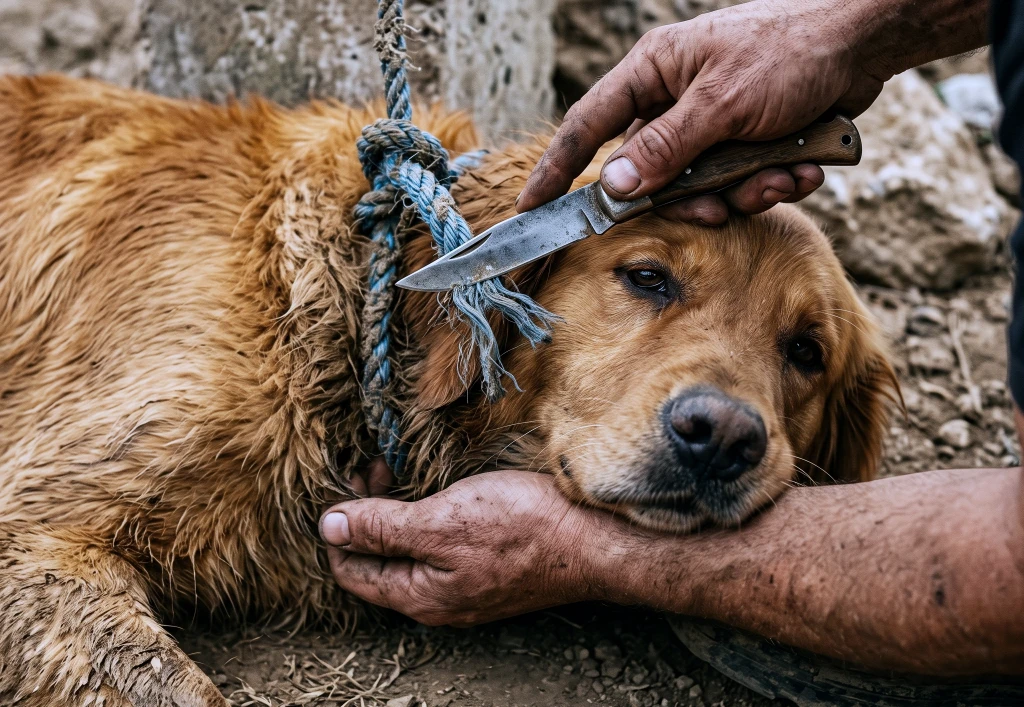
For a second, he could not make sense of what he was seeing. The dog was large, golden-red under the dirt, with long fur matted flat against her sides and a white patch on her chest that had turned brown with dust. She lay curled in the narrow shade of the post, ribs standing out under her skin, back legs tucked awkwardly beneath her. The ground around her had been scraped into a circle, exactly as wide as the rope would allow. She had walked that circle until the dirt had hardened under her paws. Then, sometime after that, she had lain down.
The rope was what stopped him.
It was looped twice around her neck, a once-white nylon line darkened by mud and blood. It disappeared under the fur at the side of her throat, then ran tight to the concrete post, where it had been knotted low and hard. The flies gathered where the rope cut deepest. They crawled over the wet fur and lifted in a black shimmer when Mark took another step.
The dog opened her eyes.
They were cloudy, feverish eyes, but they found him. She did not growl. She did not try to get up. Her tail moved once, not a wag exactly, more like the memory of one.
“Hey,” Mark said, because he had to say something. His voice came out rougher than he expected. “Hey, girl.”
He crouched several feet away. Up close, he could hear the tiny whistle in her breathing. Her nose was dry and cracked. One ear was torn at the edge, old enough to have healed crookedly. Flies settled again on the wound at her neck, and the dog only twitched her skin as if even lifting her head cost too much.
Mark reached out slowly. The dog watched his hand. Her eyes did not leave his face, and that was somehow worse than fear. Fear would have made sense. This was trust worn down to almost nothing, but still there, still waiting for a human being to do the right thing.
His fingers touched the fur between her shoulders. It was hot, stiff, and gritty. Under his palm, her body trembled once and then went still.
“You poor thing,” he whispered.
When she turned her head, he noticed the collar.
It was brown leather, cracked and stretched, buried partly beneath the rope. A small metal tag hung from it, scratched almost dull. Mark angled it toward the light but could only read part of a name, maybe the last two letters. There was a county rabies tag too, the kind vets gave out every year. Not a stray, then. Or not always.
He looked toward his house. From where he crouched, he could see the back of it through the weeds: white siding gone chalky, kitchen window with the blind half broken, the garage door standing open. The place had once been loud on Saturdays. His son, Noah, used to ride his bike in loops around the driveway while Mark changed oil or fixed lawn mower blades. Claire would call from the kitchen that lunch was ready, and Mark would pretend not to hear until she came to the door with that look that said she knew exactly what he was doing.
That was before three years of quiet. Before weekends became something to get through.
The dog’s breath caught.
Mark stood so abruptly his knees cracked. “I’ll be right back,” he told her, as if she could understand the promise and hold him to it. “Don’t move.”
She couldn’t have moved if she tried.
In the garage, his hands knew what to grab before his mind caught up: the sharp pocketknife from the pegboard, a clean towel from the shelf, bottled water from the old refrigerator, a plastic dish, work gloves, his phone. He hesitated in the doorway, then went back for the bolt cutters even though he knew they would be too clumsy near her neck. The weight of them in his hand made him feel less useless.
When he returned, the dog’s eyes were closed.
For one awful second, Mark thought he was too late. Then her side lifted, shallow and fast.
He poured a little water into the dish and set it near her nose. She smelled it, lifted her head an inch, and tried to drink. The rope tightened when she moved. Her front paw scraped the dirt, and a thin sound came out of her throat that made Mark’s grip tighten around the bottle.
“Easy,” he said. “Don’t. I’ll bring it to you.”
He cupped water in his palm and held it under her mouth. She licked once, then again, dry tongue rasping over his skin. After a few swallows, she tried to lift her head too far, and the rope dragged her back. Her eyes widened. Mark saw the moment she remembered she was still tied.
“Okay,” he said. “Okay, I’ve got you.”
He put the towel under her neck as gently as he could and slipped the knife beneath the outer loop of rope. The nylon was swollen with dirt and body heat. It resisted the blade. Mark sawed carefully, terrified of slipping, terrified of the dog jerking, terrified of the wound he could not yet see. The smell rose when he moved the rope: infection, old blood, wet fur, heat.
The first strand gave with a dull snap.
The dog flinched and then froze, her eyes rolling toward him.
“I know,” Mark said. “I’m sorry. I know.”
The second loop was worse because it had sunk farther into the fur. Mark had rebuilt engines, wired panels, patched fences in snow, and pulled nails out of lumber with his bare hands when he was angry enough. None of that had prepared him for cutting a rope away from living flesh while the animal wearing it kept trying to trust him.
He worked one inch at a time.
By the time the last fibers parted, his shirt was soaked through at the back and his hands were shaking. The rope fell loose into the dirt, heavy and stained. The dog took a breath that seemed to move through her whole body. It came out long and broken, ending in a sigh so human that Mark had to look away.
The wound under the rope was a raw groove around her neck, angry red and deep at one side. He pressed the damp towel near it, not on it, trying to keep the flies away. The dog lifted her head enough to lick his wrist.
Mark sat back on his heels.
Three years earlier, on the morning Claire left, Noah had stood by the stairs with his backpack in both hands, waiting for Mark to say something that would stop the day from happening. Mark had looked at the papers on the kitchen table. He had looked at Claire’s face, tired beyond anger. He had looked at his son’s sneakers, one lace untied.
And he had said nothing useful.
He had told himself then that not making things harder was a kind of kindness. Lately, he had started to wonder how much of his life had been built out of that excuse.
The dog’s paw shifted against the dirt.
Mark shoved the old memory down and called the nearest veterinary clinic, then the county animal services number, then the clinic again when nobody picked up at animal services. The receptionist at Brookside Veterinary Care asked if the dog could stand.
“No,” Mark said, watching the animal breathe. “I don’t think so.”
“Can you transport her?”
Mark looked at his truck through the weeds. His old Chevy Silverado had no air conditioning and a back seat full of tools, receipts, and two years’ worth of things he had meant to throw away. “I’ll make it work.”
The receptionist told him to come now.
Getting the dog to the truck took twenty minutes. Mark slid the towel under her chest and lifted carefully, expecting panic. Instead, she sagged into him with terrible trust, her body lighter than it should have been. She should have weighed seventy pounds. She felt like a bag of loose sticks under fur. When he carried her through the yard, one of her front paws rested against his forearm, limp and warm.
He laid her across the back seat on an old moving blanket. Her head turned toward him. The white band of fur around her muzzle made her look older than she probably was, and the wound at her throat pulsed faintly beneath the towel.
“I don’t know your name,” he said, half to her and half to himself. “But you’re not dying in a ditch.”
The drive into town took eleven minutes when there was no traffic. Mark made it in eight.
Brookside Veterinary Care sat between a laundromat and a closed tax office on the edge of Mill Creek, a town that had once had three factories and now had one, if you counted the warehouse that shipped parts nobody in town made. The clinic’s sign was sun-faded but clean. A woman in blue scrubs met Mark at the side door with a rolling cart before he had fully put the truck in park.
Dr. Helen Brooks came out behind her, gray hair pulled tight at the nape of her neck, reading glasses hanging from a cord against her chest. She was small, brisk, and already reaching for gloves.
“Found her tied up?” she asked.
“Yes.”
“How long ago?”
“Maybe half an hour. I don’t know how long she was there before that.”
Dr. Brooks glanced at him, and something in her face changed just enough for Mark to notice. “We’ll take her from here.”
Mark followed them inside anyway.
They did not tell him to leave. Maybe they saw that he would not have listened. He stood near the exam room door while they lifted the dog onto the stainless-steel table. The dog made no protest, only turned her head until she found Mark again.
“I’m here,” he said.
The words surprised him. He had said them automatically, like a man answering a call.
Dr. Brooks cut away more matted fur, cleaned the wound, took the dog’s temperature, listened to her chest, and spoke in low, steady instructions to the tech. Fluids. Antibiotics. Pain medication. Check her gums again. Get the chip scanner.
The chip scanner made a small beep over the dog’s shoulder.
“There you are,” the tech murmured.
Mark leaned against the wall, suddenly aware of the dirt on his boots and the dried blood under his fingernails. A framed poster above the counter explained heartworm prevention with smiling cartoon dogs. Someone had taped a child’s drawing of a cat beside it. The ordinary cheerfulness of the room felt indecent beside the rope burn around the dog’s throat.
“Is she going to make it?” he asked.
Dr. Brooks did not answer immediately. She kept her fingers on the dog’s neck, feeling for something Mark could not see. “She’s dehydrated and underweight. The wound is ugly, but it’s treatable if infection hasn’t gone too deep. She’s tougher than she looks.”
The dog’s tail moved once against the metal table.
Mark let out a breath.
The tech read the chip number from the scanner and typed it into the computer at the small desk in the corner. Dr. Brooks kept working. Mark watched the dog blink slowly under the exam light, watched her accept every touch with the exhausted obedience of an animal that had learned not to expect gentleness and still hoped for it.
Then the typing stopped.
The tech frowned at the screen. “Dr. Brooks?”
The veterinarian looked over. The room seemed to narrow around the sound of the scanner still sitting on the counter.
“What is it?” Mark asked.
Dr. Brooks took off one glove, stepped to the computer, and read whatever had appeared there. For a moment, neither woman spoke. The dog breathed against the towel, and the clock above the door clicked once.
Dr. Brooks turned back to Mark.
“The chip is registered,” she said carefully. “Her name is Sadie.”
Mark looked at the dog. Sadie. The name seemed to settle over her like something she had been waiting to hear.
But Dr. Brooks was not finished.
“The owner on file is Margaret Whitaker,” she said. “She lived over on Willow Branch Road.”
“Then call her,” Mark said. “Maybe she’s been looking for her.”
Dr. Brooks held his gaze, and the pity in her eyes made Mark’s stomach drop before she spoke.
“Margaret Whitaker died in March,” she said. “The emergency contact listed for Sadie is her nephew. Travis Whitaker. According to the record, he was the person who was supposed to take her after Margaret passed.”
Behind Mark, the dog lifted her head at the sound of the name. Not much. Just an inch. But enough for everyone in the room to see her start trembling…
To read the rest of the story – CLICK the NEXT button 👇👇👇