


The dog should have taken the sandwich. Any hungry stray in Alder Creek would have snapped at food on a night like that, with the wind dragging loose snow across the county road and the temperature already below zero. But the old brown dog on Leah Carter’s porch only lifted his head, looked at the sandwich in Walt Benson’s glove, and made a sound too thin to be a growl.
“Easy, Boone,” Walt said. “Nobody’s here to hurt you.”
Behind him, Hank Miller stopped halfway up the broken porch steps. The beam of his flashlight shook a little in the wind. “Walt,” he said quietly, “why’s he lying like that?”
Walt looked closer.
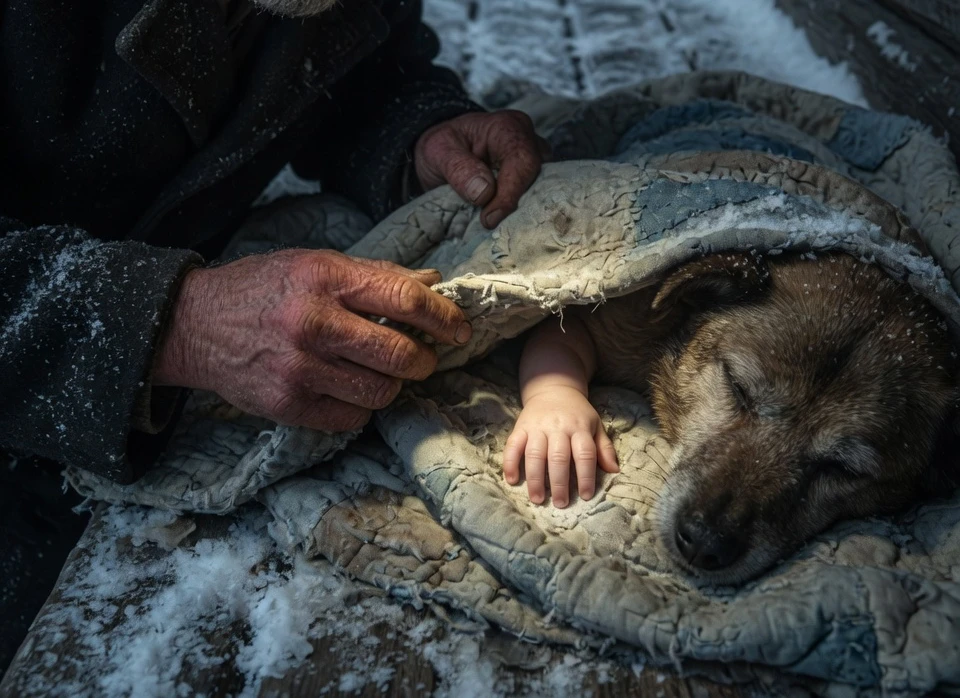
The dog wasn’t curled up to sleep. He wasn’t even lying the way dogs did when they were too tired to stand. Boone had his body pressed low against the porch boards, ribs tucked around something hidden beneath his chest, as if the last warmth left in him belonged to whatever he was covering.
At first Walt thought it was a towel.
Then the wind caught one corner of the cloth, lifted it, and showed him a tiny bare hand.
Walt forgot the cold so completely that, for two seconds, he stood there with the sandwich still in his hand.
“Lord have mercy,” Hank whispered.
The porch belonged to a weather-beaten single-wide trailer at the far bend of Morgan Creek Road, where the pines leaned close enough to scrape the roof when the wind came down from the ridge. There were only a few homes out that way, most of them old farm places, hunting cabins, or trailers that had been patched through one winter too many. Leah’s was the last one before the road dipped toward the frozen creek.
Walt and Hank had been driving back from Alder Creek Elementary, where they had spent the afternoon fixing warped wooden window frames in the older wing. They were both retired, at least officially, though neither of them had ever learned how to sit still. Walt was seventy-two, square-shouldered and slow-moving from a bad hip. Hank was seventy-one, narrow as a fence rail and twice as talkative, with a laugh that sounded like gravel in a coffee can.
They had known each other since second grade. They had built barns together, repaired church pews together, buried friends together, and argued over every card game in the county. In town, people still called them “the Benson-Miller crew,” even though the crew had been down to two old men for almost a decade.
They had not planned to stop at Leah Carter’s place.
They had been talking about spring work, about whether either of them was foolish enough to take on fence repairs up near the north pasture, when Walt saw something dark on the porch through the falling snow. Hank almost drove past it, but Walt tapped the dashboard.
“Slow up.”
“For what?”
“That dog.”
Hank squinted over the steering wheel of his old Ford. “That’s Boone, isn’t it?”
Walt did not answer right away. He remembered Boone from better days, when the dog had belonged to Leah’s father, Earl Carter. Earl had been a quiet man who kept a neat yard, fixed his own truck, and called Boone “son” more often than he called any person by name. After Earl died, the trailer had sagged faster than it should have, and Boone had gone from riding in the front seat of Earl’s pickup to sleeping under the porch steps.
People noticed. People always noticed in a town as small as Alder Creek. They noticed Leah’s porch light staying off for days, noticed the trash bags piling near the shed, noticed Boone nosing around behind the gas station for dropped hot dogs. But noticing was not the same as helping, and helping was not the same as staying long enough to see what was really wrong.
“Pull over,” Walt said.
Hank sighed as if Walt had asked him to shovel the whole road by hand, but he guided the truck onto the shoulder. “You know she’ll pitch a fit if she sees us on her porch.”
“Porch is outside.”
“That won’t matter to Leah.”
Walt took the half sandwich from the paper sack between them. It had been his supper, bought at the school cafeteria because the cook still treated him like one of the maintenance men. He opened the truck door, and the cold came in sharp enough to sting the inside of his nose.
The trailer looked dark except for the blue flicker of a television behind the front curtains. No porch light. No smoke from the stovepipe. No tracks in the fresh snow except for the two lines made by Hank’s tires and the uneven prints of a dog that had paced from the steps to the door and back again.
That was the first thing that made Walt uneasy.
Boone was old, but he was not foolish. On a night like this, any dog with sense would have tucked himself under the trailer or inside the shed, somewhere the wind could not get at his belly. Instead, he was out on the open boards, his coat dusted white, his muzzle frosted, his body stiff from holding the same position too long.
“Hey, Boone,” Walt said, climbing the first step. The wood complained under his boot. “You hungry, boy?”
The dog raised his head. His ears did not perk. His tail did not move. He only watched Walt with brown eyes that seemed too tired to hold fear properly, though fear was there too. When Walt extended the sandwich, Boone’s nose twitched.
He did not take it.
Hank came up behind Walt and clicked his tongue. “That dog’s in bad shape.”
“Been in bad shape awhile.”
“Yeah, but tonight’s different.”
Walt glanced toward the trailer door. The inner curtain glowed and dimmed with the television. Something loud played inside, laughter from a show that had nothing to do with the quiet on the porch. Walt knocked once with his knuckles, more from habit than hope.
No answer.
He knocked harder. “Leah?”
The television kept laughing.
Hank leaned close to the window and wiped a circle through the frost with his glove. “Can’t see much. Curtain’s pulled.”
“Truck in the yard?”
“Not that I saw.”
“She got no business leaving that dog out like this.”
“Leah’s got a long list of things she’s got no business doing.”
Walt gave him a look. Hank shut his mouth, but only because of the look. Both men knew the talk in town. Leah Carter had been struggling long before Earl died, and after his funeral she seemed to lose whatever thin rope had tied her to ordinary life. She missed shifts at the diner. She fought with the manager at the grocery store. She showed up at the county clinic late in her pregnancy with no coat, no paperwork, and a laugh too bright for the room.
A baby had been born less than three weeks ago. Walt’s late wife June would have known the details. She had known every baby in Alder Creek by weight, middle name, and grandmother. Walt only knew what Hank’s wife had told him over the phone: boy, small, born at the county hospital in Helena because the roads were bad that night. Leah had come home two days later.
Since then, the trailer had been mostly dark.
Walt looked down again at Boone. The dog had lowered his head, but not all the way. He kept his chin angled over the thing beneath him.
“What you got there?” Walt murmured.
Boone’s lips trembled. Not a snarl. Not quite. A warning from an animal too weak to back it up.
Hank shifted his weight. “Could be a possum.”
“Possum wrapped in flannel?”
“Could be rags.”
Walt crouched slowly, his knee cracking. Boone’s eyes followed him. The dog’s body tensed, but he did not lunge. Snow had gathered along his spine and in the coarse fur between his shoulders. Walt could see the shiver running through him, a tremor so constant it had become part of his shape.
“Easy,” Walt said again.
He reached for the edge of the cloth.
Boone moved then.
It was not much. Just the lift of his head, the smallest push forward with his front paws. But Walt stopped immediately, because the dog’s mouth opened and closed around a sound that seemed pulled from pain rather than anger. Boone was not protecting food. He was not protecting a toy. He was not protecting himself.
He was begging Walt to understand without making him move.
Hank took one step back. “Walt.”
“I know.”
“You don’t know anything yet.”
“I know enough to not yank at it.”
Walt set the sandwich down on the porch where Boone could reach it. The dog looked at it once and then looked away.
That scared Walt more than any growl would have.
He took off one glove with his teeth and tucked it under his arm. His bare fingers hit the air and went numb almost at once. He slid his hand over the porch board, slow enough that Boone could see every movement. The dog did not stop him this time. Instead, he trembled harder, as if holding still took everything he had left.
The cloth was not a towel. It was a baby blanket, thin cotton flannel with faded yellow ducks printed on it. It was damp, stiff in places where the moisture had begun to freeze. Walt touched the corner and felt the kind of cold that did not belong near living skin.
“Hank,” he said, and his voice came out wrong.
“What?”
“Get your phone.”
“My phone won’t catch out here.”
“Try anyway.”
Hank fumbled in his coat pocket. Walt lifted the corner of the blanket by an inch, then two. His first thought was that some doll had been left outside. The hand was too small to be real. The wrist looked delicate as a bird bone, the fingers curled inward, the nails pale against blue-tinged skin.
Then the fingers twitched.
Walt jerked back so hard his shoulder struck the porch rail.
Hank saw it too. His face changed. All the irritation, all the old-man grumbling, all the ordinary annoyance at Leah and the weather went out of him in one breath.
“That’s a baby,” Hank said.
Walt was already moving. “Call 911.”
“I told you, I’ve got no bars.”
“Then get bars.”
“Walt—”
“Get bars, Hank.”
Hank turned and nearly slipped on the steps. He grabbed the rail, cursed under his breath, and hurried toward the road with his phone held above his head as if two extra feet might reach the tower.
Walt stayed crouched beside Boone. His bare hand hovered over the blanket, and for a moment he could not make himself lift it farther. Not because he did not want to know. Because once he saw, he would have to do something fast enough, careful enough, brave enough, and Walt had not felt fast or careful or brave in years.
He had felt old.
Old men repaired windows. Old men drank coffee at the diner and complained about the price of lumber. Old men woke up in quiet houses and folded blankets on one side of a bed no one else used anymore.
Old men did not find newborns under half-frozen dogs.
“Boone,” he whispered, “I need to see.”
The dog stared at him. Snow clung to his whiskers. His eyes were cloudy with age, but there was something painfully clear in them now. He lowered his head by a fraction and, with what looked like the last of his strength, shifted his body just enough for Walt to slide one hand under the blanket.
The bundle was warm in one place only.
Under Boone’s chest.
Walt lifted the edge of the blanket.
A baby’s face appeared in the narrow beam of Hank’s abandoned flashlight. The child wore a cotton cap that had slipped down over one ear. His cheeks were mottled. His lips were darker than they should have been, and his eyes were closed so softly that Walt’s mind refused to decide whether it was sleep or something worse. Walt leaned close, holding his own breath. The baby did not cry. The tiny mouth opened once, barely, as if trying to remember how…
To read the rest of the story – CLICK the NEXT button 👇👇👇