


The first time Judge chose my future husband, he planted himself outside Apartment 4B at 6:17 on a Tuesday morning and refused to move. He did not meow. He did not scratch. He simply sat on the hallway carpet with his tail wrapped around his enormous paws, staring at the closed door like he had come to deliver a verdict. From the other side came a thin, miserable whine.
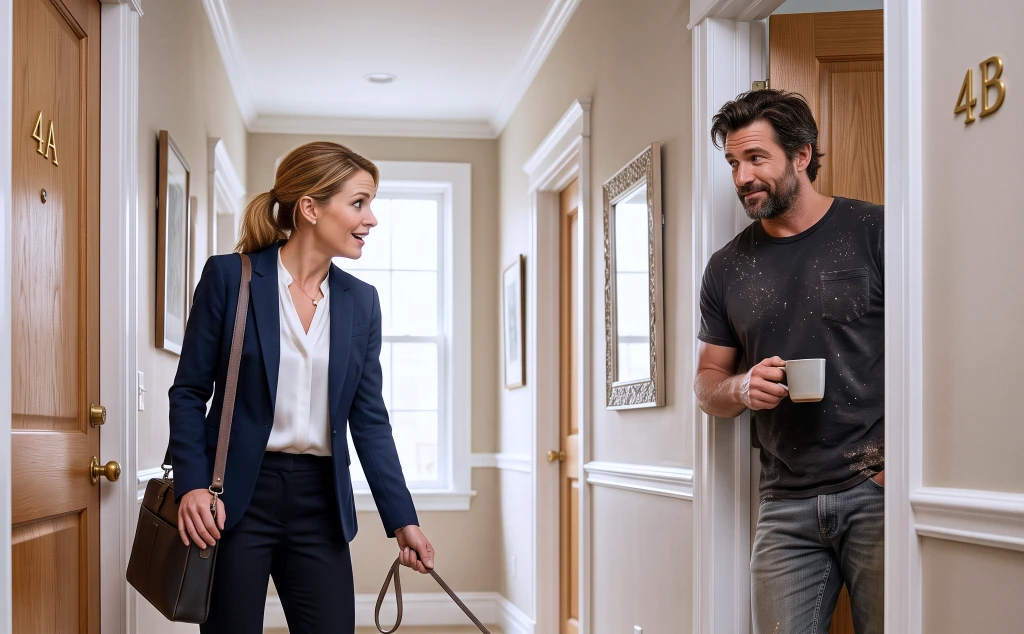
I stood there in running shoes, a blouse I had already ironed for work, and a cat harness I still did not know how to buckle properly. I had a conference call in forty-three minutes, a niece taking a college placement test across town, and a twenty-pound long-haired tabby who had apparently decided that our scheduled walk was no longer acceptable.
“Judge,” I whispered. “Absolutely not.”
He looked up at me with the expression of a man disappointed in the legal system.
That was the thing about Judge. He never behaved like a pet. He behaved like an elderly county official who had seen too much and approved of very little.
Three days earlier, I had not owned a cat. I had not owned a litter scoop, a scratching post, a bag of salmon-flavored treats, or a lint roller in every room. I was thirty-nine, single by choice, comfortably employed, and proud of the two-bedroom condo I had bought in Pittsburgh after years of saying no to vacations, no to impulse purchases, and mostly no to men who wanted me available but not ambitious.
My life was not exciting, but it was mine. Every bill was paid. Every drawer was labeled. Every Sunday night, I meal-prepped lunches in glass containers and told myself peace was supposed to be quiet.
Then my sister Meghan called from Hollow Creek and said, “Claire, Lily got into the nursing program.”
I had already promised my niece she could stay with me for her first year. Allegheny State University was only twenty minutes from my building, and Pittsburgh rent was not gentle to eighteen-year-olds from small towns with part-time savings and big dreams. I had meant it when I offered. Lily was bright, sweet, nervous, and far more capable than she believed.
What I had not offered was to take Judge.
“He’ll be fine here,” I told Meghan when I arrived that Friday afternoon to pick Lily up.
My sister stood on her sagging front porch with red eyes, one hand on Lily’s suitcase and the other buried in Judge’s thick gray-and-brown ruff. Judge sat beside her like a dignitary at a ribbon-cutting ceremony, unmoved by human grief but clearly aware of his importance.
“He won’t be fine,” Lily said, trying to sound adult and failing. “He sleeps outside my door. He walks me to the mailbox. He knows when I’m upset.”
“He’s a cat,” I said, which was the last foolish thing I said before Judge turned his head and looked directly at me.
It was not a glance. It was an assessment.
Meghan wiped under one eye with her thumb. “He’s never lived inside full-time, Claire. He comes in and out. He’ll hate the city.”
“Then that is another reason not to bring him.”
Lily did not argue. That was worse. She only bent down, pressed her forehead into Judge’s fur, and whispered something I could not hear. Judge closed his eyes, just once, as if granting her a private audience.
I had known Lily since the day Meghan brought her home from the hospital in a yellow blanket. I had watched her learn to ride a bike, learn to read, learn to hide tears because money was tight and Meghan was tired. I also knew what it looked like when a young person was leaving home before she felt ready.
So I sighed the sigh of a woman watching her organized life step directly off a curb.
“Fine,” I said. “But if he destroys my couch, he’s getting a job.”
Lily cried then. Meghan cried harder. Judge, I swear, looked satisfied.
The drive from Hollow Creek to Pittsburgh took a little over three hours, or it should have. With Judge in the car, it took nearly five.
He refused the carrier within the first ten minutes. Not by panicking. Panic would have been understandable. Judge pressed one enormous paw against the mesh door, held my gaze through the rearview mirror, and pushed until the zipper surrendered with a sound like a tiny zipper giving up on life.
“Lily,” I said carefully.
“I’m sorry.” My niece reached for him. “Judge, no. Aunt Claire is driving.”
Judge stepped out, crossed the back seat, and settled beside Lily with the grave composure of a passenger who had paid for business class.
At the first rest stop, he made it clear that he required privacy. He turned his head toward me, unblinking, until I pulled over. Lily clipped a leash to his harness, which he tolerated with visible disgust, and he disappeared behind a row of bushes for exactly three minutes. Then he returned, jumped into the car, and sat as if waiting for the chauffeur to resume service.
By the second stop, I understood the system. Judge would stare. I would obey. Lily would apologize. Judge would forgive no one.
Somewhere past Somerset, Lily stopped talking about course schedules and began picking at the sleeve of her hoodie.
“What if I can’t do it?” she asked.
“College?”
“All of it.” She looked out at the highway. “The city. The classes. Living with you. Not being home.”
I wanted to say something efficient, something like You’ll adjust or Everyone feels that way at first. I was good at efficient comfort. It did not require much vulnerability from either person.
But Judge had placed one paw on Lily’s knee. His eyes were half closed, his body steady against the motion of the car, and for once he looked less like a judge than an old soldier keeping watch.
So I said, “Then we figure it out one piece at a time.”
Lily glanced at me, surprised.
“I’m serious,” I added. “You don’t have to become a whole new person by Monday.”
She nodded, and we drove the next twenty miles in a quieter kind of silence.
My condo building sat on a tree-lined street between Bloomfield and Shadyside, close enough to coffee shops that I could pretend I had a social life and far enough from downtown that parking did not require prayer. It was an old brick building converted into condos, with polished floors in the lobby, ferns by the mailboxes, and neighbors who communicated mostly through polite nods and passive-aggressive notices taped near the recycling bins.
Judge hated it immediately.
He hated the lobby. He hated the elevator. He hated the faint chemical lemon smell of the freshly mopped hallway. Most of all, he hated the fact that there were no porches, no loose boards under sheds, no familiar maple tree, and no kingdom of backyards where he had once ruled over squirrels, sparrows, and one unfortunate golden retriever named Banjo.
We were halfway from the elevator to my door when Apartment 4B opened and a small orange blur shot into the hallway.
The blur was a Pomeranian.
At least, I believed it was a Pomeranian. It was round, elderly, and groomed into the shape of a decorative throw pillow. Its tiny feet moved so quickly they seemed unrelated to the rest of its body, and when it barked, the sound came out in two separate installments.
“Ar—”
A pause.
“—f!”
Judge stopped.
The dog stopped.
Lily froze with one suitcase in each hand.
I had been afraid Judge would attack. Instead, he looked at the dog, looked at me, then looked back at the dog with such grave confusion that I almost apologized on behalf of the species.
“Peanut!” someone called from the open apartment.
A young man appeared in the doorway, barefoot, hair still damp from a shower, a textbook under one arm. He could not have been more than nineteen. He took in the scene: my niece, me, the suitcases, the tiny dog, and Judge, who stood in the middle of the hall like a mob boss being challenged by a cotton ball.
The young man’s mouth twitched.
“Sorry,” he said. “He thinks he’s security.”
Peanut attempted another bark. “Ar—”
Judge lifted one paw.
Peanut stopped.
The young man laughed so hard he had to lean against the doorframe. Lily tried not to laugh, which made her laugh harder. I gave up first. After three hours of cat judgment and highway exits, the sight of that ridiculous dog surrendering to one raised paw broke something loose in me.
“What’s his name?” Lily asked, nodding toward the Pomeranian.
“Peanut,” the young man said. “He belongs to my grandpa, but he thinks he belongs to the building. I’m Noah.”
“Lily.”
They looked at each other for one second too long, the way young people do when they believe they are being subtle.
Judge, apparently bored by the weakness of his opponent, walked past Peanut and continued toward my condo. Peanut watched him go with open admiration.
My plan had been simple. Lily would take the guest room. Judge would adjust. I would maintain my routine. We would be kind to each other, but my life would remain essentially intact.
That illusion lasted until 2:13 a.m.
I woke to a soft thump in the hall. Then another. Then the faint scrape of claws against wood.
I found Judge inspecting my condo in the dark.
He had opened the lower kitchen cabinet. He had removed one dish towel. He had dragged a throw pillow from the living room to the hallway and abandoned it there, apparently after determining it had no value. When I turned on a lamp, he sat in the center of the floor and blinked as if I had interrupted a security audit.
“Are you done?” I whispered.
He walked past me, into Lily’s room.
The door was open an inch. Through the gap, I saw my niece curled on her side, one hand tucked under her cheek. Her phone lay face down beside her pillow. Her shoulders moved once in that small, careful way people cry when they do not want anyone to know.
Judge jumped onto the bed with surprising gentleness. He circled twice, pressed his body against her knees, and settled there like a sandbag holding down grief.
I stood in the hallway longer than I meant to. My condo looked different at night with Lily’s shoes by the door and Judge’s food dish on a mat in the kitchen. Messier, yes. Less mine, maybe. But not worse.
The next morning, Lily had orientation paperwork and a placement test on campus. I took the day off, partly to drive her, partly because I did not trust Judge alone with my furniture.
“I can take the bus,” Lily said, brushing her hair at the kitchen counter while Judge ignored the untouched bowl of premium indoor-cat food I had bought under duress.
“You can take the bus when you know where you’re going.”
“I know how maps work.”
“I know how panic works.”
She smiled a little. “Fair.”
By Monday evening, we had settled into something that resembled a routine. Lily attended orientation events. I answered emails. Judge rejected three brands of litter, accepted one windowsill, and spent twenty minutes staring at the dishwasher while it ran as if waiting for it to confess.
By Tuesday morning, I was feeling almost smug.
Then Judge sat outside Apartment 4B.
Peanut whined again behind the door.
“Judge,” I said, keeping my voice low. “We are not visiting strangers before coffee.”
He did not move.
I tugged gently on the leash. Judge became a statue covered in fur.
From inside the apartment came a muffled sound: a chair scraping, a man coughing, then footsteps. I expected Noah. Maybe his grandfather. I rehearsed a normal sentence in my head: Sorry, my cat is adjusting to the building.
The lock turned.
The door opened.
The man standing there was not Noah. He was older, maybe early forties, broad-shouldered, barefoot, wearing jeans and a faded T-shirt dusted with what looked like sawdust. His dark hair was flattened on one side from sleep, and he held a coffee mug in one hand like it was the only thing connecting him to civilization.
Peanut squeezed around his ankle and made a beeline for Judge.
Judge did not retreat. He only looked at the man, then at me, as if he had successfully delivered me to the correct office.
The man glanced down at the enormous cat on his doormat and then back up at me.
“Well,” he said, voice still rough from sleep. “Either that cat is here to inspect the plumbing, or I’m underdressed for court.” – And for the first time in years, I could not think of one sensible thing to say…
To read the rest of the story – CLICK the NEXT button 👇👇👇