


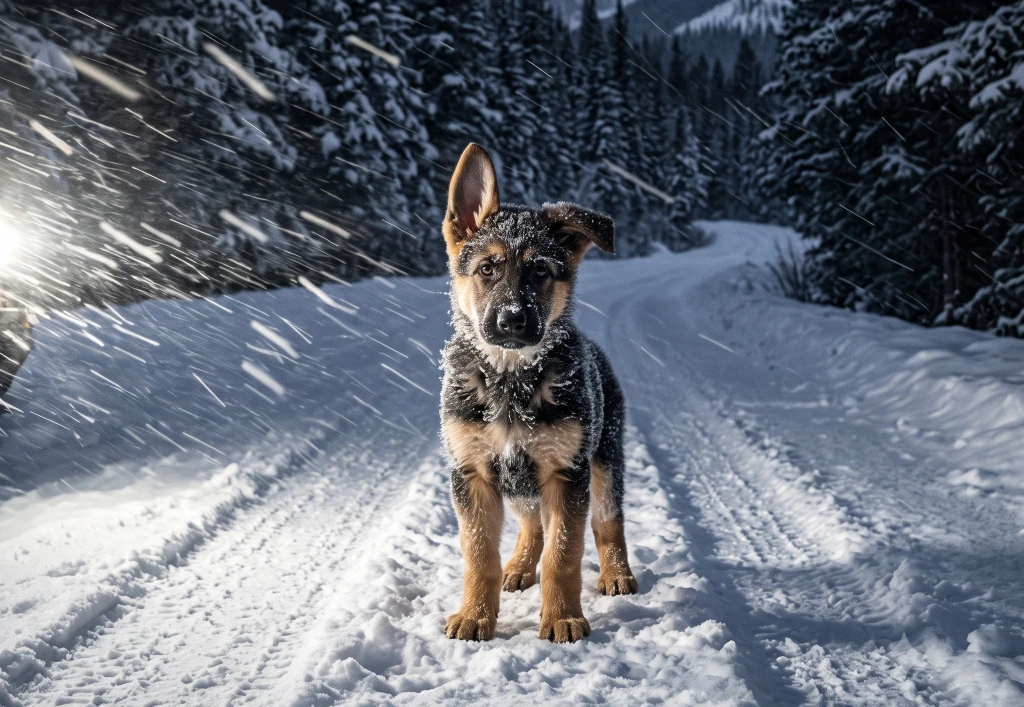
The puppy stood in the middle of the mountain road like he had been put there on purpose. Eli Turner saw him through the white blur of the storm only because the pup’s dark ears broke the flat color of the snow. At first Eli thought it was a trash bag blown loose from somebody’s pickup, or maybe a chunk of bark stripped from a pine and tossed by the wind. Then the small shape shifted, planted its front paws wider, and faced the headlights without moving.
Eli hit the brakes hard.
The old truck shuddered sideways on the packed snow, tires whining over ice. A cardboard box slid off the passenger seat and spilled a thermos, a pair of work gloves, and the folded brochure from Bear Creek Assisted Living onto the floorboard. The truck finally stopped several yards short of the puppy, its engine knocking in the sudden hush.
Eli stayed behind the wheel for a second, one hand locked around the steering wheel and the other pressed against his chest. The storm pushed at the truck from every side. Snow crossed the headlights in bright, frantic streaks, and beyond them the dark timber of the Montana backcountry leaned close enough to swallow the road.
“Lord, little fella,” he muttered. “What are you doing out here?”
The puppy was a German shepherd, maybe ten weeks old, too young for his paws and too thin under the fluff of his black-and-tan coat. One ear stood up with brave, ridiculous confidence. The other folded over as if it had not yet decided what kind of dog he meant to become. Ice clung to the whiskers around his nose, and his whole body trembled with the cold.
But he did not run.
Eli shut off the engine. The absence of that old mechanical rattle made the road feel even farther from town. He opened the door, and the storm slapped him across the face with freezing air sharp enough to water his eyes.
“Easy,” he called, lowering one boot into the snow. “I’m not going to hurt you.”
The puppy took two stumbling steps toward him, then stopped and rose awkwardly onto his back legs. He lifted both front paws in front of his chest, pressing them together for balance. It lasted only a second before he dropped back down, but Eli felt the sight of it go straight through him. The pup looked less like a stray animal than a child trying to explain an emergency in a language no one had taught him.
Eli had seen dogs beg for food. He had seen them shake, cower, guard, and grieve. He had never seen a puppy stand in the road during a blizzard and refuse to be saved alone.
The pup came running then. Instead of diving under the truck for shelter or pushing against Eli’s legs for warmth, he latched his tiny teeth into the canvas cuff of Eli’s snow pants and pulled.
“Hey, now.” Eli bent carefully, trying to free the fabric without frightening him. “You’re frozen half to death.”
The puppy growled.
It was not much of a sound, thin and childish, but it carried more determination than Eli had heard from most grown men. The pup tugged again, bracing his paws in the snow and leaning his whole small weight toward the tree line on the right side of the road.
Eli looked that way.
The forest beyond the ditch was thick with lodgepole pine and spruce, the trunks dark and close together. Snow had softened every branch, every stump, every rock. Even in daylight, a man could step twenty yards into that country and disappear. At dusk, with a storm building, the woods looked less like a place than a warning.
“No,” Eli said quietly. “No, you don’t want to go back in there.”
The puppy released his pant leg, ran three steps toward the timber, and turned around. His eyes caught the headlights. He barked once, a cracked little sound that broke into a whine, then ran back and grabbed Eli’s cuff again.
Something in Eli’s chest shifted.
He had planned this drive carefully because he did not trust himself to turn around once the house was out of sight. He had packed one duffel. He had locked the sheds. He had left a note for Frank Avery, his nearest friend and the district wildlife officer, telling him to take whatever tools he wanted before spring. He had stood in his kitchen that morning and looked at the iron stove, the chipped blue mug on June’s side of the table, the quilt she had made from old work shirts, and he had told himself a man could outlive his own life if he stayed too long in a house full of ghosts.
Bear Creek Assisted Living was forty-eight miles away, on the edge of Billings. The woman on the phone had been kind. She had said there would be meals, heat, card games, help with his pills, people around if he needed them. Eli had said that sounded fine because he was tired of lying to the walls.
Since June died, the cabin at the edge of Redwater Ridge had become too quiet to survive in and too dear to leave. Every room had a way of reaching for him. Her rubber boots still stood by the back door, though he had not let himself touch them in nineteen months. The last jar of chokecherry jam she canned sat in the pantry because he could not bear to open it and could not bear to throw it away. Their old hound, Roscoe, had gone two winters before her, and sometimes Eli still woke expecting to hear the dog’s nails on the floorboards.
He had once known every draw, ridge, game trail, and creek bend in these mountains. People had called him when children wandered too far from camp, when cattle vanished, when a storm stranded somebody at a trailhead. He had been a hunter, then a tracker, then the man who could find what everyone else had given up on.
Lately, he could barely find a reason to light the stove.
The puppy pulled again.
Eli turned from the trees to the truck, then back to the puppy. The wind changed direction, sweeping down from the ridge and across the ditch. With it came a smell that did not belong near the road. Not wood smoke from a distant cabin, not diesel, not pine sap.
Heavy musk. Wet fur. Torn earth under snow.
Eli’s fingers tightened around the open truck door. His body knew before his mind finished naming it. The woods had gone too quiet. No magpies fussing in the branches. No squirrel chatter. Not even the brittle tick of falling snow from high limbs. The whole forest seemed to be holding still.
“Something’s in there,” he said.
The puppy’s eyes did not leave his face.
Eli swore under his breath, not at the dog but at the part of himself that had already decided. He reached behind the seat and pulled out the old rifle he had meant to give to Frank before he left town for good. He checked it with the practiced care of a man who respected every tool that could take a life, then slung it over his shoulder. From the truck bed he grabbed a tire iron and a small canvas emergency pack, the kind June had insisted he keep in every vehicle after a blizzard trapped a family on the pass years ago.
He closed the truck door but did not lock it. In the storm, that small domestic action felt foolish.
“All right,” Eli told the puppy. “Show me.”
The pup let go of his pant leg at once.
He bounded toward the ditch, then stopped when the snow came up to his chest. For a moment Eli thought the little dog would be swallowed by it. Instead the pup lowered himself and began to move in short, determined pushes, sliding over the crust where he could, hopping only when he had no choice. He did not waste breath barking. Every few yards he looked back to make sure Eli followed.
Eli stepped off the road and sank nearly to his knees.
The cold hit differently under the trees. The wind thinned, but the air itself seemed older there, stored in the timber and stone until it could find a man’s bones. Eli lifted his legs with effort, each step dragging at his hips. His left knee, the bad one, complained almost immediately. He ignored it and watched the puppy’s path.
The little shepherd moved with a seriousness that made Eli’s throat tighten. No pup should have known how to conserve strength like that. No pup should have learned silence in a storm.
“Who taught you?” Eli whispered.
The dog glanced back, one ear up, one ear folded, snow dusting his face.
They pushed deeper. The road disappeared behind them, then the glow of the headlights faded into a dull smear through the trees. Eli paused often, not because he wanted to, but because his lungs burned and the weight of the rifle and pack pulled at his shoulders. Each time he stopped, the puppy waited. Not patiently, exactly. Urgently.
A hundred yards in, Eli saw the first broken sapling.
He crouched beside it, breathing through his mouth. The young trunk had not bent under snow load. It had been snapped and twisted, the pale inner wood exposed in a fresh wound. A little farther on, bark had been raked from a pine at nearly shoulder height. The marks were deep. Not old. Not made by antlers.
Eli brushed snow from the ground and found the print beneath.
Five claw marks. Wide pad. Enormous weight pressed into the crust.
His stomach went cold.
Montana bears slept through most winters if they could, but there were winters that broke rules. A disturbed den. A bad fall season. A wounded animal. A bear awake in deep winter did not move through the world like a summer bear. Hunger hollowed judgment out of it. Pain stripped away caution. A grizzly that should have been buried under snow and roots but wasn’t could become weather with teeth.
The puppy stopped beside him and sniffed the print. Then he looked toward the deeper timber.
“You’ve seen it,” Eli said softly.
The pup’s answer was a low, frightened sound, but he did not turn back.
They moved faster after that. Eli no longer tried to keep his breathing quiet. The storm covered enough sound, and speed mattered more. The puppy’s tracks crossed other marks, small and frantic. Another pup, Eli realized. The second set staggered, vanished under blown snow, reappeared beside a smear that made Eli stop.
Dark spots dotted the white ground.
Fresh enough not to freeze solid. Small enough to belong to something little.
“Easy,” Eli said, though he was not sure whether he spoke to the puppy or himself.
The pup rushed ahead and disappeared behind the roots of a fallen pine. The tree had come down years earlier, its huge root ball lifted from the ground to form a shallow hollow beneath. Snow had drifted over the top, but the space under the roots remained dark, a rough shelter of frozen dirt, stone, and rotting wood.
Eli dropped to one knee.
The brave puppy crawled under the roots and finally made the sound he had been holding back: a thin, broken whimper so full of fear and tenderness that Eli forgot the pain in his knee. He laid the tire iron on the snow and leaned down.
At first he saw only darkness.
Then the small shape inside moved.
A second German shepherd puppy lay curled against the frozen earth. This one was smaller, his coat matted with dirt and pine needles. One back leg stretched at an odd angle, and the fur along his side was stiff with dried blood. His breaths came in tiny, uneven lifts that barely stirred the frost on his muzzle.
The first puppy pressed himself against the injured one, licking his face with frantic care. He pushed his nose under his brother’s chin as though trying to lift him by love alone.
Eli’s hand hovered at the entrance of the hollow. He thought of June’s hands around a chipped bowl of warm milk, June sitting on the kitchen floor with an orphaned barn kitten tucked in a dish towel, June saying, “Small lives count too, Eli. Maybe especially when nobody else is counting.”
He swallowed hard.
“All right,” he whispered. “I’ve got you.”
He pulled off one glove with his teeth and reached carefully into the hollow. The injured puppy flinched when Eli’s fingers touched him, but he did not have strength to fight. His body was cold in a way living bodies should not be cold. Eli slid one hand beneath the pup’s chest, planning to ease him free and tuck him inside his coat.
That was when the forest cracked open.
A crash rolled through the trees ahead of them, deep and violent. Branches snapped one after another, too heavy for deer, too careless for elk. Snow poured from the spruce boughs in thick sheets. The brave puppy froze with his mouth still against his brother’s ear.
Eli withdrew his hand slowly and reached for the rifle on his shoulder.
The crashing came closer. Whatever moved through the timber was moving straight toward the fallen pine. Eli shifted his body between the hollow and the sound, one hand on the rifle, the injured pup still breathing in the shadows at his knees. The brush shook. A shape pushed through the storm, tall and gray and wrong for everything Eli had expected. It was not the bear…
To read the rest of the story – CLICK the NEXT button 👇👇👇