


The gunshot victim lost his pulse as the paramedics rolled him into Trauma Three. Mara Ellison was already moving before the gurney cleared the doors. She cut away a blood-soaked shirt while Dr. Daniel Cho called for the massive transfusion protocol, and the room filled with the practiced noise of people trying to keep a stranger alive.
Someone hung blood. Someone else pushed the ultrasound cart against Mara’s hip. When the monitor broke into ventricular fibrillation, Dr. Cho shocked him. Rain ticked against the high windows of Rainier Regional Medical Center, almost too softly to hear beneath the alarms.
The man looked about thirty-five. He had two gunshot wounds, an empty holster clipped inside his waistband, and bruising around one wrist as if a watch had recently been torn away. Mara noticed all three details and could explain none of them.
“Come on,” Mara said as the monitor searched for a rhythm. “Stay with us.”
His heart stumbled back into rhythm. The man dragged in one shallow breath, opened his eyes, and found Mara as though he had been searching specifically for her. His bloody hand closed around her wrist with startling strength.
“They tracked me here,” he whispered. “Don’t let them take me.”
Then his eyes rolled back and the monitor began screaming again.
Mara freed her wrist and went back to work. There was no time to ask who they were while the man’s blood pressure was falling through the floor. Across the bed, Dr. Cho saw the change in her face. It lasted less than a second—recognition, followed by fear, followed by the calm expression everyone at Rainier Regional knew.
For two years, Mara had made that calm look unremarkable.
At thirty-four, she was the nurse who volunteered for the shifts other people traded away. She knew which frightened children needed explanations before anyone touched them and which proud old men would accept help only if it sounded like a favor. Most of her coworkers knew she had served in the Air Force and assumed she had worked in a stateside clinic.
They did not know about her eight years with Air Force Special Operations Surgical Teams, or the recovery missions that had required training in weapons retention, escape, and survival. Mara had left because she wanted to practice nursing where violence was the exception, not the assignment. Rainier Regional was not a hiding place. It was the life she had chosen.
“We’re going upstairs,” Dr. Cho said. “OR Two is ready.”
Mara squeezed another unit of blood through the rapid infuser while the team pushed the patient toward the elevator. His hand had left a red print around her wrist.
“Do we know his name?” she asked.
“Wallet says Jonah West. No emergency contact. Tacoma Fire found him in a wrecked SUV three blocks east.” Dr. Cho glanced at her. “What did he say to you?”
“That someone tracked him here.”
“Did you know him?”
“No.”
That answer was true. Dr. Cho held her gaze for a moment longer before the elevator doors closed on Jonah and the surgical team.
Mara stripped off her gloves, washed the blood from her hands, and walked back into an emergency department bursting at the seams. Every treatment bay was full. A police officer sat with a handcuffed teenager near radiology. An elderly man named Arthur Hollis waited for a respiratory bed with his daughter beside him. Near the reception desk, a seven-year-old girl colored a purple horse while her mother argued quietly with an insurance representative.
All of them were counting on the same thing: whatever had happened to Jonah West would remain outside the doors.
Then three men entered through the main lobby.
They wore rain-darkened coats over business clothes. The first carried a leather briefcase; the second pulled a long black equipment case that could have belonged to a medical vendor. The third approached reception with an easy smile and asked where families waited during emergency surgery.
Mara saw what everyone else missed. The first man checked the camera above the pharmacy window without moving his head. The second chose a position with a clear view of both lobby exits. The third stood close enough to reception to reach the panic button before the clerk could.
They did not look nervous. Their calm was coordinated.
Mara moved into the medication room and closed the door. A number she had not used in twenty-six months was still in her memory. It belonged to Nathan Greer, once the mission commander responsible for bringing her team home and now the supervisory agent leading a federal defense-contracting task force.
She typed one message.
Possible hostile surveillance at Rainier Regional. Three trained males. Gunshot patient Jonah West says he was tracked. Confirm?
The message showed delivered but not read. Mara called 911 next, kept her voice low, and gave the dispatcher the men’s descriptions and positions. She could not confirm weapons, only coordinated behavior. The dispatcher told her patrol units were on the way.
She stepped back into the department and caught Gloria Alvarez’s eye. Gloria had been charge nurse at Rainier Regional for twenty-nine years and could read a room faster than most people read a chart.
“Those visitors by reception,” Mara said quietly. “Can you ask Security to check the west service entrance?”
Gloria did not look toward them. “Something wrong?”
“I don’t know yet.”
That was enough. Gloria picked up a phone.
The first shot came at 9:41 p.m.
It struck the ceiling above the security desk. Dust and acoustic tile rained down as the man with the briefcase pulled a compact rifle from beneath his coat. The equipment case opened on the floor, revealing two carbines, spare magazines, and folded armor. One gunman vaulted the desk and ripped the panic button from its housing. Another drove the security officer to his knees before the man could clear his holster.
People surged toward hallways before anyone knew which exit was safe. A woman slammed into a row of chairs. The handcuffed teenager pulled the police officer down behind a concrete column just as glass broke above them. One gunman rounded the column and stripped the officer’s sidearm before he could rise. Dr. Cho dragged a patient off a stretcher and used the frame as a barrier while orderlies herded children into an imaging corridor.
“Down!” the leader shouted. “Everybody on the floor. Now.”
There was no strain in his voice. He was not intoxicated, enraged, or improvising; the takeover had been rehearsed.
Within twenty seconds, the lobby belonged to him. One attacker guarded the main doors, another covered the emergency department, and the leader held his rifle across his chest while he scanned the people on the floor. Mara counted three. She had heard a service door close behind her during the first shot, which meant there might be a fourth.
The leader pulled the hospital administrator, Paul Renner, upright by his collar and put a pistol beneath his jaw.
“We want the man you took to Operating Room Two,” he said. “Bring him down, and the rest of you walk out.”
No one moved.
“You have five minutes.”
Paul was shaking so badly his ID badge rattled against his belt. “Our surgeons can’t release a patient in the middle of an operation.”
The gunman struck him with the pistol. Paul went down, blood spilling from his lip, and a gasp moved through the lobby.
“Then interrupt them,” the leader said.
From beneath the reception counter came a child’s sob.
The little girl with the purple horse had crawled there with her mother. Her name was Lucy; Mara remembered it from the wristband she had printed an hour earlier. Lucy tried to quiet herself, pressing both hands over her mouth, but fear kept breaking through.
The leader turned. “Make her stop.”
Lucy’s mother pulled her close. “She’s seven. Please.”
He walked toward them.
Mara rose from beside Mr. Hollis.
“She’s scared,” she said.
The gunman’s attention shifted to her. Around the lobby, people stared as Mara kept her hands visible and moved between him and the reception desk.
“Get back on the floor,” he said.
“She’ll be quieter if she can’t see your weapon. Let me move her into the exam corridor.”
His eyes traveled over her blue scrubs, hospital badge, empty hands, and practical shoes. He saw a nurse in her mid-thirties and no visible threat.
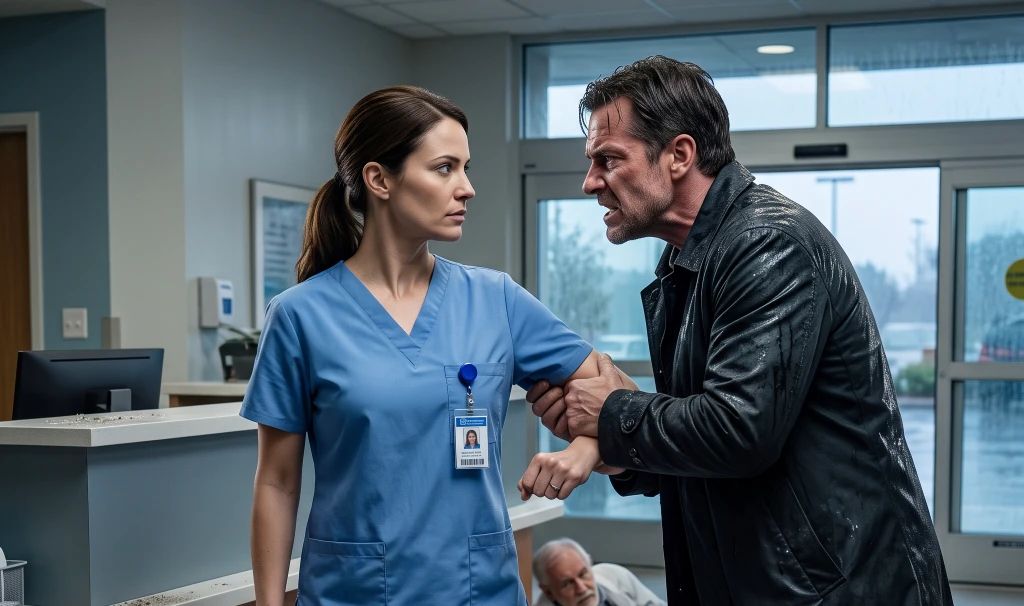
Then he smiled and caught her by the arm.
“I don’t need the child,” he said. “I need leverage.”
He dragged Mara against him and pressed the pistol to her temple. Lucy’s mother covered the girl’s face. Dr. Cho took one involuntary step forward, then stopped when the rifleman at the doors swung his muzzle toward him.
“Congratulations,” the leader told Mara. “You’re the reason they have four minutes left.”
Mara let him believe he controlled her. She felt the angle of his grip, noted that he favored his right knee, and watched the other two gunmen in the reflection of the pharmacy glass. She could hurt him. That was not the same as saving anyone. Fifty-two civilians were visible, three shooters were confirmed, and the service corridor behind radiology remained unaccounted for.
The gunman felt her measuring him. His grip tightened.
“You aren’t shaking,” he said.
“I’m a nurse.”
“No.” He leaned close enough that his breath touched her ear. “Nurses don’t count exits with their eyes. What unit?”
Before Mara could answer, a tiny green light blinked beneath a waiting-room chair. A man in a gray maintenance shirt was fastening a device to the metal frame, half hidden by the bodies on the floor. The pistol at Mara’s temple was no longer the most dangerous thing in the room…
To read the rest of the story – CLICK the NEXT button 👇👇👇