


At 12:14 a.m., three days after I buried my husband, his billionaire boss called and told me to leave my phone on the kitchen counter. “Do not call Teresa,” Grant Kessler said. “Do not call Brooke. If either of them asks where you are, you never left the house.”
I stood barefoot in my dark kitchen, looking at the sympathy casseroles stacked in the refrigerator. Grant was seventy-one, worth several billion dollars, and famous for making cabinet secretaries wait while he finished a sentence. I had met him at company dinners and one painfully formal holiday gala. I had never heard fear in his voice until that night.
“They’re my family,” I said.
“I know who they are.” His answer came too quickly. “Matthew left a restricted file on our network. Someone tried to erase it eleven minutes ago. The attempt came through credentials connected to your father’s estate.”
My hand tightened around the phone.
“Grant, what did my father’s estate have to do with Matt?”
“That is why you need to come in. South garage, level three. I’ll give you a temporary access code. Memorize it, leave this phone at home, and come alone.”
The line went dead before I could decide whether the last word had been an order or a plea.
I was Major Julia Mercer, forty-two years old and assigned to a logistics command at Fort Belvoir. By then, I had served in the Army for twenty years and deployed three times. I knew how to leave a building without turning on lights. I knew how to check whether a car had been disturbed and how to vary a route when I thought someone might be watching.
What I did not know was how to be a widow.
Eleven days earlier, a Virginia State Police trooper had come to our house in Alexandria. My unit chaplain arrived twenty minutes later. Matt’s SUV had gone through a guardrail on rain-slicked Route 7 west of Leesburg. The fire had made identification difficult. Dental records confirmed what no one in our living room wanted to say plainly: Matthew Mercer, forty-six, my husband of seventeen years, was dead.
Matt had spent seven years in the Army Finance Corps before earning his MBA and joining Kessler Systems. He still shined his shoes on Sunday nights, even after he had become chief financial officer of a private cybersecurity and logistics company valued in the billions. An Army funeral detail at Quantico National Cemetery had folded the flag from his coffin with exact, merciless precision and placed it in my hands.
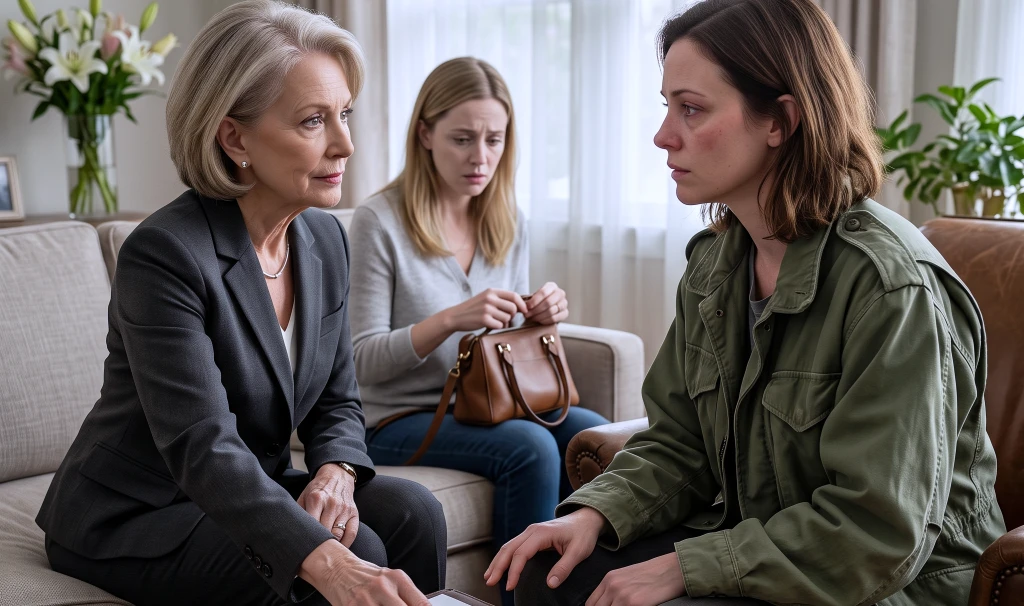
Teresa, my stepmother, had sobbed hard enough to lean against me. Brooke, her daughter, had held my elbow and whispered that I did not have to manage anything now—that they would take care of the house, the estate, all the decisions grief made impossible.
At the time, I thought they were trying to be kind.
At 12:31 a.m., I left my phone beside Matt’s coffee mug, backed out of the driveway, and drove toward Reston in his old field jacket. It still carried the dry cedar smell of the closet and, beneath it, the clean soap he had used for years. I kept one hand on the wheel and took the George Washington Parkway north before cutting west, checking my mirrors at every turn.
No car stayed with me. That should have made me feel foolish. It did not.
Kessler Systems occupied a low, angular complex of glass and pale stone rather than a downtown skyscraper. Much of the company’s work involved federal contracts, so the security was real: vehicle barriers, cameras with overlapping fields of view, guards who did not look away from their screens when a grieving officer arrived after midnight.
The six digits Grant had made me repeat opened the south garage. A security supervisor named Alvarez met me beside the elevator and sealed my car key and smartwatch in a gray signal-blocking pouch.
“Mr. Kessler is on six,” he said.
“What happened here tonight?”
Alvarez glanced at the camera above us. “Ma’am, I was told to take you directly upstairs.”
The elevator opened into the executive floor. Only the emergency lighting was on. Matt’s office sat behind a wall of glass at the far end, his name still etched on a brushed-metal plate beside the door because no one had yet decided when removing it would stop being cruel.
Grant waited in a conference room across the hall. He had abandoned the suit jackets he wore in public and stood with his sleeves rolled up, one hand braced on the table. A laptop, an old brass key, and a thick paper file lay in front of him.
“Where did those come from?” I asked.
“Your husband scheduled a dead-man release.”
Grant must have seen my reaction, because regret crossed his face.
“That is the technical term,” he said more softly. “Matt created an encrypted archive and instructed the system to notify me if he failed to reset it for ten consecutive days. It opened tonight. Someone else was waiting for the same trigger.”
I pulled out a chair but did not sit. “Who?”
“The access attempt bounced through three servers. Our security team traced the originating token to a law firm that has represented the Hale Family Trust.”
Hale was my maiden name. My father, Robert Hale, had died eight years earlier while I was in Afghanistan. Teresa had handled the funeral and most of the probate before I made it home. She told me she had done it to spare me. Matt had reviewed the final documents, asked a few questions, and then let the subject go when I told him I could not survive one more fight about money.
Or I had believed he let it go.
“What was in the archive?”
“Ledgers. Photographs. Copies of trust amendments. Audio files I haven’t listened to.” Grant looked toward Matt’s dark office. “And instructions to contact a man I believed I would never see again.”
Before I could ask what that meant, a soft chime sounded from the laptop. Grant turned it toward me. Security footage showed a black SUV idling outside the north entrance. Two men stood near the locked doors, their faces hidden by baseball caps and the camera angle. One held a phone against the access reader.
“Are they police?” I asked.
“No.”
“Your security?”
“Also no.”
The calm I had relied on during deployments settled over me—not the absence of fear, but a narrow place inside it where decisions became simple.
“Call Fairfax County.”
“Alvarez already has. The men haven’t committed a crime by standing outside.” Grant closed the laptop. “But one of them used a cloned mobile credential in the parking structure twenty minutes ago. It was issued to Matt.”
For a moment, the only sound in the room was the ventilation system.
“Someone copied my dead husband’s access credential.”
“It appears so.”
“And you still haven’t told me why my family’s lawyer tried to reach his files.”
Grant’s eyes shifted to the closed door behind him. It was a small movement, but I caught it.
“Who is in there?”
He did not answer immediately. “Julia, what you are about to see will make you question a great deal. I need you to remember that shock and truth are not the same thing. Take your time deciding what you believe.”
“Open the door.”
Grant did.
The man inside rose from a chair with the careful stiffness of someone whose body had once been badly injured. He was taller than I remembered and much thinner. Silver threaded the hair at his temples, and a pale burn scar disappeared beneath his collar. None of that changed the shape of his eyes or the small notch in his left eyebrow.
I had last seen Owen Price in a photograph beside a wreath at his memorial service.
Eight years ago, Owen had led internal investigations for Kessler Systems. A records warehouse in Manassas caught fire while he was working late. One body was recovered, and for months every person in Matt’s office spoke of Owen in the past tense. I remembered his wife clutching their daughter’s hand during the service. I remembered Grant standing at the lectern, unable to finish the final paragraph of his remarks.
Now Owen was ten feet from me, alive.
“No,” I said. It was the only word I could find.
“I’m sorry,” he answered. His voice was rougher, but it was his. “There wasn’t a safe way to correct what people believed.”
I looked at Grant. “You knew.”
“Not at first. Later, yes.”
Anger arrived before understanding. It was almost a relief to feel something clean enough to name.
“Matt attended your memorial. I sat beside him. Your family—”
“Was moved with me,” Owen said. “My wife and daughter were already under federal guard at the memorial. The marshals relocated us together afterward. The body in the warehouse belonged to a contractor, but by the time it was identified, the people who had tried to kill me believed they had succeeded. The prosecutors chose not to correct them publicly.”
“Then why are you here?”
Owen placed both palms on the conference table. He seemed to be steadying himself as much as addressing me.
“Because six weeks before Matt died, he found the name I was living under. He came to me with copies of documents from your father’s trust. The same attorney who prepared them had moved money through shell vendors I investigated before the fire.”
The black SUV remained on the monitor outside. Grant’s security team moved through the lobby below us. In the sealed quiet of the conference room, Owen reached into a leather case and set down a photograph of Teresa entering a law office beside a man I did not recognize.
“Matt believed your stepmother had been stealing from you for years,” he said. “He also believed she had finally learned that he could prove it.”
I stared at Teresa’s face in the photograph, then at the date printed in the corner: two days before Matt’s crash. Owen’s next words were nearly gentle. “Julia, your husband believed that if he died in what appeared to be an accident, it might not be one…”
To read the rest of the story – CLICK the NEXT button 👇👇👇