


The divorce petition landed beside the brass key the hospital had taken from Rachel Mercer’s father’s pocket. For several seconds, she looked at the two objects without touching either one. The key was small, old-fashioned, and stamped with the number 814. The petition was twelve white pages clipped inside a blue folder. One had belonged to the man she had buried in the rain less than eighteen hours earlier; the other had just been pushed across the kitchen table by her husband while their unborn daughter shifted beneath Rachel’s ribs.
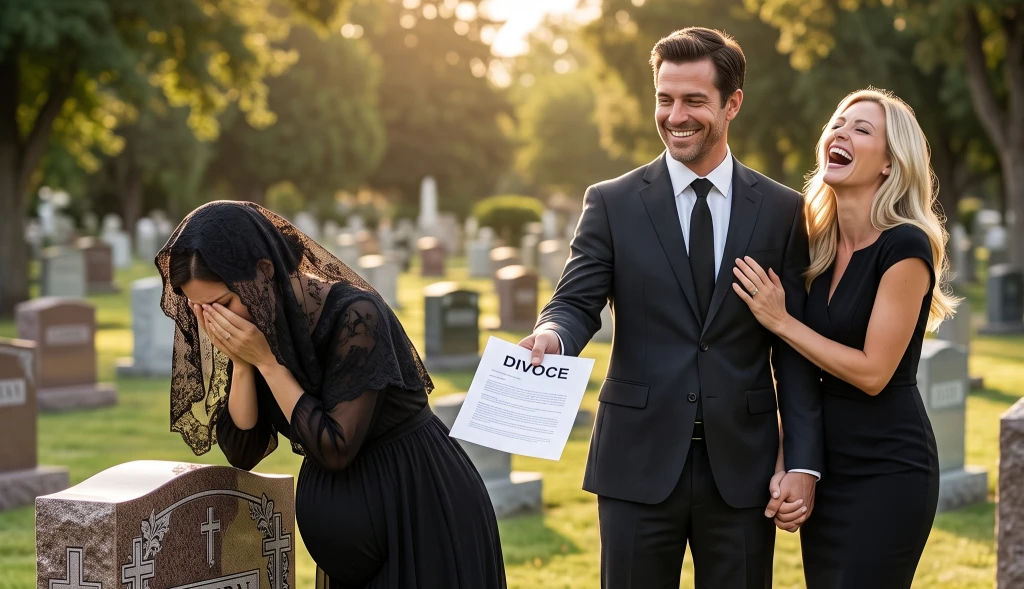
Nolan Pierce folded his hands as though they were discussing a lease. He had showered, shaved, and put on the navy shirt he wore when he wanted clients to believe he was the calmest person in the room.
“My attorney said this is the cleanest way to handle it,” he said. “Nothing has been filed yet. You can have someone review everything.”
Rachel kept one palm against the side of her belly. At six months pregnant, she had learned that grief and fear could make the baby restless. “Handle what?”
His eyes moved toward the window. “Us.”
There were softer ways to say it, but Nolan had apparently used all his softness elsewhere. He told her he had been unhappy for months. He said they had become different people and that staying together out of obligation would only make them resent each other. Then, with the careful tone of a man adding a difficult item to a meeting agenda, he admitted there was someone else.
“Camille Dawson?” Rachel asked.
His head came up. The flicker of surprise on his face answered before he did.
Rachel had seen the photograph shortly before midnight. Camille had posted it from a rooftop restaurant in Buckhead: candlelight, two champagne glasses, Nolan’s watch visible beside a plate he had barely touched. His face was outside the frame, but Rachel knew the hand resting near Camille’s and the wedding band it was no longer wearing. The caption said only, Finally choosing what feels right.
“Were you with her after the funeral?”
“Rachel, I didn’t plan for you to find out that way.”
“That wasn’t my question.”
Nolan exhaled and rubbed his thumb across the edge of the folder. “Yes.”
The answer did not hurt in the way she had expected. It settled instead, heavy and precise, into a place already hollowed out by the previous three days. Her father was dead. Her husband had left his funeral reception to drink champagne with another woman. Whatever explanation Nolan had rehearsed could not alter either fact.
“I’ll cover your health insurance through the divorce,” he continued. “And of course I’ll pay support once the baby is born. I’m not walking away from my responsibilities.”
Rachel looked at him then. Nolan seemed to need that last sentence to be true, perhaps more than she needed to challenge it.
“Have your lawyer send the papers to someone I choose,” she said.
He blinked. “That’s it?”
“What were you expecting?”
He had no honest answer. The suitcase waiting by the front door made clear that he had prepared for tears, accusations, perhaps a scene he could later describe as proof that leaving had been necessary. Rachel gave him none of those things. Ten minutes later, the apartment door closed behind him, and the quiet he left behind was almost identical to the quiet after a monitor stops sounding.
Her gaze returned to the brass key.
Three nights earlier, her father had opened his eyes for less than a minute.
Thomas Mercer had been breathing through a ventilator for two days at Ashby Regional Medical Center. The machine lifted his chest with a rhythm too even to resemble sleep. Rachel sat beside him holding the hand that had patched school roofs, replaced church plumbing, fixed neighbors’ furnaces, and packed every lunch she had carried through twelve years of school.
His hands had always told the truth about his life. The nails were trimmed short, the knuckles enlarged from work, and a pale scar crossed the base of his right thumb where a utility knife had slipped when Rachel was nine. She had never known him to wear a suit except to her college graduation. For twenty-nine years, he had been simply Dad: a public-school custodian by day, a part-time maintenance man at a Methodist church three evenings a week, and the person everyone in their apartment building called when something broke.
Yet he had never seemed ordinary to her. When she was twelve, he taught her to change a tire before he let her learn to drive. At sixteen, he showed her how to read the termination clause in her first summer-job contract. He could listen to a five-minute conversation and tell which person in the room actually held authority, though he never explained how a man who polished hallway floors had learned to notice such things.
“People tell you who they are in the choices they think no one sees,” he once told her. “Pay attention to those choices.”
Beside his hospital bed, Rachel had begged him to make one more.
“Stay,” she whispered, her forehead against his hand. “Please, Dad. Just stay until she gets here.”
His fingers tightened faintly around hers. Rachel lifted her head so fast that the chair legs scraped the floor. His eyes were open, unfocused at first, and then fixed on her with an urgency that frightened her more than the machines.
“Dad?”
His lips moved around the tube. She leaned close enough to feel the warmth of his breath against her cheek when the ventilator released it.
“Key,” he managed.
Rachel called for the nurse, but his fingers tightened again. He was trying to finish.
“Bell,” he whispered. “Downtown.”
The alarms began before she could ask what he meant. Nurses moved her into the hall, a physician arrived at a run, and the door closed between Rachel and the only parent she had ever known. A doctor came out eleven minutes later and sat beside her without needing to say the first words.
The hospital returned Thomas’s belongings in a plain plastic pouch: his watch, his wedding band, a worn leather wallet, and the brass key. Rachel had assumed it opened something in his apartment. Grief reduced the world to immediate tasks—calling the church, choosing a casket, finding the insurance policy he kept inside a coffee tin—so she slid the key into her purse and forgot it until Nolan placed his petition beside it.
The funeral had been held under a hard March rain. Nolan stood three feet away beneath his own umbrella, checking his phone while water ran down the back of Rachel’s coat. When one heel sank into the mud beside the grave, Mrs. Carter from the church caught her elbow before she fell. Nolan did not notice until Rachel was upright again.
At the reception, people told stories Rachel had never heard. A retired teacher remembered Thomas driving across town at 2:00 a.m. to shut off a burst pipe and then refusing overtime pay. A former student said he had quietly bought her a winter coat after noticing she came to school without one. The church treasurer recalled that Thomas could spot an error in a vendor contract faster than anyone on the finance committee.
Nolan left before the coffee was poured. He called it an urgent work matter, kissed the air near Rachel’s temple, and promised to be home soon. At 1:47 a.m., he let himself into the apartment, placed his keys on the counter, and went directly to the guest room. By breakfast, the blue folder was on the table.
Now Rachel sat alone with the evidence of two men: one who had spent a lifetime showing up and one who had chosen the day after a burial to leave.
She picked up the key. Under the number 814, worn letters were pressed into the brass: PEMBERTON TRUST — PRIVATE CLIENT SERVICES.
Rachel had passed Pemberton’s downtown Atlanta building many times without realizing it was a bank. Its limestone facade, discreet bronze doors, and appointment-only lobby seemed designed for people whose money required privacy. Thomas Mercer had kept less than two thousand dollars in the checking account Rachel knew about. There was no sensible reason for his key to carry that name.
By eleven, she was standing under the building’s high ceiling in the same black dress she had worn to meet the funeral director. The receptionist examined the key, asked for Rachel’s identification, and made a quiet phone call.
A silver-haired man appeared less than a minute later. He wore no expression of surprise.
“Ms. Mercer,” he said, offering his hand. “I’m Henry Bell. I’ve been waiting for you.”
Rachel did not take his hand at first. “My father said your name before he died.”
Something shifted behind the man’s professional composure. “Then he found the strength to do what he was afraid he might not be able to do. I’m very sorry. Thomas was my friend for thirty-five years.”
That was longer than Rachel had been alive.
Bell led her through a secured door and into a private room with no windows. On the table waited a narrow metal box. The number 814 was stamped into its lid.
“Before we open this, I need to tell you that your father left detailed instructions,” Bell said. “You are under no obligation to make any decision today. You don’t have to sign anything, speak to anyone, or even finish looking through what he left.”
“What did he leave?”
Bell studied her for a moment. “An explanation. After that, the choices are yours.”
He removed a second key from a leather case. Rachel placed hers in the other lock, and they turned them together. When the mechanism released, Bell stepped back and asked whether she wanted privacy.
Rachel nodded. The door closed softly behind him.
Inside the box lay a sealed envelope bearing her name, several thick legal files, and a bundle of old photographs tied with black ribbon. The first showed her father as a young man in a tuxedo, standing on the steps of an enormous stone house. His hair was darker and his face unlined, but the small scar through his left eyebrow was unmistakable.
Beside him stood men and women Rachel recognized from magazine covers and business pages.
Under the photograph was a yellowed clipping from an Atlanta newspaper, dated thirty-five years earlier. The headline read: CALDER GROUP HEIR RESIGNS AFTER PRIVATE FAMILY RIFT.
Rachel read the caption beneath the picture twice.
Thomas Calder III, only son of industrialist Franklin Calder, has withdrawn from the family company and cannot be reached for comment. The man in the photograph was her father. But Thomas Mercer—the school custodian who had raised her on his paycheck and slept on a sofa for sixteen years so she could have the apartment’s only bedroom—was not the name printed beneath his face…
To read the rest of the story – CLICK the NEXT button 👇👇👇