


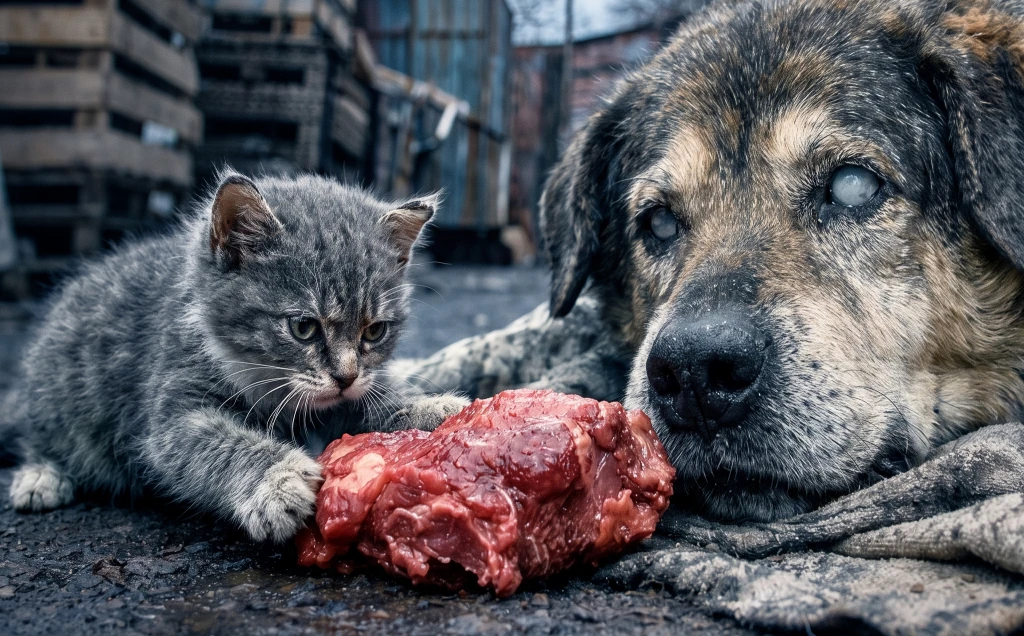
The kitten chose the busiest hour of Friday morning to steal a strip of beef longer than his body. Maggie Doyle saw the gray blur shoot from beneath the butcher counter, heard claws skitter across the tile, and closed one hand around the broom. She had spent sixteen years keeping the meat case at Hawthorne Public Market spotless. She had spent the last three keeping every living thing at a safe distance. She was not about to lose her job to a half-starved animal with a torn ear and a white patch on his chest.
“There goes your last warning,” Dale Mercer said.
He stood on the customer side of the case in a charcoal overcoat that had never brushed against a side of beef. Dale managed the market and owned Mercer Meats, which meant he could make Maggie’s life difficult from both directions. He tapped the inventory sheet against the glass.
“Six pounds of trim missing in twelve days. I can explain shrinkage once. I can’t explain a pattern.”
“That kitten can’t weigh three pounds. He’d have to eat twice his body weight,” Maggie said.
“Then find out where it’s going.” Dale glanced toward the aisle, where two customers had slowed down to listen. He lowered his voice without making it kinder. “I filed the nuisance report. County animal control will be here Sunday at eight. Anything living behind this building that doesn’t belong there will be removed.”
Maggie looked toward the gap beneath the swinging stockroom door. The kitten was gone. Only the stolen strip remained in her mind, dragging across the tile like an accusation.
“And until then?” she asked.
“Until then, protect my inventory. One more unexplained loss goes in your file.”
Dale walked away, checking a display of apples as if their shine had personally disappointed him.
Across the aisle, Tess Alvarez, who ran Mercer Meats’ poultry counter, leaned over the case. “He practices those speeches in a mirror.”
Maggie set the broom back against the wall. “He’s right about the numbers.”
“Of course that’s the part you heard.”
Maggie did not answer. She pulled a chuck roast onto the block and brought down her knife. At fifty-eight, she could still cut a pound and a quarter and come within an ounce before the meat touched the scale. Customers trusted her because she did not pad an order, gossip over their dinner, or ask questions they had not invited. She wrapped every package in white butcher paper with two clean folds and one strip of tape.
Order was useful. It kept a line moving. It kept mistakes from becoming emergencies. It kept a woman from thinking about the things no amount of precision could repair.
The gray kitten had been testing that order for nearly two weeks. He never begged by the entrance with the older strays. He studied the counter from under empty produce crates, waited for Maggie to turn, then took only soft pieces from the trim pan on the lowest shelf of a stainless prep cart. He was too thin for his age, all narrow hips and sharp shoulders. The white fur beneath his throat looked like a crooked shirtfront someone had painted on with one careless stroke.
Maggie had blocked the gaps with milk crates. He found another route. She moved the trim pan to the top shelf. He climbed a stack of flattened boxes and tipped it with one paw. Once she cornered him between a mop bucket and the walk-in cooler, but he arched, showed her a mouthful of tiny teeth, and hissed with such concentrated fury that she stopped.
Nothing in his posture asked her for mercy.
By closing time, sleet ticked against the market’s high windows. Maggie counted the remaining trim twice, entered the weight in the log, and locked the pan in the cooler. Dale’s warning should have settled the matter.
Instead, as she rode the bus home, she kept picturing the kitten choosing a piece he could barely lift.
Her house stood six blocks from the old steelworks, in a row of narrow brick homes built when Millhaven still had three shifts at the mill. Maggie had inherited it from her mother, along with the floral curtains, the china cabinet, and a kitchen calendar that still showed October from three years earlier.
The calendar hung beside the refrigerator. October 19 was circled in June Doyle’s blue ink: MAGGIE—DINNER, 7:00. It became the date the hospice nurse called instead.
June’s heart failure had been worsening for months, and no one pretended it would reverse. That Friday, she asked Maggie to come sit with her. Maggie looked at the clock, thought of the Saturday rush, and promised to come the following afternoon. The hospice nurse called before dawn. By the time Maggie reached the house, the nurse was folding June’s wedding ring into a plastic bag.
Maggie had not caused her mother’s death. What she could not forgive was choosing one more shift over the last evening June had asked her to stay. Guilt needed only a sentence to repeat, and Maggie had given it one: I’ll do it tomorrow.
She heated soup, ate standing over the sink, and left the October page untouched.
Saturday brought freezing rain and a line of shoppers buying stew meat before the weather worsened. Maggie worked faster than usual, but a portion of her attention stayed beneath the counter. At eleven twenty, she saw the kitten crouched behind a crate of onions across the aisle.
He was watching her hands.
Maggie weighed and paid for a quarter pound of soft, lean trim. During a lull, she placed one small piece on butcher paper just outside the loading door, well away from food preparation, and watched through the glass. The kitten waited. His ears turned toward Dale’s footsteps, a child crying near the bakery, the rattle of a hand truck on the dock. Then he moved.
He crossed the loading pad in a gray streak, seized the strip, and vanished beneath a stack of pallets.
Tess laughed despite herself. “That little thing has studied your schedule better than Dale has.”
Maggie stepped outside and looked beneath the pallets. Empty darkness ran toward the service lane.
“He didn’t eat it,” she said.
“What?”
“He had a safe place under there. He kept going.”
At two, the kitten returned and took a second paid piece. Near four, he tried again. A starving animal should have eaten the first scrap where no one could reach him. This one was making trips.
Maggie began to notice other details. The kitten’s belly was hollow despite the missing meat. He always came from the rear of the building and left the same way. He avoided bone and hard fat but chose small strips of lean, soft beef, even when a dropped bit of cooked chicken lay closer.
“You’re feeding something,” she murmured.
The kitten stared at her from behind a pallet, then disappeared.
The market closed early because the roads were icing. Dale left at five after reminding Maggie that the county van would arrive at eight the next morning. Tess zipped her coat to her chin and offered Maggie a ride, but Maggie said she still had to sanitize the block.
By five thirty, the public aisles were dark. Wind pushed sleet beneath the loading-dock awning, and the steel doors groaned in their tracks. Maggie finished the inventory. Nothing was missing.
Then she saw the kitten beside the trash compactor.
He did not sneak this time. He stood in the open, shivering so hard that his paws shifted on the concrete. Maggie had left one final strip of beef on the edge of a clean tray—not entered as bait, but weighed and paid for on her own receipt.
The kitten seized it. The strip was not large by butcher-shop standards, perhaps four ounces, but it was dense and awkward. It caught beneath his front feet as he tried to run. He dragged it past the shelter of the loading dock, stopped to catch his breath, tightened his jaws, and dragged it again.
He was heading into the sleet.
Maggie put on her coat and followed.
The kitten slipped through a bent section of chain-link fence behind the market. Beyond it lay a service lane, stacks of broken pallets, and the old guard booth the market had stopped using three weeks earlier. One plywood-covered window hung loose at the bottom. Water ran beneath the warped door.
The kitten squeezed through the opening with the meat. Maggie stopped ten feet away. For several seconds, there was only the hiss of sleet striking dead weeds. Then something inside the booth drew one long, ragged breath. It was too deep to belong to a cat. The kitten appeared in the broken doorway again. He planted his tiny paws wide, raised every hair along his spine, and stood guard over whatever was breathing in the dark…
To read the rest of the story – CLICK the NEXT button 👇👇👇