


On the third morning the thief came back, Walt Mercer was waiting for it. He sat motionless beside his ice-fishing hole, one gloved hand resting on his old medical bag and the other wrapped around a cup of coffee that had already gone cold. Thirty yards away, three yellow perch lay on the snow beside his black plastic sled.
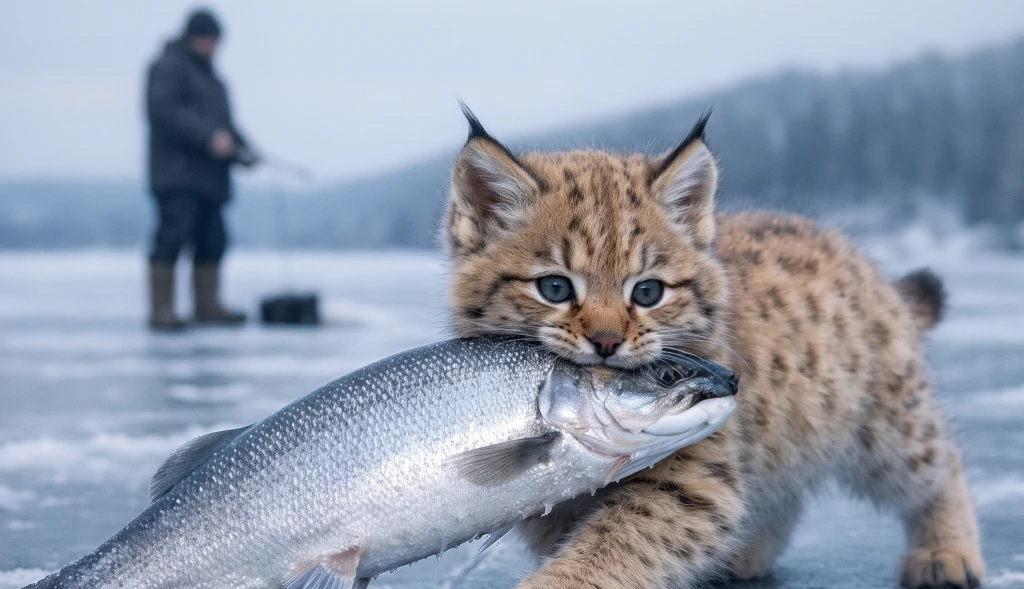
The first fish had disappeared two days earlier while Walt was drilling a second hole. He had found a drag mark leading toward shore and a line of round tracks without claw marks. The next morning, another perch vanished before he caught more than a flicker of tawny fur among the spruce.
This time, at 7:18 a.m., the animal stepped fully into view.
It was a young bobcat, probably born the previous spring. Its legs looked too long for its narrow body, and its spotted winter coat hung loosely over its ribs. One front paw barely touched the ice.
The cat watched Walt for several seconds. Then it limped to the fish, seized the largest perch behind the gills, and began dragging it toward the trees.
It never stopped to eat.
Walt rose slowly. The bobcat flattened its ears, but instead of abandoning the fish, it tightened its jaws and kept going.
“You’re either very brave,” Walt murmured, “or you’re in worse trouble than you look.”
He knew he should let it disappear.
Wild animals survived by remaining suspicious of people, and injured predators were unpredictable. Walt was sixty-five, eighteen months past a heart attack, and nearly a mile from the cabin where his prescribed nitroglycerin waited beside the kitchen sink.
But the young cat’s injured paw left a faint red mark every few steps.
Walt clipped his ice picks around his neck, slipped the medication from his fishing jacket into a chest pocket, and hooked the rope of his sled around his waist. His old St. Louis County EMS bag was already inside it. He had not worked an ambulance in four years, but he still carried gauze, trauma shears, a thermal blanket, a flashlight, and more first-aid supplies than any fisherman reasonably needed.
The bobcat reached the shoreline and disappeared through a break in the cattails.
Walt followed.
Birchwater Lake lay eighteen miles outside Ely, Minnesota, where winter did not leave according to the calendar. It retreated by inches, weakening the ice from beneath and turning the forest floor into a patchwork of crusted snow and black water.
The temperature was thirty-one degrees that morning. Warm enough to make the ice complain, cold enough to kill anything small that stopped moving.
The young bobcat’s trail climbed between black spruce and balsam fir. The perch carved a wavering groove beside its tracks. Every fifty yards, the cat stopped behind a tree and looked back.
Walt resisted the temptation to imagine it was checking whether he followed. The animal might simply have feared being robbed of its meal. Wild creatures did not ask human beings for help because they understood duty or mercy.
Still, it did not run.
Walt’s phone vibrated as he climbed a low ridge.
ERIN: May 12. Flight from Duluth at 10:40. Please tell me you haven’t “forgotten.”
He read the message twice before locking the screen.
His daughter had bought him a ticket to Chicago for what she called a two-month trial. She had prepared the downstairs bedroom, found a cardiologist, and measured the shower for grab bars he had never agreed he needed.
In December, worn down by her fear and his own loneliness, Walt had said he would consider it. Erin had heard yes. Since then, each Sunday call had become another round of negotiations conducted by two people who loved each other and no longer knew how to speak without defending themselves.
The cabin had belonged to Walt and his wife, June, for twenty-seven years. After June died, it became the last place where Walt could still hear her—not as a ghost, but in the ordinary evidence of a shared life. Her blue mug. Her gardening gloves. The dent in the porch rail from the summer she tried to move a canoe alone.
Erin saw an isolated house where her father might die before anyone found him.
Walt saw the one place where he had not yet become a burden.
The bobcat slipped beneath a fallen cedar. Walt ducked after it, and pressure gathered beneath his breastbone.
He stopped.
The sensation was familiar: not the violent crushing pain of his heart attack, but the tightening warning that sometimes came with cold air and exertion. He put one nitroglycerin tablet under his tongue and leaned against a spruce while the medicine dissolved.
“You’re not on duty,” he told himself.
That had been his cardiologist’s phrase.
You are no longer on duty, Mr. Mercer. You do not have to be the first person through every door.
Walt waited until the pressure eased. Then a thin, rough cry rose from the hollow below him.
The young bobcat had stopped beside the roots of an uprooted spruce. The storm-thrown tree had lifted a wall of frozen earth nearly eight feet high, leaving a dark space beneath it.
The perch lay at the entrance.
The bobcat pushed it forward with its nose, then backed away and looked toward the opening.
Walt smelled blood before he saw it.
He took the flashlight from his bag and crouched several feet from the den. Inside, a larger bobcat lay on a bed of dead grass and needles. She was no more than twenty pounds, but the paws curled beneath her were broad, and even in exhaustion she had the compact power of a wild predator.
A red-coated cable had closed around her left hind leg. The wire had cut through fur and skin, and the surrounding tissue was swollen nearly twice its normal size.
A newborn kitten lay against her belly, wet and barely moving.
The mother’s flanks contracted. Her head lifted an inch, then dropped.
Walt angled the light lower.
Beneath her tail, a single tiny paw protruded and did not move.
The stolen fish rested inches from the mother’s muzzle. She was too weak to raise her head toward it.
The young bobcat crept into the den, pressed its body against hers, and made the broken, rasping cry Walt had heard from the ridge.
He understood then. This was last spring’s offspring, not a small kitten but a wounded yearling that had remained with its mother. It had not brought the fish to feed newborns that could not eat it.
It had brought the fish because their mother could no longer hunt.
The adult bobcat opened her eyes. They fixed on Walt with the last hard edge of a creature that had not yet surrendered. Then another contraction shuddered through her, and the motionless paw disappeared partway back inside. Walt took off his outer gloves. He opened the medical bag he had promised his daughter he no longer needed…
To read the rest of the story – CLICK the NEXT button 👇👇👇