


At first, Eli Mercer thought the black shape in the water was a body. It surfaced in the gray trough beside the Pacific Meridian, vanished behind a wall of foam, then appeared again with two forelegs striking at the ocean. Southbound from Tacoma to Oakland, the ship was more than a hundred miles off the Oregon coast after a night of thirty-foot seas that had torn equipment loose across the shipping lanes. A dog was swimming toward them.
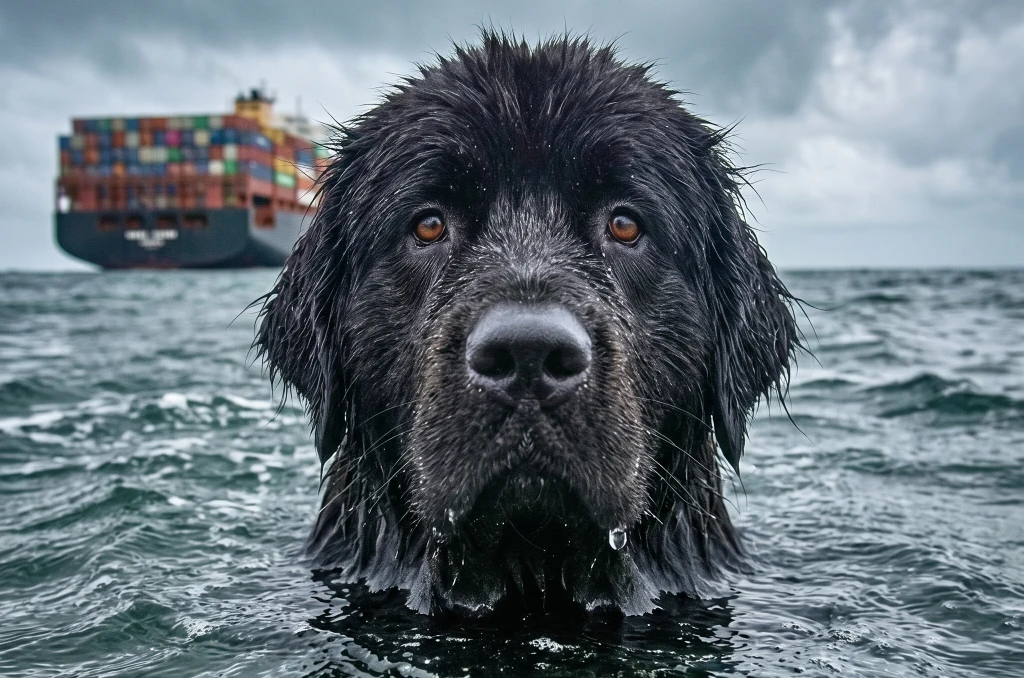
Eli pressed his binoculars to the bridge-wing glass. The lenses trembled against his brow.
“Starboard quarter,” he called into his radio. “Something alive in the water. I think it’s a dog.”
The third mate looked at him as if exhaustion had finally cracked him. Then a ragged bark rose through the wind—one hoarse note, almost swallowed by the engines.
Within seconds the bridge came awake. Captain Thomas Rourke ordered the ship to dead slow while Chief Mate Mara Ortiz brought the starboard searchlight around. Its white beam swept over torn kelp, a broken cooler, and miles of empty slate-colored water before catching the animal again.
She was enormous, a black Newfoundland with a broad head and a coat dragged flat by seawater. She should have been flailing. Instead she swam with the stubborn, measured pull of an animal following a destination she could no longer see.
Eli’s stomach tightened.
Six years earlier, people had searched two days for his parents after their fishing boat overturned near the Yaquina Bay bar. The Coast Guard found one orange fuel can, a torn glove, and nothing else. At eighteen, Eli had become Hannah’s court-appointed guardian. Since then, the ocean had never looked empty to him. It looked occupied by everything it had refused to return.
He had gone to sea anyway.
A union deck job was the only work he had found that came with wages and dependent health coverage good enough to help his sixteen-year-old sister through relapsed leukemia. That morning, before watch, Hannah had left him a voicemail from a children’s hospital in Portland.
Don’t call until you’re off duty. I’m okay. They’re just arguing with insurance again.
She always said I’m okay when she was frightened.
“Mercer, suit and tether,” Ortiz ordered. “Harlan, rig the davit recovery net. Nobody goes outside the rail.”
Eli was already moving.
The ship could not stop like a car. Even at dead slow, the thousand-foot hull shouldered through the swell while the deck rolled beneath them. On the low after working deck, Eli clipped into a safety line while Harlan lowered a cradle-shaped recovery net from its davit. They controlled it with guide lines as Ortiz used the engines and rudder to give them what little shelter the ship could make.
The dog reached the net once and missed. A wave turned her over, showing a strip of white beneath her jaw. Eli saw her mouth open but heard nothing.
“Come on,” he said, though the wind ripped the words away. “One more.”
She surfaced closer. Using boat hooks, Eli and bosun Ben Harlan drew the recovery net beneath her and settled the lifting strop behind her forelegs. The deck crew took up the davit cable. For a terrible second, her weight swung between the sea and the steel hull. Then the net cleared the bulwark, and they eased her onto the deck.
She lay motionless.
Eli crawled to her. Pink-tinged water ran from her mouth. One paw was sliced across the pad, and splinters of white fiberglass clung to the fur around her legs. He pressed two fingers inside her hind thigh and found a pulse—fast, weak, but there.
“Easy, girl.” He covered her with a thermal blanket. “You made it.”
The dog’s eyes opened.
She did not look at the blanket or the men around her. She lifted her head toward the stern, where the ship’s wake disappeared into mist, and tried to stand.
Her legs folded. She tried again.
“Hold her,” Harlan said. “She’s going back over.”
Eli braced both arms around her chest. The dog fought him with what little strength remained, staring past the rail and giving a low, broken cry. It was not fear of the ship. It was anguish at being carried away from something.
That was when Eli felt the hard cylinder against her harness.
It was an orange waterproof flare case secured to the top handle of her harness. Several turns of silver duct tape held it in place. On the outside, written in black marker, were three words.
PLEASE OPEN NOW.
Ortiz knelt beside him and cut the tape. Inside the case was a folded navigation-chart page sealed in a freezer bag, along with a child’s pink friendship bracelet. The paper shook in Eli’s wet hands as he opened it.
The note had been written in block letters, the ink blurred at the creases.
SAILING YACHT WAYFARER CAPSIZED AT 4:12 A.M. EPIRB AND MAST LOST. VHF DEAD. DANIEL AND CLAIRE WHITMORE. OUR DAUGHTER SOPHIE IS SEVEN. WE ARE IN THE LIFE RAFT TETHERED TO THE OVERTURNED HULL. HANDHELD GPS FIX 44°06’ N, 126°14’ W AT 4:19 A.M. DRIFTING SOUTHEAST. SOPHIE IS VERY COLD.
Below it, in a different hand, the letters sloped sharply downhill.
WE CAN SEE A SHIP’S LIGHTS. MAGGIE HEARD THE HORN. SHE PULLED TOWARD YOU, SO WE LET HER GO AT 4:37 A.M. IF SHE REACHES YOU, PLEASE FOLLOW THE DIRECTION SHE CAME FROM. PLEASE DON’T LEAVE US OUT HERE.
At the bottom, in purple crayon, someone had added:
Maggie, bring somebody back. Love, Sophie.
The Newfoundland made a faint sound when Eli said the name.
“Maggie?”
Her gaze shifted to him. For the first time, she stopped struggling.
Captain Rourke read the note on the bridge while Ortiz reported the recovery details. He did not waste time debating whether it was real. He ordered a distress relay sent to the Coast Guard, transmitted photographs of the message, and reduced speed while the rescue coordination center launched an aircraft toward the last reported position.
For several minutes, Eli believed that was enough. Then he saw the electronic chart.
The Pacific Meridian had already passed east of the coordinates written in the note. The Coast Guard search box lay nearly twenty miles behind them and to port. A helicopter was inbound from the coast, but the controller’s voice warned that visibility in the squalls was less than a mile.
“Request instructions regarding deviation,” Ortiz said into the satellite circuit.
The answer came through in bursts. Maintain safe speed. Preserve the message and all recovered evidence. Search aircraft would assume coordination on arrival.
Rourke acknowledged, then turned to the bridge team. “Maintain steerage at three knots while they check the stated position. We are not putting this vessel through a full turn in these seas on a guess.”
Eli stared at him. “Captain, the note says Maggie saw our lights. She came from astern.”
“The note says the family saw a ship’s lights. It does not prove they saw ours.”
“There hasn’t been another AIS contact within thirty miles all night.” Ortiz’s tone was careful. “He has a point.”
Rourke’s jaw tightened. “And the stated coordinates point somewhere else. The Coast Guard has the note, our position, our track, wind, and current. We do not invent a second distress position because a hypothermic dog happened to approach from one side of the ship.”
A printer beside the chart table chattered. It was a message from BlueCurrent Lines operations: Do not deviate from voyage plan unless directed by rescue authority. Refrigerated cargo limits critical. Document all fuel and schedule impact.
Rourke folded the page before anyone else could read it, but Eli had already seen enough.
“Mercer, get the dog to sick bay,” the captain said. “You did good work. Let the search crews do theirs.”
Eli wanted to argue. Then his phone vibrated inside his coveralls—the hospital calling again—and fear closed around his throat.
If he was written up for insubordination, he could lose the berth that carried Hannah’s insurance. He had spent three years measuring every decision against infusion bills, rent near the hospital, and the price of one more month. Captain Rourke was not abandoning the family. He had called for help. Maybe obedience, this once, was not cowardice.
Eli gathered the chart page and the orange case. As he lifted it, a bead of trapped water slid beneath the plastic and darkened the fold through the longitude.
The second digit changed shape. He stopped.
On the bridge copy, the coordinate had been entered as 126 degrees, 14 minutes west. But the writer’s number four in 4:12 A.M. was open at the top, like a narrow triangle. So was the figure hidden in the crease.
Eli laid the lines beside each other. They matched. The longitude was not 126°14’ west. It was 126°44’ west. The Coast Guard helicopter was flying more than twenty miles in the wrong direction…
To read the rest of the story – CLICK the NEXT button 👇👇👇