


The blood on the snow did not lead to a wounded deer. It led to a plastic dog crate beside Cal Mercer’s driveway, its door cinched shut with electrical wire and nearly every air slot buried under strips of silver tape. Something inside scratched once, weakly, and went quiet. Cal stood in the late-April whiteout with his hood snapping against his cheek. Wind erased his boot prints almost as fast as he made them, but the little red marks beside the crate stayed bright enough to pull him closer.
He had seen that particular stillness before—the dangerous kind, when a body had spent almost everything it owned. At forty-five, medically retired after sixteen years as an Army combat medic, Cal no longer wore a uniform. His hands had not forgotten what to do.
He cut the wire with his multitool and tore the tape away. A black pup lay on a filthy dish towel inside, no bigger than both his hands together, with ice feathered along its whiskers and one forepaw streaked red where a pad had split. Its eyes were open, but they did not track him.
“Hey, little one.” Cal slid a hand beneath the pup’s chest and felt a heartbeat so slow it seemed to pause between beats. “Stay with me.”
There were no tire tracks he could trust, no footprints, nothing but storm-scoured road and the dark wall of spruce beyond it. Whoever had left the crate had chosen a driveway ten miles outside Isabella, Minnesota, where the county plow came late and witnesses came never.
Cal tucked the pup inside his parka and carried the empty crate too. Preserving evidence was an old habit; refusing to leave anyone behind was an older one.
Cal had inherited his uncle’s cabin three years after coming home for good. Near Superior National Forest, it was far enough from the highway that winter sounded like pressure. He had moved there because a man could disappear without making his family watch.
That had been the plan. He bought groceries before dawn, answered texts with thumbs-up signs, and sometimes went four days without hearing his own voice. A Vet Center counselor appeared on his laptop every other Tuesday; some weeks Cal logged in, and some weeks he watched the appointment reminder fade because describing the dead felt like asking them to die again.
The counselor had never promised to cure him. She had taught him to notice when memory took over the room, plant both feet, and breathe until the year became the present one. Cal respected the work even when he could not make himself do it.
Now he laid the pup on folded towels near the woodstove, then stopped himself from moving it closer. Warming too fast could do harm. He pulled out his phone, climbed halfway up the narrow stairs for one bar of service, and called the emergency veterinary number printed on a magnet left by the previous owner.
The veterinarian kept him methodical: dry towels, warm water bottles wrapped in cloth, heat on only one side of the box, no food until the pup was warmer and swallowing well. Cal repeated every instruction, then checked the digital thermometer twice because 94.2 looked like a number that should not belong to something alive.
For two hours, he changed the water bottles and spoke in the even voice he used under rotor wash. The pup twitched when he touched the injured paw. Later it lifted its head and made a sound like a hinge in need of oil.
“I know,” Cal said. “This day has been bad all around.”
Near midnight, after the temperature climbed and the swallow reflex returned, the vet allowed a few drops of warmed electrolyte solution. The pup latched on to the syringe with sudden fury. Relief hit Cal so sharply that he sat back on the floor.
He did not sleep. Each time his eyes closed, he saw the taped crate filling with snow, then another metal box on another road years earlier, with two soldiers he had not reached in time. He opened his eyes, named five objects in the cabin, and listened to the pup breathe until both of them were in Minnesota again.
By morning, the storm had spent itself. Cal’s older neighbor, Tom Alvarez, arrived behind his tractor before the county plow, cleared enough of the drive for Cal’s truck, and took one look at the bundle under Cal’s coat.
“You found that out there?” Tom asked. At sixty-eight, he had the weathered patience of a man who had spent three decades as a conservation officer and another ten keeping a small team of sled dogs.
“In a crate. Taped shut.”
Tom’s mouth flattened. He reached out, let the pup smell one knuckle, and did not touch it until the tiny black nose leaned forward. “Go. The road to Ely is passable if you take it slow. I’ll keep your stove fed.”
Dr. Maya Ruiz met Cal at the side door of her clinic before regular hours. She examined the pup beneath a warming lamp, cleaned and bandaged the cut pad, treated the dehydration, and listened for so long through her stethoscope that Cal began counting the small muscles moving along her jaw.
At last, she straightened. “Male. Maybe three and a half weeks old, four at most. Underweight and cold-stressed, but I don’t hear fluid in his lungs. That’s good.”
“What kind?”
Maya turned one oversized paw between her fingers. “Someone probably dumped a shepherd-husky mix they didn’t want to deal with. At this age, breed guesses are guesses. His teeth, coat, and proportions will tell us more in a few weeks.”
She explained milk replacer, bottle position, warning signs, deworming, and vaccines. Cal wrote on an oil-change receipt until Maya pushed a care sheet toward him and took away his pen.
“Do you have someone who can split the night feedings with you?”
“No.”
“Then set alarms. Every four hours for now, and call if he fades, coughs while feeding, or stops urinating.” Maya glanced from the pup to Cal. “This is a lot, especially when you’re already tired. You can leave him with us, and we can contact a rescue.”
The sensible answer waited. Cal looked at the bandaged paw resting across his thumb. It felt as if one living thing had arrived precisely when another had nearly stopped participating in life.
“He’s coming home,” Cal said.
Maya’s expression softened without becoming sentimental. “Then he needs a name for his chart.”
Cal studied the black head and the square, stubborn set of the pup’s body. The word came from nowhere he could explain and felt solid when he said it.
“Rook.”
The next month was measured in ounces, alarms, damp towels, and bottles warming in a chipped coffee mug. Rook ate at ten, two, and six; Cal ate when he remembered. By the fourth day, the pup began searching for him when he heard the bottle shake, wobbling across the kitchen on legs that seemed borrowed from a much larger animal.
Cal kept a notebook on the counter: intake, weight, medication, sleep. The columns gradually changed. Under May 6 he wrote, Tried to fight the broom. Broom remains operational. Under May 9: First bark. Scared himself.
At five weeks, Rook graduated to milk replacer mixed with softened puppy food. At six weeks, he weighed just over eight pounds and could climb onto the cabin’s bottom step, though getting down required courage he did not possess. Cal carried him outside after every meal and stood under the dripping pines while Rook investigated each exposed patch of earth as if spring had been invented for him.
The routine did not cure Cal’s post-traumatic stress, and he knew better than to turn an animal into medicine. He still woke with his shirt stuck to his back. He still sometimes heard a helicopter in the wind and found himself crouched beside the bed before he knew he had moved.
But Rook needed breakfast whether Cal had slept or not. He needed clean water, training, play, and a calm human when thunder rolled over the forest. Being necessary did not erase Cal’s guilt; it gave him something to do after it arrived.
He stopped missing his Vet Center calls. During one session, Rook climbed into his lap and chewed the cord of his headphones, and Cal laughed before he could stop himself. The sound startled him more than the puppy.
“That sounded real,” his counselor said through the laptop.
Cal looked down at Rook, who was blinking up at him with a length of ruined cord hanging from his mouth. “Yeah,” he said. “I think it was.”
By eight weeks, Maya recorded fourteen pounds, long legs, and a clean bill of health. Rook’s eyes had turned amber around the pupils, his baby fluff was giving way to a dense black coat, and his ears could not decide whether to stand. Maya still saw a large-breed mix, though she admitted his narrow chest and unusually flexible feet were difficult to place.
Tom stopped by twice a week under flimsy pretenses. He brought too many training treats, repaired a hinge, and taught Cal to read the pup’s body before forcing a new experience. Rook adored him but watched the forest whenever Tom’s old sled dogs barked.
At ten weeks, Rook could sit, touch Cal’s palm with his nose, and come when called unless a raven had other plans for him. Cal began walking him along the old logging spur in a harness. He shaved again, reopened the curtains, and drove into town for groceries while other people were still awake.
The changes were small enough that no one could call them a miracle, which made Cal trust them. He was not becoming the man he had been before the war. He was learning that the man afterward could still be useful, still keep promises, still make room in his life for another heartbeat.
By twelve weeks, Rook weighed twenty-four pounds. He was lean rather than bulky, all knees and paws, and he moved through brush with a quietness Tom’s dogs had not learned in years of running snow. Cal noticed, but large shepherd mixes were awkward and huskies were strange; explanations remained easy to find when a person wanted one.
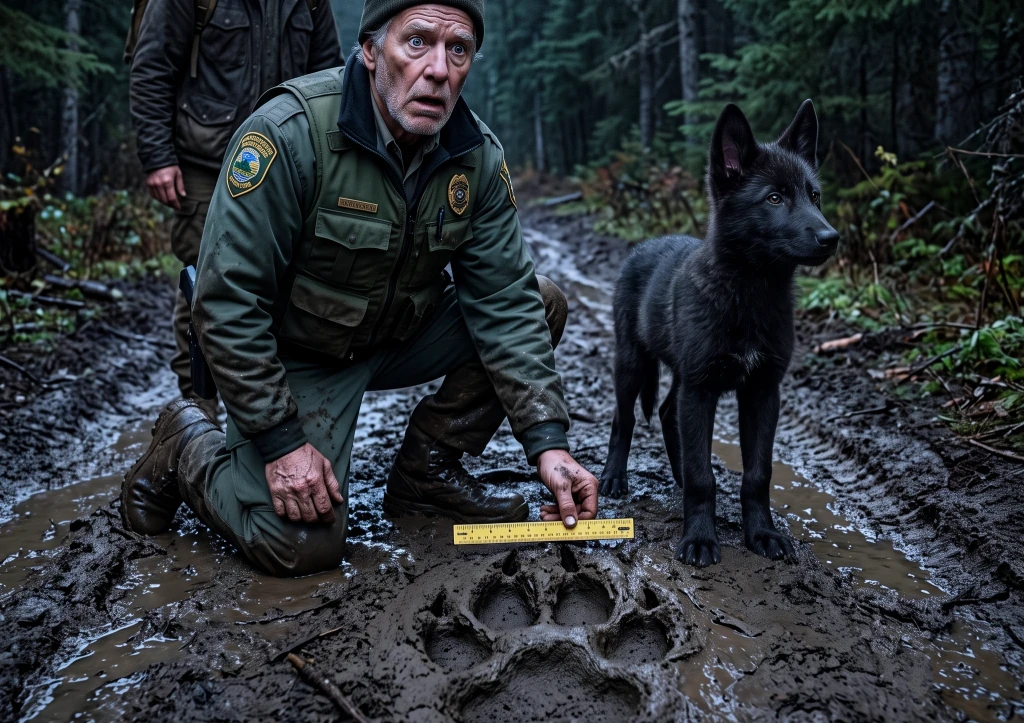
One evening in mid-June, Tom came upon them beside a muddy seep off the logging road. He stopped so abruptly that Cal nearly walked into him. Beside the broad prints from Cal’s boots ran a line of Rook’s tracks—narrow, almost perfectly aligned, with long middle toes and claw marks fine as pencil strokes.
Tom took a laminated track card from his vest and laid it beside the clearest print. Then he looked at Rook’s feet, at the print again, and measured the stride with his fingers.
“What?” Cal asked.
Tom did not answer. Somewhere north of them, beyond a low ridge dark with spruce, a wolf howled—a single level note that traveled through the evening like a wire pulled tight.
Rook froze. His ears rose, his muzzle lifted, and from the chest of a twelve-week-old puppy came a long, controlled answer—too steady and instinctive to sound borrowed.
Tom slowly stood. His face had lost all its color. “Cal,” he said, keeping his eyes on Rook. “That wasn’t a puppy pretending to be a wolf…”
To read the rest of the story – CLICK the NEXT button 👇👇👇