


At 8:17 on a Thursday night, something struck Thomas Hale’s storm door three times. The first blow rattled the glass. The second came with the scrape of metal across frozen boards. The third was softer, as though whatever stood outside had used the last of its strength reaching the porch. Tom set down his untouched bowl of soup and listened. He had spent thirty-eight years as a Montana game warden. He knew the thump of snow sliding from a roof, the scratch of a pine branch against siding, and the clumsy charge of a black bear following the smell of food. This was none of those things.
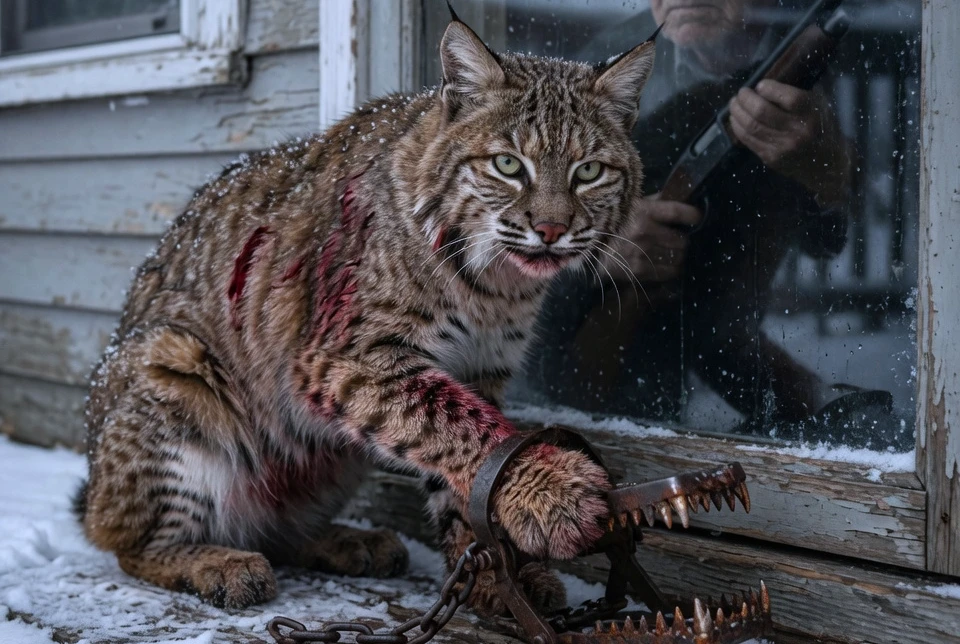
Another sound came from beyond the door—a low, hoarse growl that weakened into labored breathing.
Tom took his shotgun from the rack but left the safety on. When he switched on the porch light, wind-driven snow flashed across the window so thickly that he could see nothing beyond the glass.
Then something moved beneath the light.
A length of rusted chain slid across the boards.
Tom leaned closer. Blood marked the snow in dark, scattered drops, and crouched against the outside wall was a wild cat unlike any house pet. Long legs folded awkwardly beneath a pale winter coat. Black tufts flattened against its ears. One oversized front paw was locked inside an old foothold trap.
A young bobcat.
The animal raised its head and looked directly through the glass. Its eyes were amber, but there was no plea in them—only pain, exhaustion, and the last hard reserve of something that had survived because it trusted nothing.
Tom’s hand tightened around the shotgun.
The trap was attached to eighteen inches of broken chain. There was no owner’s tag, and the jaws had been illegally modified to close tighter than any responsible trapper would allow. The cat must have torn the anchor loose and dragged the steel through miles of timber before finding the narrow pocket beneath Tom’s porch, where the wind could not reach it as easily.
It had not come looking for a man.
It had come looking for shelter.
Behind Tom, the house was nearly as cold as the night outside. He had put two pieces of wood in the stove that morning and let them burn down without replacing them. The curtains had not been opened in days, and a gray film covered the windows.
On the far wall, the old schoolhouse clock remained stopped at 6:14.
That was the minute Ruth died.
Fourteen months earlier, after the hospice nurse had closed Ruth’s eyes and driven back toward town, Tom had reached up and caught the brass pendulum in his hand. The sudden silence had seemed merciful then. He had not understood that silence could grow until it occupied every room.
His daughter had tried to warn him.
Claire had driven from Missoula twice during the first month. She filled his freezer, washed the sheets, and sat across from him at the kitchen table while he answered every question with a nod or a word.
On her third visit, she asked him to stay with her and Lucy for the winter.
“I’m not leaving Ruth’s house,” he told her.
“It was Mom’s house because she lived in it,” Claire replied. “You’re turning it into a place where both of you died.”
He had looked at his daughter and said the cruelest thing he could find.
“Then let me finish the job in peace.”
Claire went still. She did not shout or cry. She put on her coat, carried her sleeping five-year-old daughter to the car, and left before dawn.
For several months she continued calling. Tom let the phone ring until the sound became unbearable. Eventually, he unplugged it from the wall and coiled the cord around the receiver.
No one had called after that because no one could get through.
The bobcat shifted outside, and the trap struck the door again.
“You found the wrong house,” Tom murmured.
The animal tried to rise. Its uninjured front paw braced against the boards, but the trapped leg could not bear weight. It dragged itself forward several inches before its hindquarters collapsed.
A narrow white crescent showed beneath its throat.
Tom had seen bobcats in every condition—cornered in barns, struck by vehicles, weakened by mange, enraged inside transport cages. He knew how quickly an injured cat could open a man’s arm to the bone. Pain did not make a wild animal grateful. It made the animal more frightened and more dangerous.
Ruth had been the one who taught him that.
Before the cancer, she volunteered with a licensed wildlife rehabilitation center outside Libby. Their mudroom had once held transport crates, capture shields, and covered boxes containing injured owls, fox kits, and one furious young porcupine. Ruth never named the animals.
“A name is the first thing people use to pretend something wild belongs to them,” she used to say.
After her funeral, Tom locked away the equipment. He had not opened the storage closet since.
A gust struck the house. Snow blew beneath the porch roof and covered the blood beside the bobcat’s paw.
Tom reached toward the light switch. If he turned it off and walked away, nature would make the decision for him. By morning, the porch would hold nothing more dangerous than a stiff body beneath the snow.
His fingers stopped an inch from the switch.
The cat’s head had sunk onto the boards. Its eyes remained open, but its breathing came in shallow pulls separated by pauses that lasted too long.
Tom remembered Ruth on her final night. He remembered sitting beside the bed, counting the seconds between her breaths because counting was the only task left that he knew how to perform.
He could not stand in another warm room and listen to something die on the other side of a door.
“Don’t mistake this for kindness,” he told the bobcat. “I’m just not cleaning you off my porch in the morning.”
The animal’s ear twitched, but it did not lift its head.
Tom returned the shotgun to the rack. Then he put on his coat and went to the storage closet.
Dust covered the handle. When he opened the door, the smell of canvas, disinfectant, and old cedar rose from the darkness. Ruth’s heavy leather gloves hung from a hook beside a plywood capture shield. Beneath them sat a large transport crate with a sliding steel door.
Her handwriting was still visible on a strip of white tape across the top:
CHECK LATCH TWICE.
Tom stood looking at those three words until his vision blurred. He wiped his eyes with the heel of his hand, pulled out the crate, and checked the latch twice.
The mudroom had two entrances: the interior kitchen door and a narrow exterior door beside the woodshed. Tom cleared away boots, tools, and a bag of rock salt. He placed the crate against the far wall, opened its steel door, and leaned the plywood shield across the entrance to the kitchen.
He did not put food inside. A rescue team might need to sedate the animal, and feeding it now could create another danger. Instead, he turned off the mudroom light and opened the exterior door using a rope threaded around the handle.
A ribbon of warmth slipped into the storm.
Tom retreated behind the solid kitchen door and watched through its small window.
For almost five minutes, nothing happened. Snow gathered on the threshold. Tom began to wonder whether the bobcat had died where it lay.
Then the broken chain moved.
The cat appeared in the doorway one painful inch at a time. It kept its body low and pulled the trapped paw along the boards. Its winter coat made it look larger than it was, but Tom could see the sharp ridges of its hips beneath the fur.
When it sensed the enclosed room, it froze.
Its amber eyes found Tom behind the glass.
He remained motionless.
“You don’t have to trust me,” he whispered. “Just get out of the wind.”
The bobcat’s nose lifted. It drew in the unfamiliar scents of rubber boots, dry wood, and the human standing beyond the door. Then another gust drove snow against its back.
The cat crawled into the mudroom.
Tom waited until its tail had cleared the threshold. He pulled the rope, bringing the exterior door shut, and secured it without entering the room.
The bobcat made one halfhearted charge at the plywood shield. The trap chain snapped tight beneath its body, and it fell sideways. A raw, tearing growl filled the small space before fading into a thin exhalation.
Tom’s old instincts returned—not confidence exactly, but sequence.
Contain the animal. Reduce noise. Control temperature. Call for help.
He added wood to the stove and opened the vent. Flames caught with a low roar, spreading heat through walls that had been cold for months. Then he went to the hallway table and opened its bottom drawer.
The telephone lay inside exactly where he had left it.
Tom unwound the cord and plugged it into the wall. For a moment, he heard nothing. Then a dial tone filled the receiver.
The ordinary sound struck him harder than he expected. A working line meant that the world had remained there all along. He had been the one refusing to answer it.
He dialed warden dispatch from memory.
“Montana Fish, Wildlife and Parks emergency line.”
“My name is Thomas Hale. Retired game warden, badge number 417. I have an injured juvenile bobcat contained at my residence off Boulder Creek Road.”
The dispatcher’s questions came quickly.
Was the animal conscious? Was the trap still attached? Had Tom touched it? Was anyone else in the house?
Tom gave concise answers. The habit of reporting facts steadied him.
“Do not enter the room,” the dispatcher said. “I’m contacting the duty warden and Cedar Ridge Wildlife Center. Stay on the line.”
A minute later, another voice joined the call.
“Tom?”
He recognized Erin Doyle, who had been a newly hired warden during his final year with the department.
“Hello, Erin.”
“I wish you’d picked a better reason to come out of hiding.”
“So do I.”
Her silence lasted just long enough for him to know she had heard everything he could not say.
“What’s the weather doing up there?” she asked.
“Getting worse.”
“The county plow turned back at Blacktail Bridge. We can send a snowmobile team when the wind drops, but nobody is reaching you by truck tonight.”
Tom looked through the window in the kitchen door. The bobcat had curled against the wall, protecting its trapped paw beneath its chest.
“How long?”
“Best estimate? Daybreak.”
“That could be twelve hours.”
“I know.”
A third person came onto the call. Dr. Maya Patel identified herself as Cedar Ridge’s wildlife veterinarian and asked Tom to describe the animal’s breathing, posture, and visible blood loss.
“Don’t remove the trap,” she warned. “Don’t try to bandage the leg, and don’t give it food, water, or any human medication. Keep the room dark and quiet. We need to limit stress until we can sedate him safely.”
“Him?”
“From the size and the photos Erin had you send, most likely a young male. Can you see his gums without approaching?”
Tom used an old pair of field binoculars through the window.
“He opened his mouth when he growled. They looked pale.”
“How pale?”
“Gray around the edges.”
Dr. Patel’s voice changed. “Count his breaths for thirty seconds.”
Tom watched the cat’s ribs. The first breath came shallowly. The second required a visible effort. After the third, the animal lay still for so long that Tom thought there would not be another.
“Four,” he said. “Maybe five.”
“Is he shivering?”
“He was.”
“And now?”
Tom pressed closer to the glass.
The bobcat’s body had stopped trembling. Its eyes were no longer following him, and the white crescent beneath its throat barely moved.
“No,” Tom said. “He’s completely still.”
“That isn’t improvement.” Dr. Patel’s voice sharpened. “Tom, he’s going into shock. If we wait for the road to open, he may not live until morning…”
To read the rest of the story – CLICK the NEXT button 👇👇👇