


The dog heard the dock give way before anyone else did. It was not a loud sound at first—only a dry wooden snap beneath the slap of water against the pilings. But the shepherd-Lab mix lifted her head from the weeds beside the old boathouse, every muscle suddenly still. Early April had not yet warmed the mountains of western North Carolina. A cold wind moved across Lake Briar, carrying the smell of wet leaves, mud, and rain-soaked timber. Camp Cedar Haven had been empty for years, and most people who followed the shoreline trail knew better than to trust its sagging buildings or silver-gray dock.
Eight-year-old Owen Walsh did not.
He had walked out only a few yards, stopping where sunlight broke through the clouds and scattered across the water. His mother stood near shore, picking up the glove he had dropped along the path.
“Owen, stay where I can see you,” Meredith called.
“I am.”
He bent to reach for a flat stone trapped between two boards.
The dog was already running.
Her paws struck the dock hard enough to make the loose planks jump. Owen turned at the sound. Behind him, a support beam split with a sharp crack, and the boards beneath his right foot dropped several inches.
He screamed as his leg slipped through the gap.
The dog lunged and caught the back of his hood in her teeth. His jacket tightened against his throat, but the fabric held. She braced her front legs and pulled while the broken section of dock tilted toward the lake.
Meredith looked up and saw a large, mud-streaked dog with its jaws clamped onto her son’s clothing.
She did not see the broken beam. She did not see the dark water through the widening gap beneath Owen. She saw teeth, heard him choking and crying, and ran.
“Get away from him!”
The dog released the hood as Meredith reached them. Meredith dragged Owen free with one arm and planted her other hand against the animal’s shoulder. The dog stumbled on the slick boards.
Meredith shoved again, with both hands this time.
The dog went over the side.
She struck the water between the dock and one of the pilings. For a second, she disappeared beneath the black surface. Then her head came up, ears flattened, front paws scraping at wood too high and too rotten to hold her weight.
Owen clung to his mother, coughing.
“She pulled me,” he tried to say.
Meredith was checking his face, his neck, his hands. “Did she bite you? Where did she bite you?”
“She didn’t—”
The dog’s claws rasped against the piling. Meredith glanced back and saw her paddling.
Dogs could swim. Owen was trembling, his jeans were soaked to the knee, and Meredith’s mind had narrowed to one command: get her child into the car and get him warm.
She half carried him up the path. By the time the SUV pulled away, the dog’s scraping had grown weaker.
Daniel Mercer heard it from the far side of the boathouse.
He had been collecting aluminum cans and broken fishing line along the shore, pushing his possessions in a grocery cart whose front wheel pulled constantly to the left. At first, he thought the sound came from a branch rubbing against the dock. Then he heard a low, exhausted whine.
He left the cart and ran.
The dog was still in the water, but only her muzzle and eyes remained above the surface. One front paw had become wedged between two broken boards. Each time she tried to pull free, she pushed herself farther under.
“Easy,” Daniel said, dropping to his knees. “Don’t fight me. Just give me a second.”
Her eyes rolled toward him. When he reached down, she snapped once—not close enough to bite, but close enough to warn him.
“I know. I wouldn’t trust me either.”
Daniel crawled back and grabbed the length of clothesline tied around his cart. He made a wide loop, lay flat on the dock, and lowered it beneath her chest. The boards groaned under his weight.
The first loop slipped. On the second attempt, the dog twisted in panic and nearly pulled him into the lake. Daniel wrapped the rope around his forearm, braced one boot against a sounder plank, and reached into the water with his free hand.
Cold shot through his sleeve to the shoulder.
He found her collar, worked her trapped paw sideways, and pulled.
For one terrible moment, nothing moved. Then the paw came free. Daniel hauled on the rope until the dog’s chest struck the dock’s edge. She clawed once, found no purchase, and slid backward.
“No, you don’t.”
He shifted his grip beneath her front legs and dragged her onto the boards. She collapsed against him, soaking his coat and jeans, her ribs moving in fast, shallow bursts.
Daniel stayed there until he was certain she was breathing.
His shelter was hidden behind the old maintenance building, where a deep roof overhang kept most of the rain off. A tarp blocked the wind on two sides. Everything he still owned fit inside that narrow space: a sleeping bag, a battered tool case, two changes of clothes, a camp stove, and one wool blanket sealed in a plastic storage bag.
The blanket was the only thing he had that was completely dry.
He wrapped it around the dog.
She flinched when his hand passed near her head, so he stopped trying to rub her coat. Instead, he heated water on the camp stove, filled an old bottle, wrapped it in a T-shirt, and placed it beside her. Her trembling came in violent waves that shook the blanket.
Daniel sat several feet away with his wet sleeves clinging to his arms.
“All right,” he murmured. “You set the rules.”
The dog watched him without blinking.
By late afternoon, the trembling had eased. Daniel opened the paper container a waitress at the Briar Diner had given him that morning. Inside was plain rice and a piece of baked chicken she had set aside before adding gravy. It was supposed to be his dinner and breakfast.
He pulled the meat from the bones, checked it carefully, and placed half beside the blanket.
The dog sniffed but did not move.
Daniel carried his own portion to the far end of the shelter and turned slightly away. Only then did he hear her begin to eat.
She finished quickly, then nudged the empty paper with her nose. Daniel expected her to leave. Instead, she retreated to the edge of the tarp and lay facing the open woods, ready to flee if he came too close.
He studied the faint tan markings over her eyes and the white patch on her chest.
“You look like a Sadie,” he said.
One ear shifted toward him. It was not agreement, but it was the first sign that she had heard his voice without recoiling from it.
Dusk had settled over Lake Briar when tires crunched across the gravel behind the maintenance building.
The dog rose instantly. A growl vibrated low in her chest.
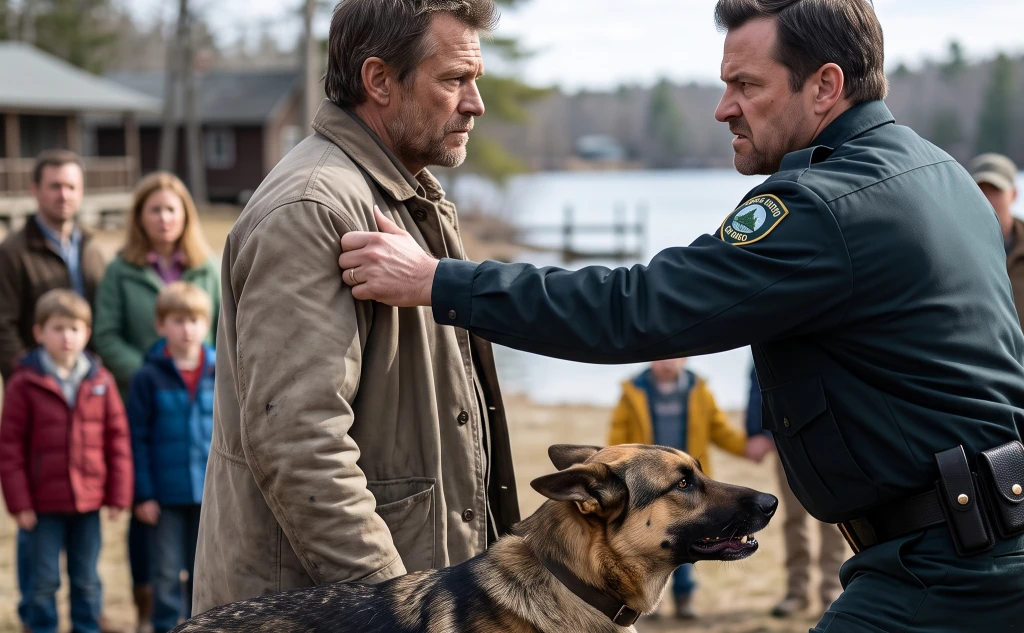
A white security pickup stopped beside Daniel’s cart. Wade Turner climbed out wearing a dark jacket with a newly stitched Cedar Haven patch over the pocket. He was broad through the shoulders, with a close-trimmed beard and the weary irritation of a man who expected trouble before anyone spoke.
His flashlight passed over Daniel, the tarp, and the blanket around the dog.
“I told you this property was changing hands,” Wade said.
“You told me somebody was looking at it.”
“They’re done looking. New owner takes possession this weekend. Work crews start Monday.”
Daniel got to his feet. Water still squished inside one boot. “She nearly drowned. I’m keeping her warm until she can walk.”
Wade’s light settled on the dog. Sadie backed into the shadows, lips lifting slightly.
“Then call animal control.”
Daniel looked at the shivering animal and then at the dark road beyond the trees. Wade returned the flashlight to his face. “You’ve got forty-eight hours, Mercer. You, the cart, and the dog. After that, I clear this place myself…”
To read the rest of the story – CLICK the NEXT button 👇👇👇