


The kitten crossed the bath towel using only its front legs. Caleb Mercer watched it drag one crooked hind leg toward the rubber tire of his wheelchair, leaving a dark streak of rainwater across the kitchen floor. His first thought was that his mother had somehow found the only creature in Pittsburgh more damaged than he was. His second was that she needed to take it back outside.
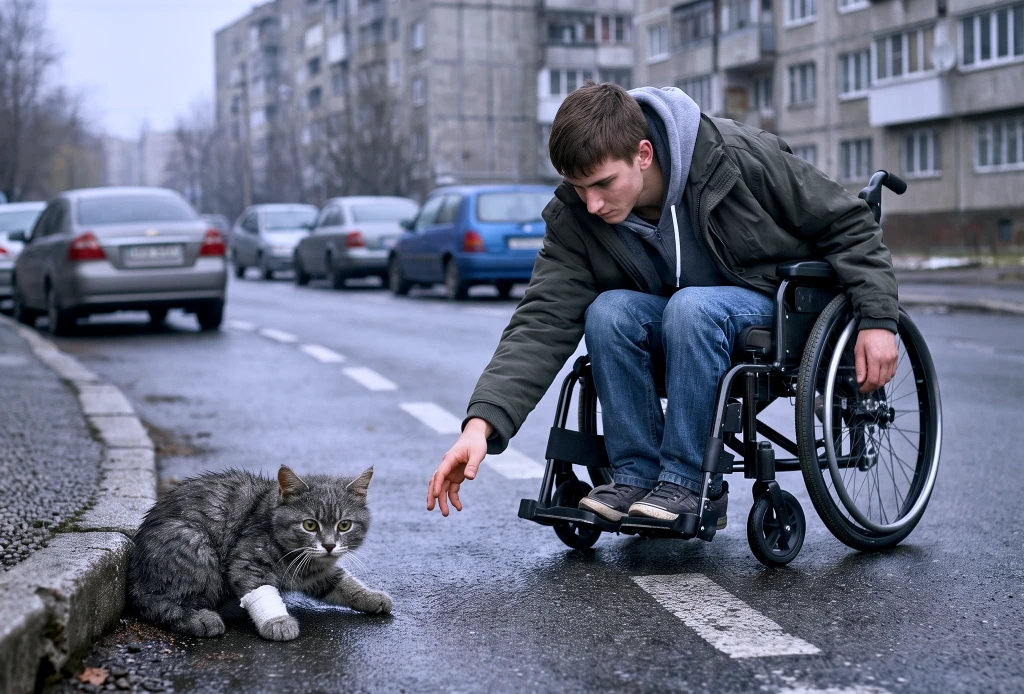
“No,” he said.
Anne was still wearing her grocery-store bakery jacket. Freezing rain shone on her shoulders, and wet strands of hair clung to her cheeks. She knelt beside the towel with both hands cupped around the kitten, not quite touching him, as if the warmth of her palms could form a shelter.
“I found him by the curb,” she said. “A car must have clipped him. Help me get him into a box.”
“I said no.” Caleb backed his chair away, and the right wheel struck a cabinet. “We can barely get me through the bathroom door. We don’t have money for a dying cat.”
The words landed harder than he meant them to. Anne flinched, but she did not argue. During the eleven weeks since the crash, she had learned to receive his anger the way an old house received winter—without surprise, and with damage that only showed later.
The kitten lifted his head. One eye was swollen shut, his gray fur was pasted to a body so small that Caleb could count the ridges of his ribs. He made no sound. He simply kept pulling himself toward the chair until his nose touched the tire, then curled against it as though he had finally reached something solid.
Caleb looked away first.
Eleven weeks earlier, he had been standing at a bus stop on Fifth Avenue with his laptop in his backpack and a half-finished software assignment open on his phone. He was twenty-two, late for a senior seminar at Allegheny State University, and annoyed that Anne had texted him twice to ask whether he had worn gloves. The morning had seemed insultingly ordinary until someone behind him shouted.
Caleb remembered the black SUV jumping the curb. He remembered the driver’s face behind the windshield—eyes open, hands locked on the wheel, the expression of a man already gone. After that came a white flash, the sensation of being folded around something much larger than himself, and then nothing.
At Three Rivers Medical Center, a trauma surgeon explained that the driver had suffered a massive heart attack. Four people at the stop had died. Caleb had survived with a complete spinal cord injury in the lower thoracic region.
The doctor had chosen his words carefully. Caleb might recover small changes in sensation. Medicine kept surprising itself. But no one on his team expected him to regain useful movement below the waist.
Anne had gripped his hand while he stared at the blanket over his legs. He could see the shape of his knees beneath it. He could not feel that she was touching his ankle.
“So I’m the lucky one,” he had said.
Neither the doctor nor his mother answered.
He completed four weeks of inpatient rehabilitation because the hospital would not discharge him without transfer practice, skin-care training, and a plan for the stairs at home. He learned to move from bed to chair using a board. He learned that a half-inch threshold could stop him more efficiently than a locked door, and that strangers often spoke to the person pushing his chair instead of to him.
Then he came home to the narrow first floor of the Greenfield duplex where he had grown up. The bathroom doorway was too tight unless he removed one wheel guard. The kitchen counters were too high. Their landlord installed a temporary plywood ramp that bowed in the middle, and the permanent aluminum one Anne was saving for remained a catalog photo held to the refrigerator by a magnet.
The university offered remote classes and an adjusted graduation schedule. Caleb deleted the first email without answering. An outpatient rehabilitation coordinator called three times; on the fourth, he blocked the number.
Anne stopped asking him to be grateful. Instead, she rose at four each morning for the bakery shift, came home smelling of sugar and fryer oil, and washed her hands until the skin around her knuckles split. She changed his sheets, fought with insurance representatives, measured doorframes, and pretended not to notice when he sat in the dark until evening.
Caleb noticed everything. That was part of the problem.
He noticed the stack of medical statements beneath the fruit bowl and the way Anne cut her blood-pressure pills in half near the end of the month. He noticed that she no longer bought coffee on her way to work. Most of all, he noticed that four families had buried someone after the crash while his mother had been handed a son who seemed determined to disappear without dying.
The SUV driver had carried only the state minimum in liability coverage, and that policy was being divided among several injury and death claims. The attorney handling Caleb’s case had warned them that no settlement would arrive soon enough to solve the bills already on the table.
Now she was kneeling in wet clothes beside a kitten with a broken leg.
“The emergency clinic will tell you to put him down,” Caleb said. “Then they’ll charge you for telling you.”
Anne reached for the phone. “Maybe. But a veterinarian gets to make that decision, not the two of us from a kitchen floor.”
“And when they hand you a two-thousand-dollar estimate?”
“I’ll deal with the estimate.”
“With what money?” His voice rose. “The ramp money? Your rent? Or should we stop buying the prescriptions that keep me from getting an infection?”
Anne went very still. “I did not make you expensive, Caleb.”
He felt the shame immediately, sharp and clean, but shame had not made him kinder lately. It had only taught him where to aim.
“Take him,” he said. “Do whatever you want.”
She lined a laundry basket with another towel and lifted the kitten into it. As she carried him toward the door, one tiny paw caught in the open weave of the basket. Caleb saw it reaching through the plastic, flexing against empty air.
“Mom.”
Anne turned.
“Put one of my hand towels under his head. The thick one. It’s in the bottom drawer.”
She did not smile. For that, he was grateful.
The freezing rain had turned to sleet by the time her old Honda disappeared down the street. Caleb returned to his room, but the apartment no longer felt quiet. He could still see the kitten braced against his wheel, too frightened to cry and too stubborn to stop moving.
At 12:38 a.m., Anne called from the emergency veterinary clinic.
“He has a fractured femur and a deep wound near the hip,” she said. Her voice sounded thin beneath the fluorescent hum behind her. “There’s no internal bleeding. They think they can save the leg, but he needs surgery before the tissue swells more.”
Caleb looked toward the refrigerator. From his doorway he could see one corner of the ramp photograph.
“How much?”
“A rescue fund will cover half. Our part would be fourteen hundred and sixty dollars.”
Almost exactly what Anne had saved. Caleb pressed his thumb into the deadened muscle above his knee, an old habit from the hospital. He watched the pressure indent his sweatpants and felt nothing.
“Tell them you can’t,” he said.
For several seconds, all he heard was the clinic noise. A metal door clanged. Somewhere close to Anne’s phone, an animal made a raw, startled cry.
“They can stabilize him overnight,” she said. “But the balance has to be authorized by nine or they release the surgical slot. A rescue group might take him tomorrow, but no one is promising.”
Caleb closed his eyes. Four people had not been given a night in which someone could still choose for them. He had spent eleven weeks resenting the fact that he had been.
“Tell them to hold the slot,” he said.
“With what money?”
He looked at the ramp photograph. “Give me until nine.”
Anne came home shortly after two carrying an empty basket and a folder of estimates. The clinic had kept the kitten on pain medication and fluids, but the surgery remained a line on tomorrow’s schedule that could still be erased. She placed her debit card beside the papers.
“If we use the ramp money, we use it,” she said. “I need you to understand what that means.”
Caleb understood. The temporary plywood entrance had nearly tipped his chair twice. Spending the savings would leave Anne wrestling him over it for months, and the kitten might still lose the leg despite surgery.
While she slept at the kitchen table, Caleb read the proposed aftercare instructions and built a recovery box from an old shipping carton, lining it with folded towels so the injured leg could not catch. Then he opened the laptop he had not touched since the crash.
An old freelance client had emailed just before midnight. A scholarship nonprofit’s registration portal was failing for people who navigated by keyboard, and applications closed at nine that morning. The emergency repair paid $1,600 before fees—enough to begin replacing what the kitten’s surgery would take from the ramp fund.
Caleb read the message three times. He had not written a line of code in eleven weeks.
At 3:37 a.m., he typed, I can deliver by nine. Send the files.
The answer appeared before he could reconsider.
They’re on the way…
To read the rest of the story – CLICK the NEXT button 👇👇👇