


The dog always arrived before the second bell. Seven minutes before weekday Mass, while Millstone was still shaking off the dark, he would slip through the bronze doors of St. Anne’s and walk down the center aisle. He was enormous beneath all that neglected fur—a shaggy gray-and-cream dog with burrs caught along his legs and dried mud darkening his belly. No collar showed beneath the mats around his neck.
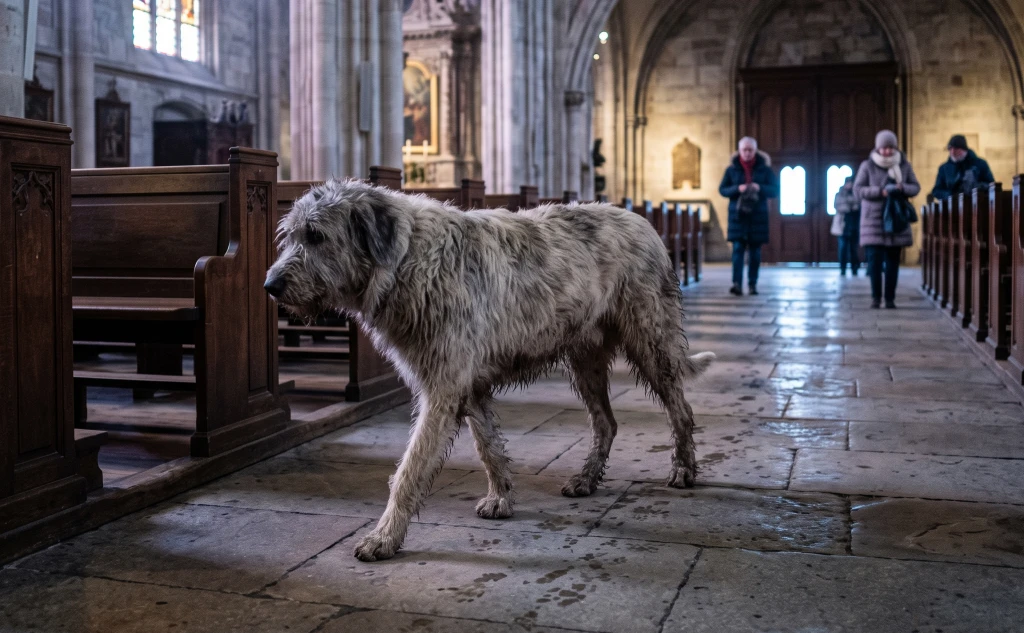
He never wandered. He never sniffed the collection baskets or approached the people removing their gloves in the pews. He went directly to the first pew on the left, lowered himself onto the stone floor, and faced the center aisle.
The first morning, Father Daniel Reyes assumed the dog belonged to someone in the congregation.
The second morning, he wondered why no one called him over when Mass ended.
By the fifth, Father Daniel had begun watching the doors almost as closely as the dog did.
Every time someone entered, the dog lifted his head. A man in work boots. Two nurses coming off the overnight shift. Mrs. Carver with her aluminum walker. A young mother carrying a sleeping toddler against her shoulder.
The dog studied each face for a moment. Then his chin returned to his paws.
Father Daniel had been at St. Anne’s for only four months. Millstone was the kind of western Pennsylvania town where families measured time by mill closures, high school football seasons, and which priest had baptized whose grandchildren. Most parishioners had known one another for decades.
They were still deciding what to make of him. He, in turn, was still learning their names.
So when he asked after Mass who owned the dog, he was not surprised by the uncertainty.
“I thought he was with Helen,” someone said.
Helen shook her head. “I thought he belonged to the man who sits behind me.”
The man behind her had assumed the same thing about someone else.
By the end of the conversation, everyone agreed on only two facts: the dog came alone, and no one had ever heard him make a sound.
The parish administrator checked the shelter’s current found-animal list and posted a photograph on the parish page. Any alert from eleven weeks earlier had already expired from the shelter’s public feed and was buried beneath newer social-media posts. The new image drew guesses but no identification. A farmer thought the dog resembled one that had vanished from a property twenty miles north; another woman insisted she had seen him behind the grocery store. Two older parishioners said he looked familiar, though neither could explain from where.
The scattered sightings mentioned in the comments clustered around an older neighborhood, the rail yard, and Porter’s Bakery. No one remembered seeing the stray enter St. Anne’s until a hard freeze settled over Millstone nearly two weeks earlier. Since then, he had come every morning.
Father Daniel began writing down the time the dog appeared. It was never exactly the same, but always between the first and second bells, as if the sound—not a clock—summoned him from somewhere in town. On Sunday, when families filled the nave, the dog remained in the vestibule under an usher’s watch. Only after the church emptied did he walk to his usual place beside the pew.
By then, Father Daniel had stopped believing the visits were accidental. He had not yet admitted that setting out a bowl and making a few calls was easier than taking responsibility for whatever the dog needed next.
Mrs. Carver began bringing him pieces of breakfast sausage wrapped in foil. He would sniff them politely but rarely eat before the service ended. Someone put a bowl of water near the side entrance. He drank from it only after the final blessing.
Then he waited.
That was the part Father Daniel found hardest to explain.
The dog did not rise with the congregation. He remained on the cold floor while coats were buttoned, candles extinguished, and conversations drifted toward the doors.
Only after the last parishioner had left would he stand, look once at the empty pew beside him, and walk out.
He was not seeking company. If he had been, there were easier ways to find it. He was not seeking warmth, either. On dry mornings he left the heated church for streets silvered with frost.
He seemed to be keeping an appointment.
One Thursday, an elderly woman entered just as Father Daniel reached the altar.
She wore a long blue wool coat and moved carefully, one hand sliding along the ends of the pews for balance.
The dog sprang up.
It was the first sudden movement Father Daniel had seen from him. His tail struck the side of the pew. He took three eager steps into the aisle, his whole body transformed by a hope so immediate that several people turned to look.
The woman stopped.
“Oh,” she whispered. “Hello there.”
The dog stared at her face.
Whatever he had expected, he did not find it. His tail went still. He backed away without touching her, returned to his place, and lowered himself onto the stone.
During the prayers, Father Daniel looked down and saw that the dog’s eyes remained fixed on the doors.
Afterward, the woman in the blue coat rested her hand on Father Daniel’s sleeve.
“That animal isn’t coming here to get out of the cold,” she said. “He’s waiting for somebody.”
Father Daniel had already begun to believe the same thing.
Over the next week, the temperature dropped. The hills around Millstone turned hard and brown, and freezing rain glazed the church steps.
The dog’s condition worsened.
His hip bones became visible beneath his coat. One morning he favored his right front paw. Another morning he remained asleep when the organist dropped a hymnal only a few feet away.
A parish council member quietly mentioned liability. A frightened dog, she reminded Father Daniel, could bite even if it had never shown aggression before. She was not being cruel. There were children in the church, and no one knew whether the animal had been vaccinated.
Father Daniel promised to handle it.
The county shelter advised him not to corner a large frightened stray. An officer offered to bring a humane trap, but each day the dog vanished before anyone arrived. Father Daniel could have closed the bronze doors after Mass. Every time he considered it, he saw the dog watching the exits and could not bring himself to turn the church into another place where the animal felt trapped.
That afternoon, he bought a large bag of dog food, a slip lead, and three cans of the expensive wet food the store clerk said no hungry dog could resist.
The dog ate half a can but moved away when Father Daniel showed him the lead.
“All right,” Father Daniel said, lowering it. “Not today.”
The dog watched him with tired brown eyes.
Father Daniel sat on the end of the first pew, leaving several feet between them.
“Whoever you’re waiting for,” he said softly, “they’re taking a long time.”
At the sound of footsteps in the vestibule, the dog’s head rose again.
It was only the custodian.
The dog lowered his chin.
The following morning brought a steady mixture of rain and sleet. Water tapped against the stained-glass windows throughout Mass, and by the final hymn the gutters were overflowing.
When the dog rose to leave, Father Daniel put on his coat and followed.
The animal glanced back once but did not run. He crossed the church parking lot, passed the closed pharmacy, and continued along Walnut Street. Father Daniel stayed half a block behind, his shoes filling with icy water.
The dog ignored the awnings where other strays might have taken shelter. He passed an overflowing trash bin without slowing.
At the corner of Walnut and Birch, he turned into an older residential street lined with narrow brick houses and bare maples.
Then he stopped before a small white house with green shutters.
The lawn had gone to weeds. Flyers sagged inside the storm door, and a real estate lockbox hung from the handle.
The dog climbed the porch steps. He pressed his nose to the crack beneath the door and stood there for several seconds, listening.
Then he scratched once—not frantically or loudly, just one quiet scrape of his paw against the painted wood.
When no one answered, he circled twice and lay down on the wet boards.
Father Daniel approached slowly. The dog did not look at him. His attention remained on the door.
A porch light came on across the street.
A woman in a raincoat stepped outside, holding the hood closed beneath her chin.
“Father?” she called. “Are you trying to catch that dog?”
“I’m trying to help him.”
She crossed the street, then stopped when she saw where the dog was lying. For a moment, her expression changed.
“Murphy?” she whispered.
The dog’s ear moved. Then he raised his head.
“You know him?”
“I helped care for him after Nell Whitaker went to the hospital.” The woman looked at the soaked animal curled against the door. “People reported a big stray near here before dawn, but he always ran before I could get close. This is the first time I’ve seen him on Nell’s porch in daylight.”
“So he belonged to Mrs. Whitaker?”
The name meant something to Father Daniel. He remembered a crowded funeral during his first weeks at St. Anne’s, white lilies surrounding a dark wood coffin.
He looked again at the locked house.
“Where is Mrs. Whitaker now?”
The woman’s gaze settled on the dog.
“They buried Nell eleven weeks ago…”
To read the rest of the story – CLICK the NEXT button 👇👇👇