


The teenager held the lighter so close to the Dalmatian’s face that the flame flashed in the dog’s dark eyes. His friend stood a few feet away, filming with his phone. The third boy kept nudging a sleeping man’s cardboard mat with the toe of a white sneaker, each shove drawing another burst of laughter that bounced off the tile walls of the pedestrian tunnel. The dog could barely stand. His ribs showed beneath a coat gone dull with grime, and his hind legs trembled as he placed himself between the flame and the man slumped against the concrete.
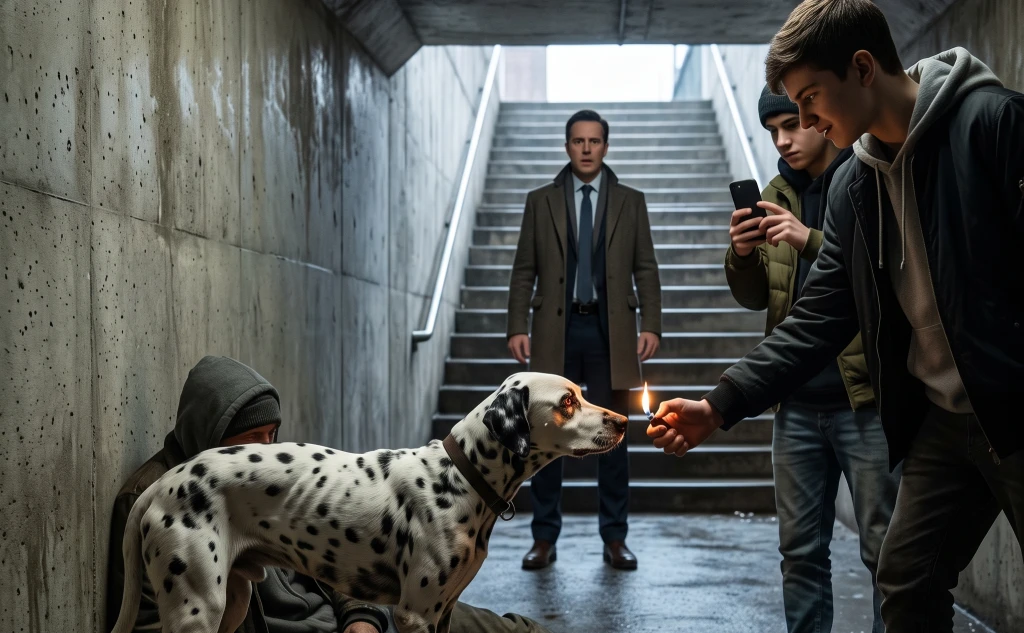
Daniel Mercer stopped halfway down the stairs.
He had taken this route beneath Pittsburgh’s North Shore for eleven years, long enough to know which ceiling panel leaked after rain and when the Riverfront light-rail platform would empty into the tunnel. He also knew the old man and the spotted dog, though only in the cowardly way people knew those they passed every day without learning their names.
“Back away from him,” Daniel said.
The boy with the lighter glanced up. “Mind your business.”
Daniel already had his phone out. He angled the camera toward all three faces and called transit police on speaker, giving the tunnel entrance and a description of their jackets. The laughter thinned. The boy filming lowered his phone, muttered something meant to sound brave, and followed the others toward the station.
One of them gave the cardboard a last kick as he left. The Dalmatian lunged half a step, not to attack but to cover the old man more completely. A low warning rolled from his chest.
“Scout,” the man rasped. “Stay.”
The name meant nothing to Daniel. The voice did.
It was buried under years of cigarettes, cold nights, and whatever else a man had to swallow before he could sleep on concrete. Still, there was an old authority inside it, the hard, level cadence of someone accustomed to being obeyed when hesitation could cost a life.
Daniel descended slowly. “Sir, are you hurt?”
The man drew his hood forward. Scout remained in front of him, head low, watching Daniel without blinking.
“Transit police are coming,” Daniel said. “I can wait.”
“Then you’ll waste their time and yours.”
Daniel felt the first cold pressure beneath his sternum. It was not pain, exactly. At forty, he knew every harmless skipped beat and every sensation worth reporting to his cardiologist. This came from memory, not muscle.
He crouched far enough away that Scout did not have to choose between defending and retreating. The old man’s beard was matted gray, his cheeks hollow. Dirt obscured most of his face, but not the narrow break in his left eyebrow or the deep vertical line between his eyes.
Daniel had stared at that line from a hospital bed while being told that the life he wanted was over.
“Dr. Whitaker?”
The old man went still.
For several seconds, the only sound was a train braking overhead. Then Samuel Whitaker lifted his face and looked directly at him.
The eyes were older and clouded at the edges, but they were the same eyes that had studied Daniel’s scans eighteen years earlier—gray, unsentimental, and impossible to fool.
“You were the forward,” Samuel said. “The one with the bad artery.”
Daniel’s knees nearly gave way beneath him.
On May 17, 2008, he had been twenty-two and convinced his body had been built for speed. A professional scout was in the stands that evening, and Daniel had scored once before halftime. The grass was damp, the stadium lights had just come on, and Claire Bennett was behind the home bench holding two paper cups of coffee and the future they had planned between them.
In the sixty-third minute, Daniel cut inside a defender and accelerated toward a through ball. He felt one violent blow in the center of his chest. Then the field tipped, the lights smeared white across the sky, and every sound folded inward.
Later, people told him the referee reached him first. A team trainer started compressions, and an automated defibrillator restored a rhythm long enough for the ambulance to carry him to St. Matthew Heart Pavilion. Daniel remembered none of it. His last clear image was Claire rising in the stands; his first after waking was his father asleep upright in a vinyl chair with both hands clenched around a paper cup.
Samuel Whitaker came in just after dawn. He was forty-eight then, lean and broad-shouldered, with a clean white coat and the contained impatience of a man who had already spent the night arguing with death.
He did not soften the diagnosis. Daniel had been born with a coronary artery routed in a way that could starve his heart during extreme exertion. The defect had escaped routine sports physicals until the precise combination of speed, strain, and bad luck stopped his heart on the field.
Samuel had repaired the artery. He had not restored Daniel to the person who had entered the stadium.
“You can have a full life,” he said. “But not as an elite athlete.”
Daniel stared at him. “I have a contract meeting Monday.”
“Cancel it.”
“You don’t know what this is.” Daniel tried to sit up, setting off alarms and a burst of pain beneath the bandages. “You don’t know what I’ve given up to get there.”
Samuel waited until a nurse settled him back against the pillows. “I know exactly what I’m taking from you. I also know what happens if I tell you what you want to hear.”
Daniel hated him for the calmness of that answer. He hated the sure hands resting on the bed rail and the fact that those hands had earned the right to speak.
As Samuel reached for a pen, a photograph slipped partly out of the notebook he carried. It showed a little girl of three or four hugging a stuffed Dalmatian nearly as large as she was. Her grin had transformed Samuel’s face when he tucked the picture away.
Daniel remembered it because it was the only moment the formidable surgeon had looked entirely unguarded.
“My daughter,” he said. “Lucy believes spots improve everything.”
Daniel had thought then that a man like Samuel could offer stern advice because he had never lost anything. He had a wife, a child, work that mattered, and the power to pull a dying stranger back into the world. Daniel knew better now, but that morning he could see only the locked door where his future had been.
Claire stayed through the first week. She brought sports pages he refused to read and slept with her head against the wall when visiting hours ended. By the second week, she flinched every time a monitor changed rhythm.
When she finally told him she could not build her life around the possibility of his heart stopping again, she was crying too hard to make the words graceful. Daniel heard only the part that confirmed his new understanding of the world: weakness made people leave.
She had chosen a quiet afternoon, when his parents were downstairs and rain streaked the hospital window. Claire kept twisting the paper band from a coffee cup until it broke. She said she was twenty-two, frightened all the time, and ashamed that part of her resented him for surviving into a future neither of them recognized.
“I don’t know how to be what you need,” she said.
Daniel could have told her he did not know what he needed either. Instead, he asked whether there was someone else. The question gave him an easier injury to defend, and when she said no, he turned his face to the window and did not answer again. She left her coffee untouched. For years afterward, he remembered that cup more clearly than her final look.
He recovered. He finished the journalism degree he had once treated as a backup plan, then became very good at describing other people’s victories. By forty, he had covered championships on three continents and built a life so controlled that nothing could surprise or need him. His condo remained as orderly as a hotel room. He owned no pet, kept no spare toothbrush, and never dated anyone long enough to give her a drawer.
His parents died within four years of each other, leaving him the condo and its careful furniture. Daniel preserved their rooms by changing almost nothing, as if tidiness could keep loss from spreading. He called it independence when colleagues asked. Standing in the tunnel, he understood that it had always been quarantine.
Every workday, he passed the redeveloped block where St. Matthew had once stood. Every workday, he walked through this tunnel and saw the homeless man with the Dalmatian. He had never once looked closely enough to recognize the person who had opened his chest and returned his life to him.
Now Daniel took a sealed bottle of water from his bag and placed it on the ground.
Samuel’s mouth bent in something too bitter to be called a smile. “Still following directions?”
“Not very well, apparently.” Daniel glanced toward the stairwell. The teenagers were gone; the transit officers had not arrived. “How long have you been down here?”
“Long enough to know the late train brings warmer air.”
Scout sniffed the bottle, then looked back at Samuel. Up close, Daniel could see white fur around the dog’s muzzle and a worn leather collar beneath the grime. He was older, but not the ancient animal Daniel’s first confused memory had tried to make him.
“Is he Lucy’s dog?” Daniel asked.
Samuel’s hand closed around the collar.
The change in his face was immediate. He looked not embarrassed now but exposed, as if Daniel had pulled open a door without knocking.
“You remember the photograph,” he said.
“I remember you saved my life.”
“I did my job.”
“Then let me do something.” Daniel heard the urgency rising in his own voice and forced it down. “A hotel tonight. A doctor. Food for Scout. Whatever you’ll accept.”
Samuel twisted the cap from the water with both hands. They shook badly enough that a little spilled onto his coat. He watched the dark patch spread through the fabric before taking a drink.
“You think gratitude makes this your responsibility,” he said. “It doesn’t.”
“That isn’t an answer.”
“It is the only one you’re getting.”
Scout eased backward and pressed his flank against Samuel’s knees. The gesture was quiet and practiced. Daniel wondered how many nights the dog had kept him warm, how many strangers had stepped over both of them, and how often Daniel had been one of those strangers.
“Dr. Whitaker, what happened to you?”
Samuel looked toward the tunnel mouth, where November daylight made a pale rectangle beyond the stairs. When he spoke again, the hard clinical cadence had left his voice.
“Five years ago an ambulance brought my wife and my sixteen-year-old daughter into my hospital. Rachel was already dead. Lucy still had a pulse.” His fingers tightened in Scout’s collar. “I put on a surgical gown—and my own chief tore it off me before I could enter the OR…”
To read the rest of the story – CLICK the NEXT button 👇👇👇