


Eli Rowan woke with his cheek against wet hemlock bark and the taste of blood under his tongue. He tried to move his arms. Hauling rope tightened across his chest, his waist, and both wrists behind the trunk. The line smelled of rancid fryer grease and fermented fruit, the same bait stink soaking the front of his field coat. Someone had turned him into part of a bait site.
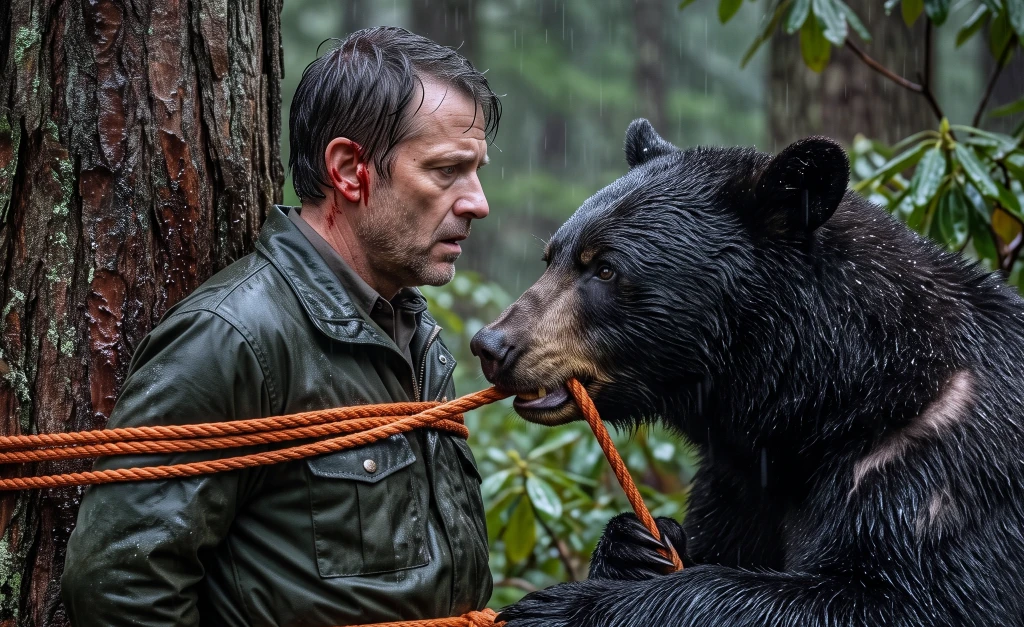
Leaves shifted downhill. A black bear stepped between the mountain laurels, close enough for Eli to see rain caught in the fur along her muzzle. She stood twenty feet away and tested the air while his blood, the bait, and the warm animal fear rising from his skin told her exactly where he was.
Eli stopped pulling.
His radio was gone. So were his phone, satellite messenger, and duty belt, with the sidearm, spray, handcuffs, and folding rescue knife he carried on it. Pain pulsed behind his left ear, and each shallow breath found a hard bright place beneath his ribs.
At forty-eight, after more than two decades as a Tennessee Wildlife Resources Agency officer, he knew how rarely a black bear chose to attack a person. He also knew those reassuring numbers assumed the person could back away.
Eli could not turn around the tree.
The bear lowered her head and came forward. She was an adult female, perhaps two hundred pounds, lean from nursing or a poor mast season. Her ears stood high and alert. One had a small notch near the tip, but Eli noticed it only as a field mark, the way training kept sorting details even while fear hollowed him out.
“Go on,” he said softly. “Nothing here for you.”
The lie sounded thin in the dripping woods. Her nose followed the scent on his coat. The bait mixture had dried tacky across his chest and one sleeve, sweet enough to draw insects and strong enough to travel through the Laurel Fork drainage.
Whoever poured it on him had understood bears, or thought they did. A picture broke loose in Eli’s mind: a white plastic jug tipped over his shoulder, a hand clamped at the back of his neck, a voice he had known since boyhood saying, almost apologetically, Hold still.
Then darkness again. The bear closed half the distance.
East Tennessee folded steeply around them, ridge after ridge darkening beneath a low October sky. They were deep inside Cherokee National Forest, above an old logging trace that had not appeared on public maps in years. Laurel Fork ran somewhere below, hidden under rhododendron and the steady hush of water over stone.
Chance foot traffic was unlikely in that hollow, and no vehicle should have been beyond the locked Forest Service gate.
Eli had come because of a photograph sent from an unregistered number at 2:13 that afternoon. It showed a bait barrel chained to a tree and, behind it, the pale curve of a cable disappearing into brush. The sender had added five words: They are back up Laurel.
He had forwarded the image and coordinates to dispatch before driving in. At least he thought he had. The last mile had offered no signal, and he could not remember seeing the message marked delivered.
He remembered parking at the washed-out trace. He remembered fresh boot marks, cracked corn mashed into mud, and the greasy smell that now covered his coat.
After that came pieces.
A rifle bolt closing behind him. A familiar voice saying, You should have stayed in the truck.
Another voice, unsteady and nearer his right shoulder: This was not what we agreed to.
Then the first blow.
The black bear reached the hemlock. Eli lowered his eyes without losing sight of her. Her front claws were made for climbing and tearing rotten wood, curved and black beneath mud-dark paws. She sniffed his boot, moved along his leg, and stopped where the bait had soaked his sleeve.
Her muzzle touched the fabric.
Every muscle in him went rigid.
The bear opened her mouth and caught the loose cuff between her front teeth. She tugged once. Cloth pulled tight along Eli’s shoulder, and the rope around his chest bit deeper.
He made a sound before he could stop it.
She released the coat and jumped back two strides. Her jaws closed with a soft click. For several seconds she stared past him into the trees, not frightened enough to flee and not settled enough to approach again.
Eli drew air through his nose. “That hurt,” he whispered. “So let’s not do that twice.”
The bear’s ears turned toward his voice. Then her attention dropped to the rope crossing his upper arm.
The line had come from a hunter’s hauling rig, thick enough to drag a carcass and roughened by years of sap and dirt. Grease had soaked into it. When the bear nosed the braid, the fibers rasped against Eli’s coat.
She hooked one paw over the rope and pulled down.
The force drove his spine into the hemlock. Pain flared behind his eyes, but something near his right shoulder snapped—a single strand, not the line. The bear swiped again, claws scraping bark, and opened a tuft of orange fibers.
It was not rescue. Eli would not call it that.
She was investigating a concentrated food scent. The rope moved when she touched it, and movement invited another touch. Whatever purpose Eli saw in her actions belonged to him, not to the animal.
Still, the pressure over his ribs changed.
He worked his right elbow, gaining less than an inch. It was enough to let him fill the bottom of his lungs.
The bear bit the damaged rope and leaned back.
Eli clenched his jaw. The line compressed his chest, dragged across his shoulder, then gave with a dry tearing sound. One loop slipped from high on his ribs to the crook of his arm.
She let go and shook her head, grease and fibers unpleasant in her mouth. Then a cry came from the rhododendron.
It was high, breathless, and unmistakably young. The bear wheeled so fast that wet leaves flew behind her. She rushed toward the thicket, stopping at its edge with her head low and her shoulders bunched. The cry came again, followed by the metallic scrape of cable over stone.
Eli forgot his own breathing. A cub was trapped in there.
He twisted against the hemlock, trying to see beyond the glossy leaves. The loosened loop allowed him to turn a few degrees farther than before. He caught a flash of cinnamon-black fur near the ground, then a sapling bending under sudden strain.
Cable rasped again.
The mother pushed into the rhododendron. Branches shook around her back. A cub squealed, and she retreated at once, circling to another opening rather than crowding whatever held it.
Eli knew that sound. Cable restraints were quiet, cheap, and easy to hide. Some cable snares had limited legal uses for furbearers under tightly controlled conditions; this was not one of those sets.
No legal device belonged beside an illegal bait barrel in a closed hollow. The bear came back into view, agitated now. She paced three steps, turned, and paced them again. Twice she reached toward the thicket and stopped when the cub fought the line.
“Easy,” Eli said, though the word was useless to both of them. She looked toward him.
For the first time, he saw her broadside.
Wet black fur lay flat over her left shoulder. Through it ran a pale crescent, beginning near the top of the shoulder blade and curving forward toward her chest. The scar was old, the hair along its edge grown thin and silver-gray.
The small tear near the tip of her ear suddenly belonged to the same memory: a temporary tag had pulled free during her first year after release. Six years vanished.
A younger bear lay sedated beneath a blue tarp while rain struck an abandoned apple shed outside Hampton. A torn cable had cut through the left shoulder but missed the artery by less than a finger’s width. Eli had knelt in red mud beside the agency veterinarian, holding a light steady while the wound was cleaned.
The bear had been entered in the report as Female 17-B. At the rehabilitation center, staff needed something easier than the number, so Cedar became their private working name during authorized handling. Eli had spoken it during sedated exams and once beside the open release crate, but it never appeared on a public sign or social-media post.
He had never fed her or pretended that being present at her release made any part of her his. He had seen her only twice afterward, both times on trail-camera images miles apart. Now she stood in front of him with a cub crying behind her.
“Cedar?” he said. The bear went still.
Her head lifted. The effect was so immediate that hope surged before Eli could stop it, but he forced the feeling back. She might have reacted to a remembered sound, or only to tone, movement, and a new disturbance in an already dangerous clearing. Recognition was a story people told when uncertainty made them lonely.
The cub cried again.
Cedar turned away and plunged to the edge of the thicket. She pawed at the ground, tore loose a mat of roots, then recoiled when the cable rang against stone. The cub’s cries broke into short, exhausted grunts.
Eli pulled against his wrists. “If I can get loose,” he said, “I can see the set.”
Cedar stood over the opening, sides moving quickly. She could not understand the sentence. But when Eli strained, the hauling rope rubbed loudly around the hemlock.
Her head snapped toward the sound.
He stopped.
She crossed the clearing in a low, swift line, coming around the right side of the trunk where his bound hands were hidden. Eli could not see her anymore.
He heard her sniff the rope behind him. Hot breath moved across his numb fingers. His body begged him to jerk away, but the tree and the knots left no place to go. Teeth closed on the line between his wrists and the bark. Cedar pulled. The knot moved…
To read the rest of the story – CLICK the NEXT button 👇👇👇