


The first dog left his handler at 2:17 in the morning. Rook, a black Belgian Malinois with a pale scar crossing his muzzle, pulled free during the final rehearsal for Chief Petty Officer Benjamin Maddox’s memorial. He crossed the receiving bay without running, stopped beside the flag-draped casket, and lowered himself to the floor facing the door. Sable followed. Then Mako. Within seven minutes, all twelve dogs selected for the honor detail had abandoned their assigned positions and formed a tight ring around the casket.
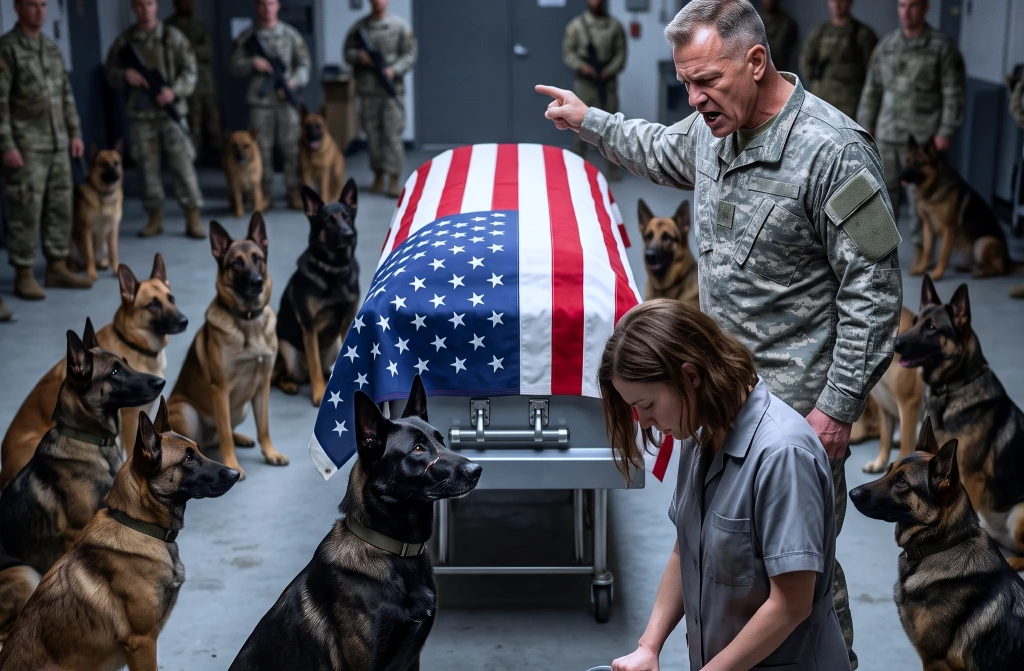
By sunrise, no one could persuade them to leave.
“They’ve had six hours to make their point,” Master Chief Gavin Rourke said. “The service begins at eleven. Move them.”
Petty Officer First Class Matt Pritchard stepped to the edge of the circle with a leash in one hand and Rook’s rubber training ball in the other. He had worked military dogs for thirteen years and carried himself with the confidence of a man who had never given an order twice.
“Rook. Heel.”
The Malinois did not look at the ball.
“Rook, heel.”
This time, the dog raised his head. His ears came forward, and a low warning rolled through his chest.
The other eleven dogs lifted their heads with him.
Pritchard stopped. He had faced frightened dogs, injured dogs, and dogs still running on combat adrenaline after an extraction. This was different. None of them looked confused. None appeared out of control. They watched him with the cold concentration of a team protecting a position.
He slowly placed the ball on the floor and backed away.
Lieutenant Commander Peter Lawson glanced at the clock above the reinforced observation window. “The funeral detail needs the casket at the chapel by nine-thirty.”
“I’m aware of the schedule,” Rourke said.
“We could move the casket with them around it.”
“And let twelve operational dogs escort it through a crowd of three hundred people without handlers?” Rourke shook his head. “No.”
The casket had arrived from Dover shortly before midnight. Maddox had been declared dead eighty-seven days earlier, but the location of his final assignment and the delay in recovering his remains had kept the return private. Even now, most of the sailors gathering for the memorial knew only that he had died during a classified overseas operation.
The dogs knew more.
Maddox had helped select or train every animal in the room. Some had deployed with him. Others had learned their first search patterns from his hands and voice before being assigned to younger handlers. The twelve had been brought together as a living honor guard for the man who had shaped the program.
No one had anticipated that they would appoint themselves guardians of his body.
The side door opened, and a custodial cart rolled into the bay with one wheel squeaking at every turn.
The woman pushing it wore a faded gray uniform, rubber-soled shoes, and a contractor badge identifying her as Hannah Reed. Brown hair hung loosely around her face. She kept her shoulders rounded and her gaze lowered, as if apologizing for the space she occupied.
Rourke turned on her before she had crossed the threshold.
“This area is closed.”
She stopped. “The sanitation roster says this building has to be cleared before the memorial, Master Chief.”
“The roster changed.”
“No one notified our supervisor.”
“I’m notifying you now.” Rourke pointed toward the hallway. “Take the cart and go.”
Her fingers tightened around the handle, though her voice remained soft. “Yes, Master Chief.”
She began turning the cumbersome cart. As she did, a bottle shifted on the upper shelf and struck the metal rail with a quiet click.
Rook’s head snapped toward the sound.
The woman froze.
For one suspended second, the dog and the custodian stared at each other across the room. Rook’s nostrils flared. The tension left his ears, and the tip of his tail touched the floor once.
Only once.
Then he placed his head back on his paws.
Dr. Lena Ortiz, the civilian veterinarian standing beside the observation window, saw it. So did the woman.
Rourke did not. He was already arguing with Lawson about whether the regional canine behavior team could reach Dam Neck before the service.
Hannah Reed pushed her cart into the corridor and allowed the door to close behind her. She continued until she reached the blind corner beside the supply room. There, hidden from the bay cameras, she stopped and pressed both palms against the cart.
Her husband was lying twenty yards away.
For eighty-seven days, Claire Maddox had lived under a fabricated name, cleaned offices after midnight, and endured conversations that stopped only when men remembered the custodian was still in the room. She had emptied the trash of officers who had signed Benjamin’s casualty report. She had polished the floor outside the secure communications suite. She had listened while sailors repeated the official account of an enemy assault that the satellite logs said had never occurred.
She had learned to become forgettable because forgettable people were allowed near doors that remained closed to everyone important.
The disguise had worked until Rook smelled her.
Claire shut her eyes. She could still remember the night she and Ben had brought the Malinois home from the training kennel during a thunderstorm. Rook had been nine months old, underweight, and too suspicious to sleep. Ben had stretched out on the kitchen floor beside him. Claire had joined them, and the three had remained there until morning.
Now Ben was inside a steel casket, and the dog they had raised together was guarding him from the world.
She wanted to return to the bay. She wanted to kneel beside Rook, place her hand on the flag, and stop pretending she was someone who had no right to grieve.
But she was not finished.
Benjamin’s murder had required more than one frightened traitor with access to a weapon. Someone had altered the duty logs. Someone had suppressed the first ballistics report and replaced it with a combat-loss summary. Someone with considerable authority had delayed the return of his remains while evidence disappeared from three separate systems.
Claire had identified one man involved. She still did not know who controlled him.
If she exposed herself before finding that answer, the people behind Benjamin’s death would close ranks. Eighty-seven days of silence would be wasted.
She opened her eyes, straightened the bottles on the cart, and resumed walking with the small, weary steps expected of Hannah Reed.
Inside the bay, Dr. Ortiz completed another slow circuit around the dogs. She remained outside the perimeter, watching their breathing, eye movement, and response to sound.
“They aren’t in distress,” she said. “They’re tired and thirsty, but they’re regulating themselves. This isn’t panic behavior.”
“What would you call it?” Lawson asked.
“A watch.”
Rourke exhaled through his nose. “Doctor, they’re refusing food, water, and direct commands.”
“They’re not refusing everything. They’re making choices.” Ortiz looked toward the door through which the custodian had disappeared. “And I think they’re waiting for someone.”
“The man they obeyed is inside that casket.”
“Ben wasn’t the only person who trained them.”
Before Rourke could answer, Senior Chief Joseph Navarro entered from the corridor. His dress uniform jacket hung over one arm, and grief had deepened every line in his weathered face. He had served beside Maddox on three deployments and had argued against using force from the moment the standoff began.
“She’s right,” Navarro said.
Rourke faced him. “You know who they’re waiting for?”
“No. But Ben used to mention a second handling protocol. Commands that weren’t included in the regular program.”
“Whose commands?”
“He never said.” Navarro looked at Rook. “Once, after a bad extraction, I heard him tell the dogs, ‘If I don’t make it back, hold for Echo.’ I thought it was just a contingency call sign.”
Ortiz studied him. “Did the dogs understand?”
“Every one of them went still.”
The room quieted.
Outside, vehicles carrying memorial guests had begun entering the annex. A news crew waited beyond the main gate to cover the military honors, unaware of the standoff inside the receiving bay. The chapel staff called twice. Each time, Lawson promised that the casket would arrive shortly.
At 8:36, three black government vehicles pulled beside the building.
Rear Admiral Rebecca Shaw entered without an entourage, wearing service dress blues and an expression that discouraged ceremony. She listened to Lawson’s report, asked whether anyone had been bitten, and immediately rejected the suggestion of sedation.
Then she stood before the circle and studied the dogs.
“Show me the security footage from the moment they entered,” she said.
Lawson brought the recording up on a wall monitor. Shaw watched Rook leave his handler, cross the bay, and take position. She watched the remaining dogs follow in an order that appeared almost rehearsed.
“Go forward,” she said.
Lawson advanced the footage.
“Stop.”
The image showed Hannah Reed turning her custodial cart near the door. Rook’s face was visible in profile.
“Play it at half speed.”
The bottle struck the rail. The dog raised his head. His tail moved.
Shaw stepped closer to the screen. “Who is that woman?”
“Civilian custodian,” Rourke said. “She’s been assigned here for about three months. I’ve already removed her from the area.”
The admiral turned sharply. “You did what?”
“She had no authorization to be inside the bay.”
“Get me her personnel file.”
Lawson left and returned twelve minutes later with a tablet. “Her contractor credential is valid, ma’am, but the rest of the record is strange. The background verification was approved through a federal override. There’s no underlying investigative report attached.”
Shaw scrolled through the file.
“Hannah Reed,” she read. “Thirty-eight. Previous addresses in Wyoming, Maryland, and North Carolina.” Her eyes narrowed. “No school records. No credit history before twelve years ago. No medical claims. No relatives.”
“A manufactured identity?” Navarro asked.
“A very good one.”
Shaw entered a longer authorization code, followed it with a biometric scan, and opened a system no one else in the room had clearance to see. For several seconds, she read in silence.
Then a different photograph appeared.
The woman in it had the same face as the custodian, but none of the submission in her posture. Her hair was pulled tightly away from her eyes. She wore field gear and stood beside a younger Rook, one hand resting on his harness. Benjamin Maddox stood at her shoulder.
Navarro moved closer to the screen. “Who is she?”
Shaw looked toward the closed door.
“Her name is Claire Maddox. Echo was her operational call sign. She helped build the advanced canine program Ben served in, and she trained six of the dogs in this room herself.”
Rourke stared at the photograph. “Maddox?”
The admiral’s expression hardened.
“Benjamin’s wife.”
No one spoke.
“His file said there was no immediate family,” Lawson finally said.
“His public file said that. Their marriage was sealed under the same special-access program that protected their assignments.” Shaw handed the tablet back to him. “She disappeared from official channels the day the preliminary report on his death was issued. Apparently, she disappeared into our janitorial staff.”
Navarro looked at the motionless dogs and understood before anyone else did.
“They knew she was here.”
“They’ve known all morning,” Ortiz said.
Shaw turned to Navarro. “Find her. Go alone, and don’t approach her with security personnel.”
“What should I tell her?”
The admiral looked at Rook, still holding his place beside the flag.
“Tell her he’s waiting.”
Her gaze moved over the twelve exhausted animals, then settled on Benjamin Maddox’s casket.
“They aren’t defying us, Senior Chief. They’re holding the line until his wife gives them permission to stand down…”
To read the rest of the story – CLICK the NEXT button 👇👇👇