


At 7:12 on a gray October morning, twelve military working dogs stopped obeying the United States Navy. The first refusal belonged to Rook. The black Belgian Malinois had been brought into the secure ceremonial bay alone, his leash held by Petty Officer First Class Luis Mendoza. The visit was supposed to last five minutes—a private scent farewell before Chief Petty Officer Daniel Quinn’s casket was transferred to the chapel.
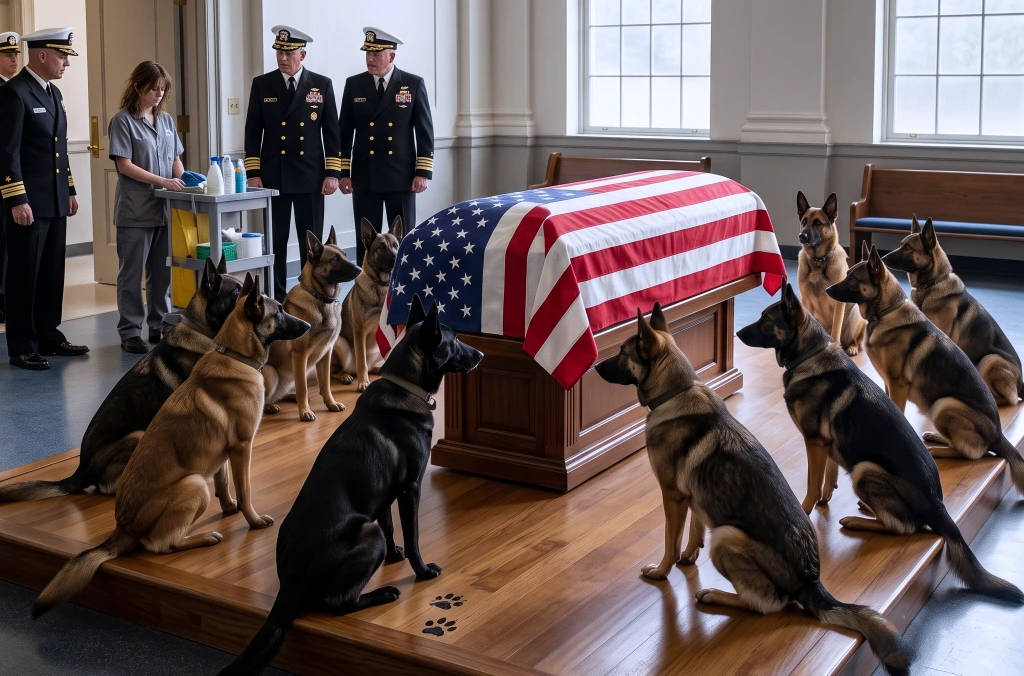
Rook walked directly to the flag-draped casket, lowered his nose to the polished wood, and stood there breathing in the scent of the man who had once been his handler.
Then he lay across the path of the pallbearers.
Mendoza gave the heel command. Rook looked at him and stayed where he was.
He tried again, first in English and then with the hand signal Rook had followed through gunfire, helicopter wash, and two overseas deployments. The dog did not move.
When Mendoza stepped forward to take his collar, Rook raised his head and released a low warning growl.
He did not lunge. He did not bare his teeth. The message was controlled and unmistakable: Do not touch him.
The second dog brought in was Juno, a sable German Shepherd who had worked beside Quinn during hostage-recovery training. She sniffed the casket, circled once, and lay down opposite Rook.
Then came Mako. Sable. Boone. Echo.
By the time the twelfth dog entered, the handlers understood that the farewell had become something else. The dogs settled shoulder to shoulder in a rough ring around the casket, their leads trailing across the tile. Each faced outward. Each watched a different entrance or section of the room.
They had formed a perimeter without being told.
Master Chief Owen Garrison stood beyond it, his coffee cooling untouched in his hand. He had supervised working-dog teams for fourteen years and had seen fear, handler aggression, separation anxiety, and grief. He had never seen twelve independently trained animals make the same decision at once.
“Mendoza,” he said, “call Rook off again.”
“I’ve been calling him for six minutes, Master Chief.”
“Then make him hear you.”
Mendoza drew a slow breath. “Rook. Heel.”
One dark ear angled toward him. That was all.
Garrison set down the coffee and approached until he reached the invisible boundary the dogs had established. Rook rose. Around the casket, eleven other heads lifted with him.
A growl passed through the room—not loud, but layered, twelve chests producing a single vibration that Garrison felt through the soles of his boots.
He stopped.
Behind him, Commander Grant Ellis glanced at the wall clock. “The funeral detail needs the casket at the chapel by ten-thirty.”
“I’m aware of the schedule, sir.”
“The family service begins at one. We have personnel arriving from three states, and Rear Admiral Shaw is already on her way.”
Garrison kept his eyes on Rook. “Then we have three hours to remind these dogs how the chain of command works.”
Near the open service door, a mop bucket struck a metal threshold with a soft clang.
Everyone turned.
A small woman in a faded gray contractor’s uniform stood behind a cleaning cart. Her temporary badge read NELL BROOKS. Brown hair hung loose around her face, hiding most of her expression. She had worked the graveyard custodial shift for nearly three months, long enough to become part of the building’s background: the woman who emptied trash cans before dawn and disappeared whenever officers entered a hallway.
Garrison’s frustration found the easiest available target.
“This bay is restricted,” he said. “Your supervisor was told to keep all civilian staff outside the cordon.”
“I was assigned the east corridor,” she answered quietly.
“Then clean the corridor. Not this room.”
Lieutenant Aaron Price, the unit’s assistant operations officer, looked at the mop and gave a humorless smile. “Unless that bucket comes with a release command.”
One of the younger handlers let out a brief, nervous laugh.
The woman did not react. She lowered her eyes, pulled the cart backward, and turned toward the hall.
As she moved away, Rook’s posture changed.
His ears came forward. His nose lifted, testing the air beneath the smell of floor cleaner, coffee, and damp uniforms. Then his tail touched the tile once.
A single, deliberate thump.
Senior Chief Caleb Donovan saw it. So did Commander Ellis.
Everyone else was watching the clock.
The woman paused with one hand on the cart. For half a second, her fingers tightened around its plastic handle. Then she continued down the corridor without looking back.
Rook lowered himself beside the casket again.
“What was that?” Ellis asked.
Garrison glanced at him. “What was what, sir?”
“Nothing,” the commander said, though his eyes remained on the empty doorway.
Outside the bay, Nell Brooks pushed the cart into an alcove and stopped. She removed a cloth from the top shelf and wiped the same clean patch of plastic three times. Her breathing had gone shallow, but she controlled it with a practiced count—four seconds in, six seconds out—until her hands became steady again.
Bootsteps passed at the far end of the corridor. She bowed her head and waited for them to fade.
Then she placed the cloth neatly beside the spray bottles and listened to the dogs guarding the dead man twenty yards away.
Inside, Garrison tried each assigned handler in turn. They used familiar voices, favorite toys, food rewards, and individual recall cues. Two dogs acknowledged their handlers with a glance. None crossed the perimeter.
When a pair of sailors attempted to roll the casket toward the side door, Rook and Juno stood simultaneously. The sailors released the cart before either dog had to warn them.
At eight-ten, Dr. Lena Ortiz arrived from the installation veterinary clinic. She listened to a rapid briefing, set her medical bag beside the wall, and spent several minutes studying the dogs from outside their boundary.
“They aren’t panicking,” she said. “Their breathing is elevated, but appropriate. No uncontrolled pacing, no redirected aggression, no confusion.”
“One of them threatened a handler,” Garrison replied.
“Rook warned Mendoza because Mendoza crossed the line. If he intended to bite him, we wouldn’t be discussing it.”
Commander Ellis folded his arms. “Then what are they doing?”
Ortiz watched Juno reposition herself when a sailor passed behind the casket. “Maintaining a watch.”
“No one gave them that command.”
“I know.”
Price stepped forward. Rook immediately tracked him with his eyes.
“If this is grief behavior,” Price said, “we can sedate them one at a time, move the casket, and let them recover in the kennels.”
“No,” Ortiz said.
“We don’t have the luxury of sentiment, Doctor.”
“This isn’t sentiment. Sedation is a medical intervention, and there is no clinical reason for it. Trying to inject twelve defensive dogs in a confined room would also turn a controlled situation into a dangerous one.”
Price’s jaw tightened. “So your recommendation is that we let them cancel a military funeral?”
“My recommendation is that we understand the behavior before we punish it.”
Senior Chief Donovan had remained near the back wall, silent since the standoff began. He had served with Daniel Quinn before Quinn transferred into the specialized canine program. Eleven weeks earlier, Donovan had been the officer who took the encrypted call reporting that his friend had died at an overseas staging site. Quinn’s remains had reached Virginia only two nights ago after weeks of diplomatic delays and classified reviews.
Now Donovan studied the dogs his friend had helped train.
“Daniel used to call it holding the line,” he said.
Garrison turned. “What?”
“If a handler went down during an extraction, the dog stayed with him until an authorized person gave the release. Daniel built variations of that protocol into the advanced course.”
“These dogs have twelve different handlers.”
“They all worked under Daniel’s program.”
Ortiz looked from the casket to Donovan. “How many people were authorized to release them from that kind of hold?”
Donovan hesitated.
“Senior Chief?” Ellis pressed.
“Two,” he said at last. “Daniel—and the person who developed the program with him.”
Garrison stared at him. “Who was the second trainer?”
“I never met her. Most of that unit was compartmented.” Donovan’s voice softened. “Daniel mentioned her once after Rook was wounded. Said she slept on the kennel floor beside that dog for six nights because he wouldn’t settle for anyone else.”
Ortiz looked toward the corridor where the custodian had disappeared.
Price gave a sharp exhale. “We’re building a theory around a tail movement and a story from years ago. Quinn is dead, and whoever this mystery trainer was clearly isn’t here.”
At the sound of Price’s voice, Rook’s gaze shifted to him again.
The lieutenant noticed. “That dog has been unstable since he came back.”
“Rook has never been unstable a day in his life,” Donovan said.
The two men held each other’s eyes until Commander Ellis stepped between them.
“That’s enough. Master Chief, keep the room secure. Doctor, monitor the dogs. Nobody attempts contact without your approval.”
He left the bay and walked directly to the security office.
The camera above the east corridor had recorded the custodian’s arrival. Ellis replayed the footage twice. On the second viewing, he slowed it down.
Nell Brooks stood in the doorway. Garrison dismissed her. She backed away.
Rook lifted his head before she moved.
The dog had recognized her scent the instant the door opened.
Ellis asked the security chief for her personnel file. It appeared ordinary at first: a valid contractor identification, completed background screening, no disciplinary reports. Then he reached the installation-access authorization.
The sponsor field was locked.
Not blank. Locked behind a federal compartment the commander of the installation was not cleared to open.
“Who approved her badge?” Ellis asked.
The security chief shook his head. “The credential came through an inspector-general channel. I can’t see the originating office.”
“Has she ever entered the kennel wing?”
“According to the logs, no. She cleans the exterior corridors and administrative spaces. She has avoided the secured animal areas since the day she arrived.”
That detail troubled Ellis more than an unauthorized entry would have. An ordinary custodian would not know enough to avoid every camera, access point, and restricted threshold so precisely.
At nine-five, Rear Admiral Evelyn Shaw arrived ahead of schedule.
She entered without an entourage, removed her rain-darkened coat, and went straight to the ceremonial bay. The room quieted as she stepped inside.
Shaw did not demand that the dogs be removed. She walked the outer edge of their formation, studying each animal before stopping in front of Rook.
“Daniel’s primary dog,” she said.
“Yes, ma’am,” Donovan answered.
Rook watched her but remained silent.
Shaw’s face tightened when she looked at the flag over the casket. She had approved Quinn’s final deployment. She had also signed the sealed casualty report that explained his death in three carefully worded paragraphs.
“Who has entered this room since the dogs took position?”
Garrison listed the handlers, officers, veterinary staff, and funeral personnel.
Commander Ellis added, “A member of the custodial crew paused at the door.”
Shaw turned. “Show me.”
They viewed the security recording in Ellis’s office. The admiral watched it once at normal speed and again frame by frame. When Rook’s tail touched the floor, she leaned closer to the screen.
“What name is she using?”
“Nell Brooks.”
“Using?”
Ellis placed the restricted file in front of her. “Her access sponsor is concealed behind an inspector-general compartment.”
Shaw’s expression changed.
She took the secure phone from his desk and asked both men to leave. The call lasted eleven minutes. When the office door reopened, her face had lost all color, but her voice remained controlled.
“Find Senior Chief Donovan. Bring him here alone.”
Donovan arrived moments later. Shaw locked the door behind him and turned the computer monitor so he could see a photograph.
The woman in the image had the same face as Nell Brooks, but nothing else about her looked small or tired. Her hair was pulled back. Her posture was straight, her eyes direct. Beside her stood Daniel Quinn, one hand resting on Rook’s shoulders.
Donovan stared at the photograph. “Who is she?”
“Her real name is Mara Quinn. She was the senior field trainer attached to Daniel’s interagency canine program. The two of them designed the shared-release protocol these dogs are using now.”
“Quinn?”
“They were married for six years.”
Donovan looked toward the wall as if he could see through it to the woman pushing a cleaning cart in the east corridor. “Daniel’s wife has been working here as a janitor?”
“Her cover is part of a compartmented investigation into the circumstances of his death. Until twelve minutes ago, I wasn’t authorized to know she was on this installation.”
“But the dogs knew.”
“Yes,” Shaw said. “They knew the moment she opened that door.”
Donovan’s throat tightened. “What do you want me to do?”
“Find her.”
“What should I say?”
The admiral looked toward the ceremonial bay, where twelve dogs were still guarding Daniel Quinn’s casket from everyone except the woman they had recognized.
“Don’t use the name on her badge,” Shaw said. “Tell Mara that Rook is still holding the line for Daniel.” Donovan stood motionless. “And if she asks who sent me?” “Tell her the dogs did.” He reached for the door, but Shaw stopped him with one final sentence. “Bring her to her husband, Senior Chief. They have all been waiting long enough…”
To read the rest of the story – CLICK the NEXT button 👇👇👇