


The light above Room 418 clicked twice, paused, and clicked again. After eleven weeks in the pediatric intensive care unit at Riverside Regional Medical Center, Mara Ellison knew every version of that sound. Damp weather lengthened the pause. When the heat came on, the fixture added a brittle buzz that traveled through the ceiling and settled behind her eyes.
A maintenance worker had listened to it three weeks earlier. He wrote something on a clipboard, said the ballast probably needed replacing, and promised someone would return.
No one had.
Mara sat beside her son’s crib in a vinyl chair whose padding had given up before she did. A metal support pressed into the back of her thigh. She wore a faded denim jacket over a gray sweatshirt because the unit always felt cold, whatever the thermostat claimed.
Inside the crib, six-month-old Noah lay beneath a web of tubing. He had been born fourteen weeks early, small enough that Mara’s wedding ring had once slipped past his elbow. His lungs had never caught up. A soft mask pushed humidified air into him while a feeding tube disappeared beneath the tape along his cheek.
Sensor wires translated his body into green numbers and measured beeps. Mara had learned not to stare at those numbers. She stared anyway.
Noah’s right hand rested near his face, his fingers loosely curled. Mara reached through the access opening and touched one knuckle.
“I’m here,” she whispered. “You don’t have to look for me.”
His eyelids did not move.
Across the room, the ventilator sighed. Above it, the light clicked twice, waited, and clicked again.
Noah’s father had stopped coming in September. At first Evan blamed his supervisor, then the drive, then the parking fees. After that came messages sent after midnight: I can’t breathe in that place. I don’t know how you do it. The last one had arrived seventeen days ago.
Mara had left it unanswered.
There was no energy left for a fight with Evan. There were bills, careful messages from the diner manager about her return date, and unopened envelopes on the kitchen counter. None of them felt real inside Room 418. The only thing that felt real was the rise of Noah’s chest.
The door opened, and Ruth Bell came in carrying a tablet and a paper cup that smelled of scorched coffee. Ruth had worked pediatric critical care for thirty-one years. She checked lines and pumps in the same order every time and usually found something small to complain about while she did it.
That morning, she said nothing.
Mara watched her face. “What changed?”
Ruth kept her eyes on the monitor. “Dr. Reyes is coming.”
“That isn’t what I asked.”
Ruth adjusted the blanket beneath Noah’s arm. Then she set one hand on Mara’s shoulder and left it there.
Dr. Samuel Reyes arrived ten minutes later. He normally entered while reading, talking, and washing his hands at once. Today he closed the door first, pulled over a stool, and sat facing Mara.
Her mouth went dry.
“We repeated the kidney panel,” he said. “It’s worse.”
Mara folded her arms across her stomach. “How much worse?”
“Enough that I don’t want to keep giving him the same medications.”
“The antibiotics?”
“The antibiotics and the anti-inflammatory drug. His body is under too much stress.”
“You said the infection was resistant.”
“That was the best explanation we had. His cultures haven’t supported it as clearly as I expected.” Reyes rubbed his thumb along the edge of his badge. “More treatment could add to the kidney injury.”
Mara looked at Noah. “So you’re stopping?”
“We’re stopping the drugs that may be hurting him. We’ll continue respiratory support, fluids, nutrition, pain control—everything he needs to stay stable and comfortable.”
“And then?”
Reyes did not reach for Noah’s chart.
“I’ve asked palliative care to meet with us.”
The word landed softly. That made it worse.
Mara had heard it during Noah’s first week, when a social worker explained that palliative care did not always mean the end. It meant comfort, goals, and honest conversations about what medicine could do. Today it sounded like permission to stop hoping.
“No.”
“Mara—”
“You don’t get to decide he’s done because your medicine didn’t work.”
“I’m not saying he’s done.”
“You brought in palliative care.”
“Because he may be suffering, and because you need choices that are honest.” Reyes leaned closer. “I’m still looking for another explanation. I can’t promise there is one.”
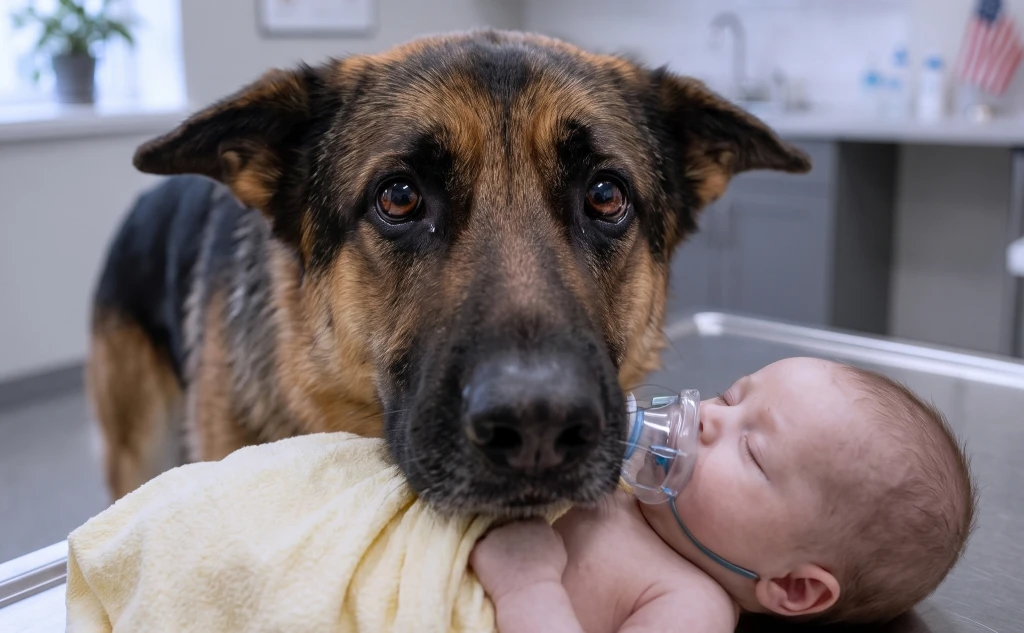
Noah’s monitor changed rhythm. Mara turned, and the alarm settled before Ruth had to touch anything. A memory came with painful clarity: Noah three weeks into the admission, awake for nearly an hour, his hand tangled in the fur behind Scout’s ear.
Scout was an aging German shepherd who belonged to Daniel Mercer, a retired county fire captain and urban-search handler. After an injury ended Scout’s disaster work, Daniel had retrained him for Riverside’s animal-assisted care program. The dog never climbed onto beds or licked faces. He waited where Daniel placed him and seemed content to share a room without demanding anything from it.
With Noah, Scout always stood first.
Daniel would set a low platform beside the crib. Scout placed his front paws on it and rested his chin near the mattress. Noah’s scattered heart rate eased. Sometimes his eyes opened.
Then Riverside suspended the program during an insurance and staffing review.
“Bring Scout back,” Mara said.
Reyes blinked. “What?”
“Once. Let Noah see him once.”
“The program is suspended.”
“I know.”
“And Noah is more vulnerable now. Infection prevention may refuse.”
“He was calmer with Scout.”
“He was. I remember.”
“Then ask.”
Reyes glanced at Ruth. “I’ll take it to Dr. Keene.”
“Today.”
“Today.”
Dr. Lauren Keene came before noon. She was Riverside’s chief clinical operations officer, a pediatrician who had moved into administration years earlier. Mara knew her from hallways: dark suits, quick steps, a face that rarely showed how much sleep she had missed.
Keene remained standing.
“Dr. Reyes explained your request,” she said. “I’m sorry, Ms. Ellison. I can’t approve it.”
“Did infection prevention review Scout’s records?”
“The program has no current inpatient coverage. An exception would place the nurse, the handler, and the hospital outside the approved protocol.”
“He’s vaccinated. He’s groomed. He’s been in this room before.”
“Under the old protocol.”
“Noah may be dying.”
Keene looked at the crib. A small movement crossed her face before her expression settled again.
“I understand why you’re asking.”
“Do you?”
Keene took a breath. “Tomorrow the Hartwell Family Foundation is touring the unit. Their grant could replace respiratory equipment and fund three clinical positions. We have beds we cannot open because we don’t have enough staff to use them safely.”
Mara stared at her. “So this is about a tour.”
“It’s about a unit serving children from six counties.”
“My child is in it.”
“So are eleven others.” Keene’s voice remained quiet. “I can’t suspend infection-control and liability rules for one family because the reason is heartbreaking.”
“You could ask the people who make the rules.”
“The ethics office can review a compassionate exception tomorrow afternoon.”
“He may not have tomorrow afternoon.”
Keene’s fingers tightened around the folder in her hand.
“I am sorry,” she said. “The answer is no.”
She left without looking at the light. By evening, Noah’s urine output had fallen again. Ruth moved through the room with a silence that told Mara she had seen the new results.
“You know Daniel Mercer,” Mara said.
Ruth stopped beside the sink. “I did when he volunteered here.”
“Can you call him?”
“I cannot give you his number.”
“I didn’t ask for it. Give him mine.”
Ruth studied her for several seconds, then picked up her phone. “I can do that.”
At 8:43, Mara’s phone rang.
A dog barked once in the background. A man’s voice followed, low and worn around the edges.
“Ruth says Noah needs Scout,” Daniel said. “Tell me what’s happening.”
Mara looked at her son. “The doctors think he may be dying.” Daniel was quiet just long enough for her to hear a leash buckle.
“I’ll be at the east entrance in forty minutes.”
Security would not allow Scout through the lobby. Ruth was off duty by then, but Nia Alvarez, the night nurse assigned to Noah, met Mara at the covered drop-off.
Daniel stood near the curb with Scout at his left side. He was taller than Mara remembered, with a close gray beard and a face weathered by years outdoors. Scout’s muzzle had gone white, and he favored one rear leg when he shifted his weight.
The dog recognized Mara. His ears rose, and he leaned once into her hands when she crouched beside him.
“He remembers Noah?” she asked.
Daniel looked toward the glass doors. “He remembers this place. I won’t pretend I know more than that.”
Nia held the door open a few inches. “Dr. Reyes knows you’re here. He didn’t authorize it.”
“Is he stopping us?” Mara asked.
“He said to call him if anything changes.”
Daniel did not move. “What happens to you if we go in?”
“I may be suspended.”
“And Mara?”
“Her visitation could be restricted.”
The fear Mara had kept outside the room came rushing back. She imagined a security guard deciding whether she could touch Noah. She imagined him dying while she sat downstairs.
Daniel watched her understand it.
“You can change your mind,” he said.
Mara looked at Scout, then through the doors toward the elevators. “No.”
Nia led them through a service corridor after the unit had settled. There was no elaborate plan. They took one elevator, passed one respiratory therapist who looked away, and reached Room 418 before Mara had time to decide whether courage felt any different from terror.
Daniel stopped at the threshold. “Five minutes. If Scout is stressed, we leave. If Noah’s breathing changes, we leave. No one moves a line.”
Mara nodded. Scout entered beside him.
The shepherd paused while Daniel set the familiar platform next to the crib. Then he placed his front paws on it and lifted his head until his muzzle rested near Noah’s mattress.
Noah’s eyelids fluttered.
“Hey,” Mara whispered. “Look who came back.”
His fingers opened against the sheet. After several seconds, they closed around a fold of fur near Scout’s ear.
Mara covered her mouth.
Scout stayed perfectly still. Noah’s heart rate eased by a few beats, then a few more. It was no cure, and Mara asked nothing else of the moment. Her son was awake. His hand was touching something warm.
Then Scout’s nose twitched.
He pulled away from Noah’s fingers and sniffed along the edge of the mattress. His muzzle followed the feeding tube to the pump and rose toward the hanging bag of pale fortified milk.
Daniel shortened the leash. “Easy.”
Scout inhaled sharply at the plastic seam, backed off, and sneezed. When Daniel guided him toward the crib again, the dog turned instead to the stainless-steel cabinet where the unopened feeding bags were kept.
He planted his feet. The low sound in his chest was unlike anything Mara had heard during his visits. Scout was no longer looking at Noah. He was staring at the feeding cabinet while the pale liquid in the hanging bag kept moving into Mara’s son…
To read the rest of the story – CLICK the NEXT button 👇👇👇