


The first word Daniel Mercer managed after thirty-six hours under sedation was not his wife’s name. “Bram?” The name scraped his throat raw. Machines hummed around him, and pale March sunlight lay across the intensive care room. Laura sat beside the bed in the same blue sweater she had worn the morning he left home. Her hair was pulled back carelessly, and there were shadows beneath her eyes Dan had never seen before.
Her fingers tightened around his hand, but she did not answer.
“Where is he?”
Dan tried to lift himself. Pain seized his chest, a monitor began protesting, and Laura pressed a palm carefully against his shoulder.
“Don’t. You were on a ventilator until yesterday.”
“Bram was with me.”
“I know.” She looked toward the window before making herself meet his eyes. “The rescue crew didn’t bring him in. Mike has been to the lake twice. Noah called every shelter in Crow Wing County. The sheriff’s office has his description. We’re looking.”
The words came to Dan through a fog. Rescue crew. Lake. Looking.
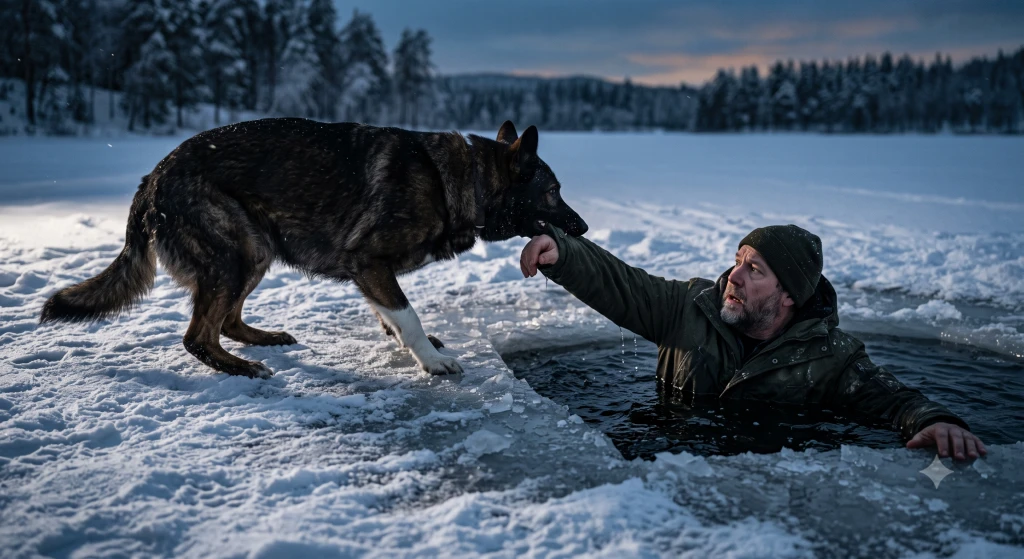
Then memory returned in broken flashes: black water swallowing the sky, ice crumbling beneath his gloves, Bram’s teeth locked in the sleeve of his parka. The dog had pulled until his paws slid toward the hole. Dan remembered shouting. He remembered Bram letting go.
And then he remembered the dog running away.
“He wouldn’t leave me,” Dan whispered.
Laura’s face changed. Relief was still there, fierce and exhausted, but so was anger.
“No,” she said. “He wouldn’t. That’s why he’s missing.”
Five years earlier, on a wet April morning at the same lake, Dan had heard a sound beneath a patch of thorny brush and almost walked past it.
He and Mike Donnelly had just backed the boat trailer toward the public launch at Alder Lake. Rain had fallen for three days, and the ground beside the marshy inlet had turned to black soup. Mike was complaining about the forecast when a thin cry rose beneath the dripping brambles.
“You hear that?” Dan asked.
Mike killed the truck engine. The cry came again, weaker this time.
They found the puppy ten yards off the path, sunk to his belly in mud. A length of green nylon cord was tangled around one hind leg and caught beneath a root. Every time he struggled, he drove himself deeper. His coat was so caked with muck that Dan could not tell what color he was, but one small front paw flashed white as it clawed uselessly at the bank.
“Easy, little man.” Dan crouched at the edge. “I’m coming.”
The mud took his boot to the ankle, then the calf. Mike grabbed the back of his jacket while Dan stretched forward. The puppy snapped once from fear, missed his hand, and gave a sound closer to a sigh than a growl. Dan cut the cord with his pocketknife, slid both hands beneath the trembling body, and pulled.
For one alarming second, the mud seemed determined to keep them both. Then the puppy came free with a wet sucking sound and collapsed against Dan’s chest.
They never put the boat in the water.
At the veterinary clinic in Brainerd, Dr. Patel cleaned half a dozen infected cuts and removed a sliver of wire embedded near the puppy’s left shoulder. The wound would leave a pale crescent-shaped scar. Dehydrated and underweight, he might have been ten weeks old. No collar, no chip, and no missing-dog report matched him.
“He may have wandered,” the veterinarian said. “Or somebody may have decided the lake was easier than a shelter. We may never know.”
Before the puppy went home, the clinic vaccinated and microchipped him.
Dan sat beside the warming kennel until the puppy opened his eyes. They were brown, but not the same brown: one was almost amber around the pupil. The dog lifted his white paw and placed it against the wire door.
That was the moment Dan knew he was not leaving alone.
Laura’s first response was practical. They already had two elderly cats, vet bills did not pay themselves, and Dan’s small heating-and-air business had just survived a thin winter. Noah, eleven then, listened from the kitchen doorway with his whole body leaning toward hope.
“Just until he gets well,” Laura said at last.
It was the kind of sentence families say shortly before changing their lives.
Noah named him Bramble because the thorn patch had tried so hard to keep him. Within a week it had shortened to Bram. He grew into a long-legged shepherd-and-retriever mix with a dark brindled coat, a white left forepaw, and an expression that made strangers think he understood more than he did.
He hated air brakes and heavy engines. The first time a garbage truck released pressure beside the house, he flattened himself under the porch steps and shook. Yet he loved Dan’s pickup, fishing mornings, and the blue foam pad Dan carried for him. He could sit beside a rod for an hour, tracking the line with solemn concentration, then ruin the dignity of the moment by trying to nose a crappie back into the lake.
He belonged to the whole family, not only to Dan. Bram waited outside the bathroom when Laura had the flu, slept across Noah’s doorway during thunderstorms, and learned every game the boy invented. His favorite was hide-and-seek. Noah would hold his collar while Dan or Laura hid, then release him with the words, “Find him,” or, “Find Mom.”
Bram always found them.
By the time Dan opened his eyes in intensive care, the dog had been beside the family through five Christmases, Noah’s first day of high school, Laura’s father’s funeral, and more ordinary evenings than anyone had thought to count. The empty place he left was not a gap in the house. It was a room of its own.
The morning of the accident had begun with a phone call at 5:17.
Mike sounded congested enough to be underwater. “I’m out. Fever, chills, the whole miserable package.”
Dan stood in the mudroom wearing insulated bibs, his tackle packed and coffee steaming in a travel mug. Three warm afternoons had softened the snowbanks, but the temperature had dropped below freezing overnight. He had checked the local ice report the evening before. Anglers had measured solid ice near the north access, and he had fished Alder Lake for twenty years.
Laura heard enough of the call to understand. “Then unpack.”
“I’ll check it from shore. If I don’t like what I see, I’ll come home.”
Noah looked up from the cereal bowl. “The county rescue page said late ice can be rotten even when it’s thick.”
Dan gave him the patient smile adults use when they believe experience has settled an argument. “I have ice picks, a spud bar, and a flotation suit. I’ll stay near the access. One hour.”
“Equipment doesn’t make bad ice good,” Laura said.
She was right, and some part of him knew it. But the truck was loaded, dawn was spreading pink behind the pines, and this would probably be his last ice-fishing morning of the season. Dan kissed her cheek and promised to text when he reached the lake.
Bram jumped into the truck, but at Alder Lake he would not leave it.
Dan set the blue foam pad on the snow and called him. The dog hopped down, sniffed the wind, then stared across the empty white surface. There were no other vehicles at the access. Meltwater had refrozen in glassy ribbons near shore, and the south wind carried the faint scent of wet earth.
“We’re not crossing the Arctic,” Dan told him. “Just the north cove.”
He tested each step with the spud bar. Near shore, the ice answered with the hard knock he expected. Farther out, the top inch had softened beneath a crust of refrozen snow, but the bar did not break through. Bram followed reluctantly, pausing every few yards to look back at the truck.
Sixty yards from shore, Dan stopped above a familiar drop-off. The lake was quiet enough that he could hear water moving somewhere beneath the ice. He should have turned around then. Instead, he told himself it was runoff near the inlet, several hundred yards away.
The auger bit too easily.
Dan had time to register the strange granular texture rising around the blade. Then a crack snapped beneath his right boot. The surface did not split cleanly; it collapsed into vertical crystals like a window breaking inward.
The water struck him hard enough to steal his breath.
His flotation bibs brought him back up, but cold shock locked his chest. He clawed for the ice picks hanging at his collar. One caught. The edge disintegrated when he pulled.
Bram came low across the surface, barking. Before Dan could order him back, the dog seized the sleeve of his parka and pulled. For one hopeful second, Dan’s shoulder rose above the water. Then the ice beneath Bram’s front paws cracked, and the dog’s white paw slid toward the hole.
“No! Back!”
Bram released him, circled, and lunged for the sleeve again.
Dan saw the ice bending under the dog’s weight. His hands were already losing feeling. If Bram went into the water, neither of them would get out.
“Find somebody,” Dan gasped. “Bram—go find!”
The dog held on for another second. Then his teeth opened. He backed away from the hole, turned, and ran toward shore. The last thing Dan saw before the white sky blurred above him was the dog he had once carried out of the mud racing away toward the road…
To read the rest of the story – CLICK the NEXT button 👇👇👇