


Forty-three minutes after a neuro-oncologist told Rebecca Caldwell that the treatment was no longer holding the tumor in her brain, she found a little girl on a park bench trying to warm a pregnant gray cat inside her coat. The temperature was six degrees. The girl’s father had wrapped most of his canvas jacket around them both. He sat curved over the child, taking the wind across his own back, one bare hand cupped around her purple mitten. The cat’s copper eyes stared out from beneath the girl’s chin. Its belly hung low, drawing tight every few breaths.
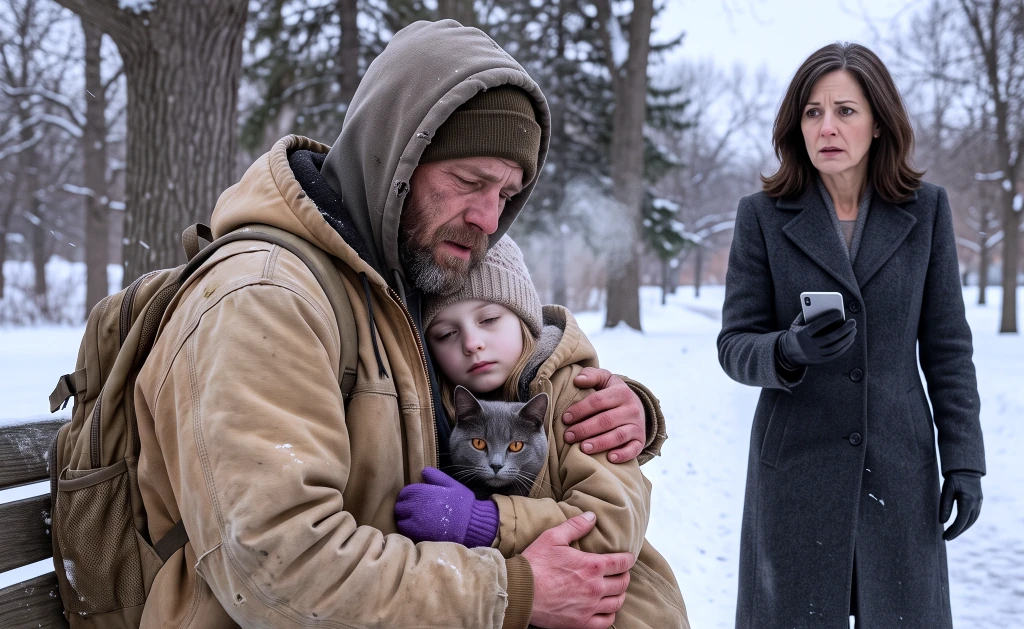
Rebecca almost kept walking. Not because she had failed to see them, but because for the past nineteen months she had trained herself to move through fear without letting it alter her schedule. Then the girl’s head rolled against the man’s shoulder. She was not shivering.
“Sir.” Rebecca stepped off the path into the drift around the bench. “Look at me.”
The man lifted his face. He was perhaps forty, with a week’s beard and the fixed, exhausted vigilance of someone who expected every stranger to tell him to leave.
“We’re going,” he said. “She just needed a minute.”
“What’s her name?”
His arm tightened. “Lily.”
“Lily, can you tell me whether your fingers hurt?”
The girl opened gray-green eyes. “They stopped.”
Rebecca took out her phone and called 911.
The man rose too quickly, pulling the child and cat against him. “Don’t call the police.”
“I’m calling an ambulance. Your daughter needs one.”
“They’ll separate us from Pepper.”
“Then we will make a plan for Pepper. But your daughter goes inside now.”
He studied Rebecca’s dark wool coat, her clean gloves, and the phone in her hand, trying to find the condition hidden inside the offer. She knew that look. At Caldwell Community Builders, she had seen it on tenants who had survived too many promises with clauses buried at the bottom.
“My name is Rebecca Caldwell,” she said. “The paramedics are coming. I will stay until we know where all three of you are going.”
The girl stirred against him. “Dad, Pepper’s shaking.”
The cat was not shaking. A contraction traveled beneath her gray coat and drew her body into a rigid curve.
Rebecca gave the dispatcher their location, then called Marcus Lee, who had dropped her near Kenwood Park after the appointment. While they waited, the man lowered himself onto the bench again and said his name was Owen Bennett. He was forty-one.
“How long have you been out here?” Rebecca asked.
“Forty minutes. Maybe an hour.” His voice was rough. “The county family line said an outreach van would come, but my phone died. The family shelter had no beds. The warming center is adults only, and the emergency foster list had no one for a pregnant cat. A borrowed van quit two blocks from here.”
“How long have you had the cat?”
“Two days. We found her in a taped carrier behind a grocery store. No tag, no chip. The animal shelter was full.” He looked down at Pepper. “Lily wouldn’t leave her. Neither would I.”
“Even with nowhere to sleep?”
His expression hardened. “Having nowhere to sleep doesn’t make it easier to leave something alive in a box.”
The words landed harder than he could have known. Folded inside Rebecca’s coat was the radiology report she had creased into quarters while Dr. Maya Patel explained that the pale flare on the MRI had reached beyond the old surgical cavity. Progression. Infiltration. Treatment resistance. Rebecca had spent nineteen months learning the language of grade 4 glioblastoma while chairing meetings, approving land purchases, and telling concerned employees, I’m doing well, thank you.
“The current regimen isn’t holding it,” Dr. Patel had said. “We’ll review trial options, but I don’t want to mislead you about what this scan means.”
Rebecca had asked how long she could keep working. The doctor had answered that a scan could not give an exact date. It was a humane answer and therefore no answer at all.
At forty-nine, Rebecca had built Caldwell Community Builders from one rehabilitated apartment house into a company responsible for thousands of homes across Minnesota. Her name appeared on donor walls and university programs. Work had also supplied a respectable explanation for everything missing from her private life: no marriage, no children, friends trained to expect invitations three weeks in advance. Her parents were gone. The large Kenwood house held Dottie, covered dinners, aligned folders, and rooms no one used.
When surgeons removed Rebecca’s first tumor, she told senior staff only that she needed medical leave. Privacy had felt like discipline. Now, with the report folded in her pocket and a father shielding a child from the wind, it felt uncomfortably close to having arranged her own disappearance.
The ambulance reached the park before Marcus did. A paramedic wrapped Lily in warmed blankets, checked her temperature twice, and carried her to the rig when her legs would not hold her. Owen climbed in beside her, still cradling Pepper.
“The cat can’t ride in the ambulance,” the paramedic said. “We need room to work.”
Panic crossed Owen’s face. Before he could choose between them, Marcus pulled the SUV to the curb with its hazard lights flashing.
“Mr. Lee will take Pepper to the emergency veterinary hospital,” Rebecca said. “You go with Lily. I will follow and keep you updated.”
Lily reached one mitten toward the carrier Marcus had brought from the car. “Promise she won’t think we left her.”
Rebecca had spent most of her adult life refusing promises that depended on chance. She looked at the child and made one anyway. “She will not be alone.”
At the emergency department, Lily was treated for cold exposure while Owen sat close enough to keep a hand on the rail of her bed. Her core temperature rose steadily, and she had no frostbite. The staff checked Owen’s hands and breathing as well. After more than three hours, Lily could walk to the bathroom with a nurse and was alert enough to complain about the grape electrolyte drink.
A hospital social worker named Carla met with Owen privately. Afterward, with his permission, she told Rebecca that she had confirmed he was Lily’s father through records available on his phone and helped him request the identification and certified documents stolen with his backpack three days earlier. Those records mattered for employment and longer-term housing, not emergency shelter. Carla also verified his calls to the county line. There was still no family bed that night.
Marcus sent Rebecca updates from the veterinary hospital. Pepper was dehydrated and underweight, but imaging and fetal heart checks showed five living kittens. Dr. Lena Ortiz believed early labor had begun without signs of obstruction or fetal distress. With a mobile veterinarian scheduled to follow her, Pepper could be moved once to a quiet, warm room, but she should not be taken from place to place.
“I have a ground-floor guest suite,” Rebecca told the social worker. “Separate entrance, two rooms, private bath. My house manager is a retired nurse. They can stay tonight while the county works on placement.”
Carla did not let Rebecca’s name or tailored coat replace questions. She asked whether the room was safe, whether Dottie knew, and whether Rebecca understood that Owen and Lily needed a defined arrangement rather than a favor that might disappear in the morning. Rebecca called home in front of her.
Dorothy Wallace—Dottie to everyone who knew her longer than ten minutes—listened without interrupting.
“A child, her father, a cat in labor, and five kittens?” she said when Rebecca finished. “I assume dinner is now for four.”
“Is that a yes?”
“It’s a warning that Marcus needs to stop for kitten formula and more towels.”
Owen resisted until Lily woke and asked whether Pepper had somewhere warm to have her babies. He signed the hospital discharge plan and the social worker’s temporary-address form. He accepted the guest suite for one night, no longer.
By the time they reached Rebecca’s Kenwood house, Marcus had installed Pepper in the small sitting room off the kitchen. Dottie had covered the rug, arranged a nesting box, and set the veterinary hospital on speakerphone. She gave Lily dry flannel pajamas and Owen clean clothes from a box of household emergency supplies. There was no comment about snow melting across the limestone floor.
Pepper paced once beside the fireplace, then dropped onto her side.
“She’s contracting again,” Dottie said.
Owen knelt beside the cat. His cracked hands hovered above her, uncertain where to touch. Lily lowered herself next to him, wrapped in two blankets, her color finally returning.
The mobile veterinarian was delayed by storm calls, but Dr. Ortiz talked Dottie through the signs that would require an immediate return to the hospital. Keep Pepper warm and quiet. Offer water. Do not pull a kitten unless instructed. Call if she strained without progress.
“She needs quiet,” Dottie said.
Lily sat cross-legged two feet from the prepared nest, wrapped in a blanket over her dry pajamas. Owen stayed on the floor beside her. He had accepted a bowl of soup but had eaten only three spoonfuls.
Rebecca stood in the doorway, suddenly conscious of the report in her coat pocket. She could go upstairs. Dottie was competent, Owen was with his child, and a veterinarian was on the way. There was no practical need for her in the room.
She had spent the last year measuring her days by practical need. Infusions had been fitted between financing calls. Radiation appointments had become blocks on a calendar labeled PRIVATE. Even tonight, there were people who could manage this better than she could. But competence was not the same as presence, and for once she did not want to delegate the part that mattered.
Pepper raised her head and looked directly at her.
Rebecca removed her coat and sat down on the rug.
The first kitten arrived twenty-two minutes later in a translucent sac. Dottie cleared its face with a towel while Pepper turned to lick it. A thin squeak came from the bundle, and Lily released the breath she had been holding.
“Is it okay?”
“That is a very opinionated little kitten,” Dottie said. “I think it’s okay.”
The second came quickly, then the third. Pepper cleaned them with weary concentration, nudging each toward her belly. Owen kept one hand on Lily’s shoulder. Every few minutes he asked if she was warm enough, and every time she told him to watch Pepper.
The mobile veterinarian called to say she was still twenty minutes away. Dottie reported the timing and Pepper’s condition. Four kittens were breathing. Pepper’s abdomen remained tight, and she continued to strain.
“There may be another,” Dottie said after ending the call.
Pepper’s next contraction seemed to take what remained of her strength. Her hind legs trembled. Rebecca moved closer without being asked and supported the cat against a folded towel while Dottie followed the veterinarian’s instructions.
“Come on, sweetheart,” Lily whispered. “You found us. You can do this.”
It was not true, Rebecca thought. Lily and Owen had found Pepper. But perhaps rescue never belonged entirely to the person who arrived first.
Another contraction passed. Then another.
Rebecca’s knee ached against the floor. Her headache had sharpened behind her eye, and for a moment the room blurred at the edges. She fixed her attention on Pepper’s breathing and waited for her vision to clear.
The final kitten slipped free into Dottie’s towel.
There was no sound.
Dottie opened the sac and wiped the tiny face. “Rebecca, take him. Keep him level.” He weighed almost nothing. His wet gray body fit along the length of Rebecca’s hand, one foreleg folded against his chest. She waited for the ribs to move. They did not. The fifth kitten lay silent in Rebecca’s palm. Lily looked up at her. “Please,” she whispered. “Make him breathe…”
To read the rest of the story – CLICK the NEXT button 👇👇👇