


At 3:14 on Thursday afternoon, while a nurse adjusted the oxygen flowing into Noah Ellison’s lungs, his mother held a phone beside his crib and played twelve seconds of a German shepherd breathing. There was no bark in the recording, no music, nothing a stranger would have considered comforting. Just the warm huff of a large dog, the faint tap of tags against a collar, and Mara’s own tired voice saying, Easy, Atlas. Let him find you.
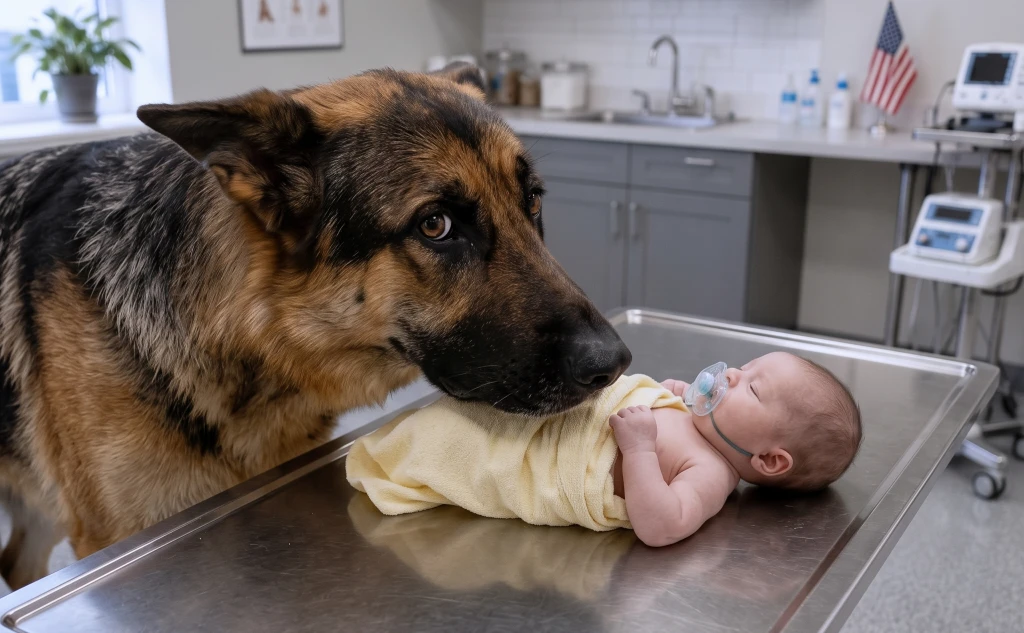
Noah’s heart rate had been climbing toward 180. By the end of the clip, it had fallen by nearly twenty beats, and his left hand, clenched around nothing, slowly opened against the blanket.
Denise Holloway looked from the monitor to Mara. In thirty-one years as a pediatric intensive care nurse, Denise had learned not to call every change a miracle. She also knew better than to pretend she had not seen one.
“He remembers him,” she said, and Mara pressed replay.
Seven months old by the calendar and barely four months old by the measure used for babies born too early, Noah had spent more of his life beneath hospital lights than beneath the yellow lamp in his nursery at home. He had been born at twenty-nine weeks with lungs that tired easily and an intestine that did not absorb enough nutrition. This admission had begun eleven weeks earlier with a fever and a bloodstream infection. Since then, there had been two central-line changes, four antibiotics, a feeding tube, and an expanding circle of specialists who spoke more softly each time they entered the room.
Atlas had visited during the first seven weeks. The eight-year-old German shepherd had once searched damaged buildings with a regional disaster team. His job had been to follow a scent to its strongest source, then sit square and look back at his handler; after retirement, he had been evaluated and credentialed for hospital therapy work. He never climbed onto Noah’s bed or went near the equipment. He simply lay beside the crib on a clean barrier while Noah stared into the dark fur around his eyes.
On the last visit, Noah had wrapped three fingers in the ruff beneath Atlas’s collar and slept for forty uninterrupted minutes. Mara had taken the video because it was the first time in days that her son’s face had looked like a baby’s instead of a patient’s.
Then Lakeshore Regional Medical Center had paused its animal-assisted care program. The notice on the family board cited a temporary infection-control review connected to construction on the fourth floor. Atlas disappeared from the ward. A week later, Noah’s fever returned.
The door opened. Mara stopped the video as Dr. Aaron Patel entered with a tablet tucked against his chest. He did not go to the computer or ask Denise for the overnight numbers. He pulled the second chair close to Mara and sat down.
“The culture from this morning is positive again,” he said. “The infectious-disease team has reviewed everything. We can make another adjustment, but Noah’s kidneys are under much more strain than they were yesterday.”
“How much more?”
Dr. Patel rested the tablet facedown on his knee. “Enough that I’m worried the next treatment may hurt him without clearing the infection.”
Mara heard the words, but her mind snagged on the careful space between them. For weeks she had lived by numbers—oxygen saturation, creatinine, milliliters per hour—because numbers could be watched and argued with. The doctor had brought no numbers this time.
“Are you asking me to stop treatment?”
“No. I’m asking you to let us bring in the palliative-care team and talk about limits before we face an emergency. They help with comfort and decision-making. They don’t replace Noah’s doctors, and they don’t mean we stop caring for him.”
She looked through the clear side of the crib. A strip of tape held the oxygen cannula against Noah’s cheek. His skin had taken on the faint gray cast she had first noticed three days ago, though everyone kept telling her that hospital light distorted color.
“Is my son dying?” she asked.
Dr. Patel did not hide behind a phrase about uncertainty. “I think he may be.”
The room continued around her. A pump clicked. Air moved through the ceiling vent. Somewhere beyond the glass, a cart rolled over a seam in the floor. Mara kept one hand on the crib because it was the only solid thing she could find.
Noah’s father had not been in that chair since the second week of the admission. Mara’s manager at the Lakefront Diner had stopped promising to hold her shifts. There were unopened envelopes in her apartment, a load of laundry she had forgotten in the washer, and a blue sleeper in Noah’s dresser that he had already outgrown without ever wearing. None of it felt real enough to grieve.
“Let Atlas come back,” she said.
Dr. Patel glanced up. “The therapy dog?”
“You can see what his voice does. When Atlas was here, Noah slept. His oxygen stayed up. If you’re asking me to think about the end, then let him have one thing that doesn’t hurt.”
Denise had turned toward the medication counter, giving them the privacy of her back. She remained very still.
Dr. Patel watched the monitor for several seconds. “A one-time compassionate visit is medically reasonable if infection prevention clears the conditions. I’ll enter the request myself.”
Mara closed her eyes. It was not hope exactly, but it was something she could hold without breaking. “Thank you.”
The answer came forty-three minutes later in the form of Dr. Vivian Sloane.
Lakeshore’s chief medical officer wore a white coat over a navy dress, though Mara had never seen her examine a patient. Her badge identified her as a physician and vice president of clinical affairs. She entered with a slim folder under one arm and paused just long enough to read the room before choosing not to sit.
“Ms. Ellison, Dr. Patel forwarded your request,” she began. “I’m sorry for what your family is facing. Unfortunately, the animal-assisted care program is under a unit-wide suspension. We cannot make a bedside exception while that review remains open.”
“Infection prevention hasn’t even spoken to me.”
“The restriction is administrative as well as clinical.”
Mara stood. After eleven weeks in the same chair, her knees protested and the room tilted for a second. “Has Atlas ever caused an infection here?”
“That is not the standard we use to assess risk.”
“Then assess him. His veterinary records are current. His handler bathes him before every visit. You used to put down a clean sheet, wipe his paws, and keep him away from every line. Denise can tell you.”
Sloane’s expression remained composed. “Those procedures belonged to a program that is not presently operating.”
“My son may not be alive when it starts operating again.”
For the first time, the administrator’s gaze moved to Noah. The change in her face was so slight Mara might have imagined it: a brief softening around the mouth, followed almost immediately by resolve.
“I understand why this feels cruel,” Sloane said. “But a hospital cannot abandon a floor-wide safety decision because one case is heartbreaking.”
The folder under her arm shifted, exposing a printed itinerary clipped inside. Beneath the gold tree logo of the Arden Family Foundation were the words Infant Nutrition Initiative—Media Walkthrough, Saturday, 10:00 a.m.
“This isn’t only about infection control,” Mara said. “You’re clearing the floor for Helena Arden.”
Sloane slipped the card deeper into the folder. “The Arden Foundation is funding the milk-preparation renovation and a substantial portion of this unit’s modernization. Saturday’s visit does not change our safety obligations.”
“No. It just changes which obligations matter to you.”
Denise turned from the counter. “Ms. Ellison—”
The warning in her voice was gentle, but Mara understood. Sloane had the authority to restrict a disruptive visitor, and Mara could not protect Noah from a hallway.
Sloane seemed to understand that too. “Stay with your son,” she said, her tone almost kind again. “Let us do our work. The answer is no.”
After she left, Mara sat without moving. The phone remained in her hand, the paused image showing Atlas beside the crib. Noah’s fingers were buried in his fur, and Mara was smiling at something outside the frame. She could not remember the last time her own face had looked that open.
Denise finished charting, checked the hallway, and pulled the privacy curtain halfway across the glass.
“Atlas’s handler is Caleb Mercer,” she said quietly. “He left cards with the volunteer office because families kept asking about visits at rehab centers and at home. It is public contact information. Giving you one does not violate anybody’s privacy.”
From the back of a drawer, she took a bent business card. It bore a small photograph of Atlas in a red therapy vest and a phone number written in thick black type.
Mara looked at the card but did not reach for it. “Dr. Sloane said no.”
“Dr. Patel entered a compassionate-visit order. I checked. Infection prevention has not denied it; the request was stopped in the executive office before they reviewed it.” Denise placed the card beside Mara’s phone. “What you do with public information is not part of my charting.”
The call lasted less than two minutes. Cal answered on the third ring, his voice rough and unhurried—the voice of someone accustomed to hearing bad news without rushing the person delivering it.
“Mr. Mercer, this is Mara Ellison. My son is Noah. Atlas used to visit him at Lakeshore.”
There was a pause, then the sound of a chair moving. “The little guy with the blue knit cap.”
Mara looked at the cap folded on the windowsill. “Yes.”
“How is he?”
She tried twice before the sentence came out. “They don’t think he has much time.”
Cal did not offer reassurance he could not give. “Does his doctor approve a visit?”
“His doctor does. The chief medical officer doesn’t.”
Another pause. In the background, a dog’s tags gave a single bright shake.
“Atlas still goes to the garage door when we pass Lakeshore,” Cal said. “Tell me where you need us.”
By seven that evening, Denise’s shift had ended and Sofia Ramirez had taken charge of the PICU. Sofia was thirty-two, precise, and not known for casual rule-breaking. She read Dr. Patel’s order, called the on-call infection-prevention nurse, and wrote down every condition on the back of her patient sheet.
“Fresh bath within twenty-four hours, current veterinary clearance, clean vest, paws wiped at entry, barrier on the floor, no contact with tubing or broken skin,” she recited. “Medically, they have no objection.”
“And Dr. Sloane?” Mara asked.
Sofia folded the sheet once. “She gave an oral administrative instruction after the clinical order was entered. If someone asks me tomorrow which one I chose to honor, I’ll tell them—and accept the consequences.”
At 8:36, the family-care entrance at the end of the service hall opened and cold Lake Erie air pushed through the vestibule. Cal Mercer came in first with Atlas at his left knee and a folder of records beneath one arm. He was leaner than Mara remembered, with a close gray beard and an old burn scar disappearing beneath the cuff of his canvas jacket.
The shepherd’s coat had been brushed until the sable hairs shone. His nails were short, his red vest was freshly washed, and he waited without pulling while Sofia checked the date on his veterinary certificate. Only when Mara whispered his name did his ears rise.
He crossed the vestibule in three steps and pressed his forehead gently against her hip.
Mara bent over him. The smell of clean fur and cold air undid what the prognosis, the refusal, and eleven weeks of alarms had not. She gripped the loose skin at his neck and cried into it without making a sound.
Cal rested a hand between Atlas’s shoulders. “He knows why we’re here.”
They entered Noah’s room without speaking. Sofia spread a clean cotton barrier beside the crib, and Cal guided Atlas onto it. For one suspended moment, the dog simply stood there, looking through the clear rail.
Noah’s eyelids moved.
“Hey, bug,” Mara whispered. “Your friend came back.”
Atlas lowered his head until his muzzle rested against the outside of the crib. Noah turned toward the sound of his breathing. His heart rate eased—not dramatically, but enough for the alarm threshold to clear—and one tiny hand lifted from the blanket and opened against the clear plastic between them.
Cal looked away. Sofia pressed her lips together and busied herself with the monitor. Mara laid her palm over Noah’s hand from the other side and let herself believe, for perhaps thirty seconds, that this had been the whole reason they had broken the rule.
Then Atlas raised his head.
His nose worked once, sharply. He looked past Noah toward the feeding pump mounted beside the crib. The easy set of his body disappeared. His ears came forward, and a narrow line of fur lifted along his shoulders.
“Atlas?” Cal said.
The shepherd stepped off the barrier before Cal could shorten the leash. He followed the feeding tube to the pump, inhaled at the plastic reservoir, and backed away with a low, unsettled whine. Then he crossed to the sink and pressed his nose against the return-air grille near the floor.
Sofia reached for him. “We have to keep him on the—”
“Wait.” Cal’s voice had changed.
Atlas moved between the grille and the feeding pump, checking each one again. On the second pass, he sat hard and square in front of the wall, his eyes fixed on Cal. It was not therapy-dog behavior. It was the still, deliberate response of the working dog he had once been.
Mara reached toward the feeding reservoir. Cal caught her wrist before her fingers touched it.
“Don’t move that bag,” he said. She stared at him. “Why?” “I don’t know yet.” Cal’s eyes shifted from the pale liquid beside Noah’s crib to Atlas, still holding his position at the wall. “But he isn’t reacting to your son. He just marked the feed—and something behind that wall…”
To read the rest of the story – CLICK the NEXT button 👇👇👇