


The first rifle shot reached Mowana Station while Nathan Reed was listening to his granddaughter explain why the lion in her drawing had six legs. “The extra two are for when the first four get tired,” Emma said in the voice message. Paper crackled near the phone, and then his daughter laughed somewhere behind her. “Mom says real lions don’t work like that, but she’s never met one, either. You have.”
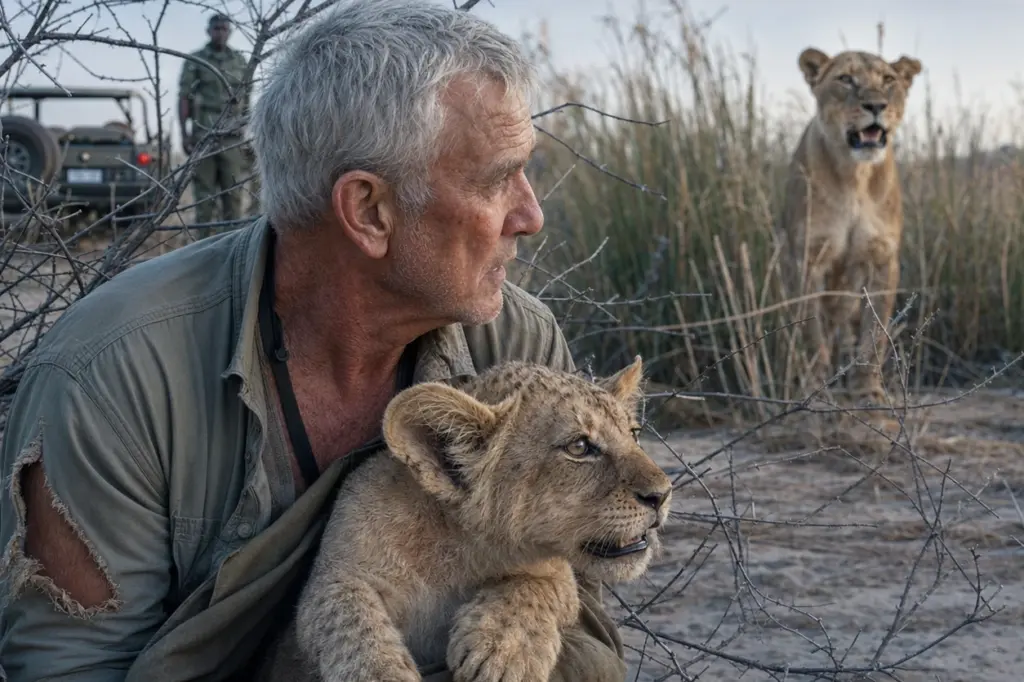
Nathan paused the recording and stepped onto the screened veranda. Beyond the station’s firebreak, the last of the Okavango flood lay in silver strips between dry islands. Reeds whispered along the channel. A second shot came from the southeast, flatter and clearer than the first, followed several seconds later by a third.
He checked his watch, wrote the time and bearing on the back of an equipment invoice, and reached for the VHF radio. The old impulse was already in him: keys, rifle locker, Land Cruiser, go. Thirty-five years in lion country had not cured him of confusing speed with usefulness.
“Kabo, this is Mowana. Three shots southeast of the station. Likely beyond the North Channel track.”
Static answered, then Kabelo Molefe’s unhurried voice. “I heard two. Patrol Two heard all three. Stay where you are, Nathan.”
“I wasn’t planning otherwise.”
“Then you won’t mind hearing it twice.”
Nathan looked through the screen toward the dark. Eleven packing boxes stood behind him in the dining room. One held his late wife Ruth’s plant surveys; most of the others were still empty. In nine days, Dr. Naledi Moagi was supposed to take over the field station, and Nathan was supposed to fly to Colorado. He had promised Leah he would be on that plane. He had also promised to finish cataloging the camera records, hand over the keys, and clear twenty-seven years of notebooks out of the office. The ticket had already been changed once.
The anti-poaching patrol reached Mowana before dawn. Kabo drove, with two Botswana Department of Wildlife and National Parks officers in the back and a police investigator following in a second vehicle. Nathan climbed into the passenger seat with his field camera and the map on which he had marked the shots. He left Emma’s message unfinished.
They took the closed service track south, moving slowly through deep sand. The floodplain was paling around them, first gray, then the color of old bone. A pair of giraffes crossed ahead of the vehicles with their necks dark against the morning sky. Kabo barely glanced at them. He watched the track, stopping twice to inspect fresh tire marks that did not belong to either patrol vehicle.
At a fork near a stand of mopane, he raised one hand. Twenty yards farther on, the tire impressions turned off the legal track and cut across the grass.
“Same tread as the tracks below the camera that caught those headlights last week?” Nathan asked.
“Maybe. Don’t decide before the track does.”
Kabo had been telling him versions of that sentence for twenty years. Nathan had occasionally managed to listen.
They found the lions near a dry pan where the North Channel pride often rested after feeding. The adult male lay on his side beneath an acacia, the dark mane around his face powdered with dust. Two lionesses were several yards away. One still wore a research collar, its antenna motionless against the dust.
No one spoke for a while. The officers spread out along the perimeter without entering the trampled center. Kabo photographed the tire impressions and marked the approach route. The police investigator pulled on gloves. Nathan stayed where he had been told, beside the hood of the Land Cruiser, and used his long lens.
The dead male was Baro, recognizable by the split in his upper lip. The older lioness was Nala, who had raised at least eleven cubs. The younger was one of her daughters. Nathan had watched that family through drought, flood, takeover fights, and two seasons when prey had shifted so far west that every camera image showed ribs.
He knew death in the wild. He had seen a buffalo break a lioness’s spine and hyenas take a newborn cub before its mother could stand. Those deaths had never looked like this. There were boot prints among the paw marks, cut straps where equipment had been removed, and the clean parallel lines of a vehicle reversing toward the bodies.
Kabo came back from the edge of the pan. “Small tracks here. More than one cub.”
“How many?”
“I said tracks, not cubs.” Kabo pointed without stepping closer. “They scatter. Two go toward the vehicle. One goes north.”
The northbound prints were faint, no larger than the palm of Nathan’s hand. They crossed bare ground, vanished where the grass thickened, then appeared again beside a blackthorn thicket.
Nathan heard the sound only after he stopped trying to hear it. Not a roar or even the sharp complaint of a hungry cub. It was a dry, catching breath from inside the thorns.
He looked at Kabo. Kabo had heard it, too.
The officers checked the brush first for wire, people, and any sign that the animal had been used as bait. Then Nathan and Kabo approached together. Nathan crouched outside the thicket while Kabo opened a narrow space with a forked branch.
The cub was wedged against the roots, its spotted coat nearly the same color as the sand. A small female, perhaps eleven weeks old, with a narrow crescent missing from the edge of her right ear. Her eyes were open but dull, and burrs clung to the fur along her belly. The last inch of her tail bent slightly to one side, an old kink rather than a new wound. When Nathan reached one gloved hand toward her, she flattened her ears and tried to spit. Almost no sound came out.
“Good,” he murmured. “Keep some of that.”
Kabo gave him a look. “No talking.”
Nathan nodded. He knew better. Human voices, hands, engines, food—each association could become dangerous if the cub ever returned to the wild. But knowledge did not stop his body from responding to the smallness of her, or to the way she attempted to bare milk teeth while too weak to lift her head.
The patrol commander reached the regional warden by satellite phone and received authorization for emergency removal. They would preserve the site and wait for the veterinary and investigative teams. The cub could not wait with them in the rising heat.
Nathan slid a folded canvas sheet under her while Kabo held the thorns apart. The cub made one sudden effort to twist free. Her paw caught in Nathan’s sleeve, claws passing through the fabric, and for a second her whole weight hung from his forearm.
He did not pull. He lowered his arm until her feet found the canvas, then wrapped it around her without covering her face.
As he stood, a low call moved across the pan, and everyone stopped. It came from beyond the reed bed, too soft to be a territorial roar. A lioness’s contact call: deep, measured, repeated once. The cub’s head lifted inside the canvas. Her mouth opened, and this time a cracked little answer came out. From the far side of the reeds, the lioness answered again…
To read the rest of the story – CLICK the NEXT button 👇👇👇