


At 4:17 on a cold November afternoon, Owen Reed called the sanctuary director and said the seven words no carnivore keeper ever wanted to say.
“There’s a house cat in Koda’s habitat.”
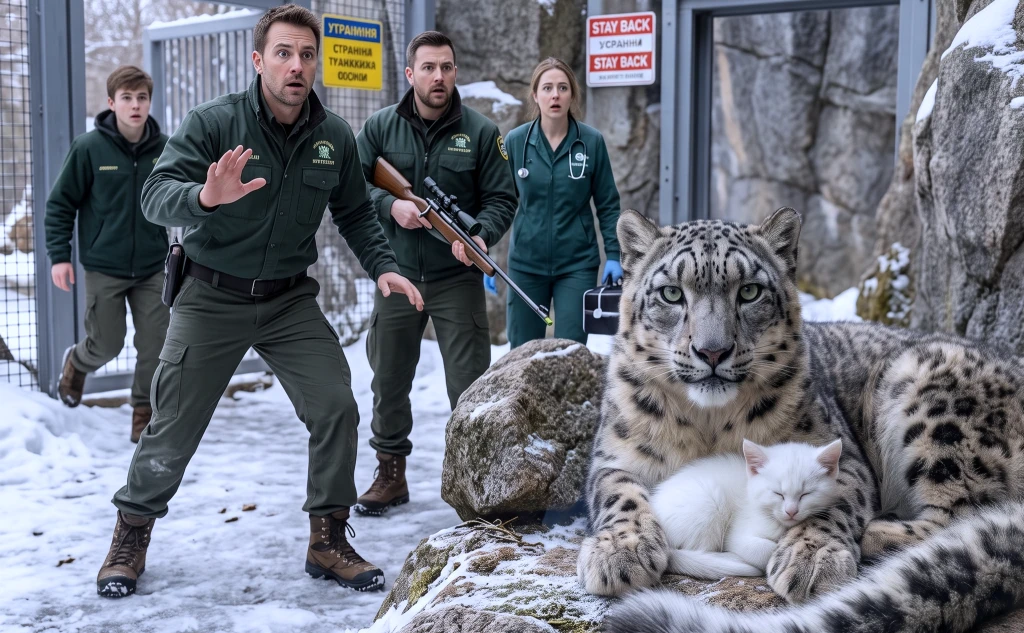
Dr. Claire Harlan was halfway across the veterinary building before he finished the sentence. By the time she reached the snow leopard wing, the response team had the emergency corridor sealed, the shift doors locked, and a tranquilizer rifle waiting in its case. No one had opened it yet. Through the observation glass, every person in the room was staring at the same impossible patch of white.
A kitten was asleep between Koda’s front paws.
Koda weighed just over a hundred pounds. The kitten might have weighed three. One of Koda’s paws covered nearly the length of the little animal’s body, and his thick tail lay curved around it like a low wall. If he tightened either one, even by accident, the kitten would have no chance.
But Koda was not looking at the people gathering behind the glass. His pale green eyes kept moving from the kitten to the service gate and back again. He was alert, yet there was none of the fixed stare, lowered head, or coiled tension Claire would have expected from a cat preparing to hunt.
What frightened her was something else.
For 730 days, Koda had shown almost no voluntary interest in another living creature. Now he appeared to be guarding one.
“How did it get in?” Claire asked.
Owen shook his head. He had been Koda’s primary keeper since the snow leopard arrived at Cedar Ridge Wildlife Sanctuary, and he was usually the calmest person in any crisis. That afternoon his voice sounded thin.
“We’re tracing it. The kitten disappeared from recovery about forty minutes ago. I thought he was still inside the education building until Leah found the loose vent cover.”
The white kitten had arrived thirty-two days earlier in a shoebox left beside Cedar Ridge’s front gate. A piece of blue yarn had been tied around the box, but there was no note and no name. He was about three months old, blue-eyed, underweight, and astonishingly unafraid. After his first veterinary screening, the staff had temporarily housed him in a small-animal recovery room inside the education building while they arranged a foster placement.
Claire had examined him herself. He had no microchip, no collar mark, and no sign that anyone was searching for him. County animal control took an abandonment report while Leah drew blood, treated him for fleas, and began the health screening required before any animal left quarantine. The legal hold expired before quarantine ended, with no owner coming forward. Milo objected to the thermometer, forgave Claire as soon as she offered food, and spent the rest of the appointment trying to climb into the sink.
He had completed the sanctuary’s quarantine period, including repeat parasite screening, respiratory observation, age-appropriate core vaccinations, and negative tests for the common feline viruses the veterinary team monitored. He ate with the concentration of a much larger animal, slept on his back, and greeted every person at the recovery-room door. When Owen passed on his rounds, Milo reached both paws through the bars and hooked one claw into his jacket.
“You have terrible judgment,” Owen told him, freeing the fabric.
Milo purred as if he had been praised. Owen had named him after trying a dozen possibilities; the kitten answered to none of them but climbed everyone as if they were furniture.
The previous night’s windstorm had loosened a metal cover over a disused utility chase beneath the recovery room. Years earlier, before the education wing was remodeled, that chase had carried drainage lines toward the carnivore service yard. Its far end should have been capped. Instead, Milo had followed it beneath the service road and squeezed through a damaged sleeve into Koda’s off-exhibit yard. The opening was far too small for Koda to use, but it had plainly breached containment and biosecurity in the other direction.
Claire would investigate every failure later. In that moment, the only question was how to get Milo out alive.
Koda had come to Cedar Ridge at eight months old after an international wildlife-trafficking case. The records that followed him were incomplete, but investigators believed his mother had been killed in Central Asia and the cub moved through several holding sites before authorities intercepted the shipment. By the time a rescue coalition placed him at the Colorado sanctuary, he was physically stable and almost entirely withdrawn.
Claire remembered the day his transport crate arrived. The cub did not lunge at the bars or retreat when people approached. He sat with one shoulder pressed into a corner and stared at the metal floor. When the crate opened onto his quarantine den, he waited six hours before stepping out. His first movement was not toward water, food, or the climbing shelf. He walked to the far wall, turned his face away, and folded himself beneath a bench.
Aggression would have given the team something clear to manage. Fear might have eased with distance and predictable care. Koda’s absence was harder. He complied with the basic demands of staying alive while offering no sign that any part of the world interested him.
The staff were careful about the words they used. They did not diagnose grief from a distance or turn a wild animal into a human tragedy for donors. In Koda’s chart, Claire wrote observable facts: prolonged stillness, little exploratory behavior, minimal response to enrichment, avoidance of the indoor den unless weather forced him inside.
The facts were bleak enough. Koda ate because hunger eventually brought him to the feeding hatch, but he would not voluntarily station at the training mesh for closer examinations. Procedures that could not be deferred required chemical immobilization. He spent most daylight hours on a high slab of granite facing the western ridge, his body present and his attention somewhere the staff could not reach. They had tried new scents, puzzle feeders, rotating climbing structures, recorded mountain sounds, and carefully managed visual access to another snow leopard in a distant habitat. Nothing had held his interest for more than a few seconds.
There had been small fluctuations, never a true turn. He sometimes used a new ledge for a day. Once he rolled a scented log with one paw and walked away. During his second spring, he watched a magpie steal nesting material for nearly a minute. Owen recorded each event because hope at a sanctuary often lived in measurements too modest for anyone else to notice.
But Koda never initiated play. He never came to the mesh merely because Owen was there. He never made an affiliative sound, sought sustained contact, or changed his plans to remain near another animal. On the seven-hundred-thirtieth day, those facts still defined him, though Owen still spoke to him every morning.
“No bargain,” he would say while setting down food on the other side of the barrier. “You don’t owe me anything. I’m just here.”
For two years, Koda had answered with silence.
Now Milo shifted in his sleep and pressed his face deeper into the silver fur of Koda’s chest. The snow leopard lowered his head. Claire’s hand moved toward the radio, but Koda only breathed across the kitten’s back and touched his nose to one small ear.
The sound he made was soft and breathy, almost a chuff.
Owen looked at Claire. “He’s never made that sound for us.”
“That doesn’t tell us what happens in ten minutes.”
“I know.”
Claire asked for the remote camera feeds and the habitat map. There were three ways to shift Koda away from the kitten without sending a person inside: open the heated den and offer food, raise the gate to the secondary yard, or use the familiar target station near the medical chute. Owen tried all three in sequence.
Koda’s ears turned toward his voice, proving he heard, but he did not move. They brought his highest-value food and placed it beyond the den gate. Koda glanced at the hatch, then back at Milo. Owen tapped the target pole against its holder, a sound Koda had learned during routine care. The snow leopard’s tail tip moved once, but the rest of him stayed still.
The tranquilizer case remained on the table. Chemical restraint was possible, though it was neither instant nor risk-free. A dart could startle Koda into a reflexive movement. The drugs would take time, and an unsteady hundred-pound cat falling near Milo might be more dangerous than the quiet animal in front of them.
“We wait for a clean separation,” Claire said. “If Milo moves away, we draw him toward the baffled service tunnel. No sudden noise. No one improvises.”
For twenty-three minutes, nothing happened.
Then Milo woke.
He stretched one front paw over Koda’s leg, yawned, and sat up as if discovering the enclosure for the first time. Koda raised his head. Every person behind the glass stopped breathing when the kitten stepped across the enormous spotted paw.
From behind a secondary barrier, Owen opened a dish of warm chicken pâté outside the remote service tunnel. The narrow, baffled passage was normally used to transfer small equipment and extended beyond Koda’s paw reach. The smell carried into the habitat.
“Milo,” he called quietly. “Come on, trouble. Dinner.”
The kitten’s ears lifted. He walked toward the sound, first casually, then with purpose. Six feet separated him from the inner end of the tunnel. Owen remotely raised its panel just high enough for a kitten and no farther.
Five feet. Four.
Behind Milo, Koda remained on the rock. He did not stalk or follow. Claire felt the first small release of pressure in her chest.
Then Koda made the breathy sound again.
Milo stopped.
He looked at the food. He looked back at the snow leopard. Owen called once more, but the kitten turned away from the open panel and trotted across the habitat with his tail upright.
He climbed over Koda’s foreleg, circled twice between the great cat’s paws, and lay down. Koda lowered his chin above him. His tail moved inward until the white kitten disappeared behind a curve of silver fur. Claire lowered her radio before anyone could ask for the next instruction.
“Nobody opens that gate,” she said.
The cameras had recorded three plain facts: Koda called, Milo turned back, and the snow leopard curved his tail around him. Claire now had to decide how to remove the kitten without turning Koda’s first sustained social response into another disappearance…
To read the rest of the story – CLICK the NEXT button 👇👇👇