


By the time the cashier said the card had been declined a second time, Claire Weller had already decided not to look. The grocery store was ten minutes from closing. Claire stood behind a man carrying a sleeping infant against one shoulder while a little girl clung to the back pocket of his jeans. On the conveyor belt were a can of hypoallergenic formula, a sleeve of diapers, bananas, and a loaf of bread.
“Take off the diapers,” the man said.
The cashier did. He tried his card again.
“Still short.”
“The bread, then.”
The girl tightened her grip on his pocket. She was four, perhaps five, with one sneaker untied and a pink plastic barrette sliding out of her hair.
The total dropped. The card still failed.
The baby stirred against the man’s shoulder, turning his mouth toward the worn cotton of his father’s shirt. The man closed his eyes for half a second.
“Take off the formula.”
The girl looked up. “But Eli can’t drink the other kind.”
“I know, Nora.”
“His stomach hurts.”
“I said I know.”
The sharpness in his voice startled all three of them. He crouched awkwardly, keeping one hand beneath the baby, and fixed the girl’s shoelace.
“I’m sorry,” he whispered. “Daddy’s going to work it out.”
Claire had spent most of her adult life solving problems before anyone could watch her struggle with them. She knew what this one cost: forty-one dollars and eighty-six cents.
She set her wine and packaged salad on the belt.
“Leave the formula,” she told the cashier.
The man straightened. He was in his mid-thirties, his face lean with fatigue. A pale line circled one finger where a wedding band had recently been.
“No,” he said. “Thank you, but no.”
“It’s one can.”
“It’s still no.”
The cashier glanced toward the darkened produce section. Someone had begun turning off half the overhead lights.
Claire reached for her wallet, then stopped. Taking out the black card would make the difference between them wider than it already was.
“All right,” she said. “Call it a loan. Put your number on the receipt, and when you’re able, you can pay me back.”
The man studied her. Claire was accustomed to people recognizing her from business magazines, charity photographs, or the local news. This man seemed only to notice the things that mattered to his decision: her steady hands, the lack of impatience in her face, and whether she would humiliate him in front of his daughter.
“Just the formula,” he said.
“Just the formula.”
The cashier rang it separately. The man wrote his name and number on the back of the receipt in square, careful print.
MARCUS REED.
Claire folded the paper into her wallet without looking at the number.
Nora watched her father place the formula in a reusable tote. “Is the lady a friend?”
“We just met her.”
“That wasn’t my question.”
The cashier coughed into her fist to hide a laugh. Marcus’s tired face softened.
“No,” he said. “Not yet.”
Claire should have paid for her own groceries and gone home. Instead, she found herself following them across the wet parking lot.
A steady rain had begun. Marcus stood beneath the narrow shelter at the bus stop, the infant zipped inside his jacket and Nora pressed against his leg. The electronic route sign had gone dark.
“The last bus came twenty minutes ago,” Claire said.
Marcus checked his phone, though its cracked screen showed no signal.
“We’ll walk.”
“In this?”
“It’s two miles.”
“With two children.”
His jaw shifted. “You’ve already helped.”
Claire’s SUV waited beneath a parking-lot lamp. She unlocked it from a distance, then held out her phone with her driver’s license displayed.
“You can photograph this and my plate. Send both to whoever you trust. I’ll take you where you’re going, and you never have to see me again.”
Marcus looked down at Nora. She had rested her forehead against his thigh and closed her eyes.
He photographed the license and the SUV’s plate, then sent the images in a text. Only after it showed as delivered did he open the back door.
Claire had never installed child seats. Marcus secured the infant carrier he had been balancing beneath the tote, then fastened Nora into the rear seat using the belt. He checked both restraints twice.
“Cedar Court,” he said as he climbed in beside them. “On Wilkinson.”
Claire’s hand paused over the ignition.
Weller Urban had acquired a property on Wilkinson Boulevard that month. She could not remember its name. The transaction had been one of nine items in a thick electronic packet she had approved between calls.
“Extended-stay place?” she asked.
“For now.”
The rain deepened as they drove west from uptown Charlotte. In the rearview mirror, Claire saw Marcus measure formula into a bottle using water from a sealed jug. He tested a drop against his wrist before feeding Eli.
Nora watched him with the solemn attention of a nurse.
“Does their mother work nights?” Claire asked.
Marcus did not look up. “She died in March.”
Claire tightened both hands around the wheel.
“I’m sorry.”
“Maya had a heart condition nobody found until after Eli was born.”
He offered nothing more, and Claire did not ask. She understood at least that much about grief: the quickest way to make it worse was to demand that it explain itself.
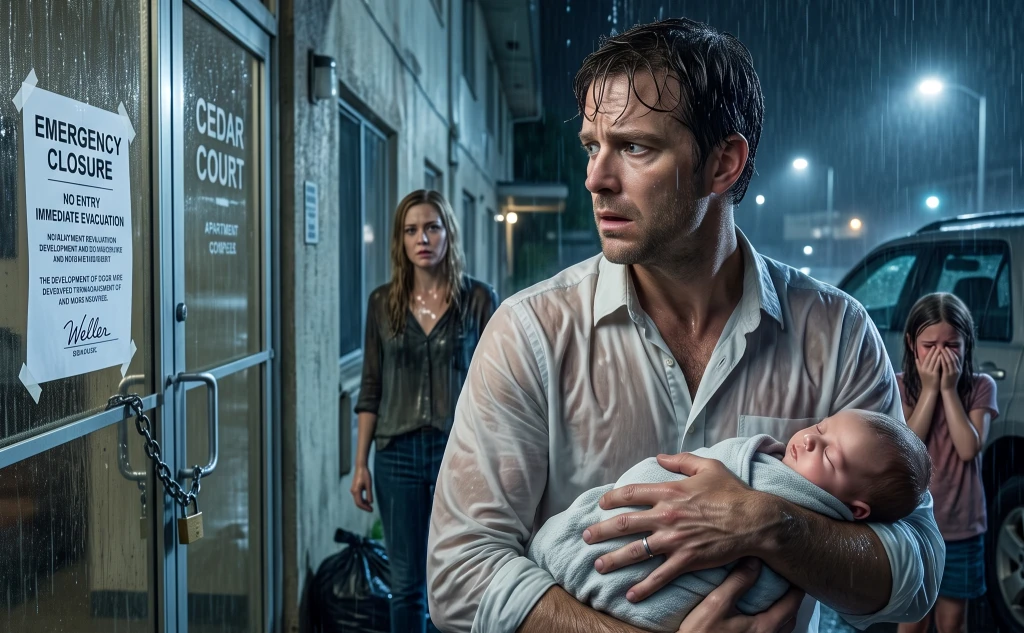
Cedar Court appeared beyond a used-car lot, its two-story wings arranged around a cracked parking lot. Yellow tape stretched across the driveway. A chain had been looped through the office doors.
Mattresses, plastic bins, trash bags, and two battered suitcases sat beneath the shallow awning. A woman holding an umbrella stood beside them with three children.
“What happened?” Marcus asked.
Claire pulled to the curb. A white notice covered most of the office window.
EMERGENCY CLOSURE. NO ENTRY.
Below the city seal was the logo for Weller Urban.
Marcus was out of the SUV before Claire shut off the engine. He ran to Room 214 and tried his key card, then pounded on the door.
“Sir,” the woman beneath the umbrella called. “They changed the locks. Told us everybody had been moved.”
“My children’s things are in there.”
“So are mine.”
Nora began crying in the back seat. Not loudly. She pressed both hands over her mouth, as if crying might create one more problem her father could not solve.
Claire stepped into the rain and approached the notice. Beneath the emergency order was a second sheet announcing the future site of a Weller Urban medical-office development.
Her own signature had been reproduced at the bottom.
Marcus came back carrying Eli. Water ran from his hair and along his face. His eyes moved from the notice to Claire.
“Weller,” he said. “That’s the name you gave me.”
Claire could have called security. She could have called her chief operating officer and waited inside the SUV while someone else assembled an explanation. Marcus pointed at the sign. – “This is your company…”
To read the rest of the story – CLICK the NEXT button 👇👇👇