


On the last Thursday of September, Asha Mwinyi saw a lion cub walking inside an elephant’s footprints. From two hundred yards away, each round depression looked large enough to contain him, its raised rim reaching almost to his knees. He would climb out, trot three or four steps, and enter the next, following the broad stride of an old bull elephant toward the dry river channel.
Neema lowered the tablet she had been holding against the Land Cruiser’s dashboard. “Tell me I’m seeing this wrong.”
“You’re seeing a cub following an elephant.” Asha eased her foot off the accelerator. “Everything after that is still a question.”
The answer was meant to cool her daughter’s excitement. It had the opposite effect. Neema reached for the long-lens camera between their seats while Juma Kessy, in the back, leaned forward until his hat brim touched Asha’s headrest.
“That is Baraka,” he said.
Asha had already recognized the bull’s blunted right tusk and the V-shaped notch in his left ear. As Mawingu’s field veterinarian and a longtime elephant researcher, she had followed Baraka’s movements for more than twenty years. Three generations of field staff knew his habits. He was about fifty-two now, still broad across the shoulders but hollowing at the temples. An old pale scar angled across his left foreleg, and when the ground hardened late in the dry season he favored that foot.
Adult bulls came and went on routes of their own, sometimes alone, sometimes in loose company. Baraka had narrowed his world as he aged. He no longer made the long eastern circuit after the rains. He moved between the Rufiji floodplain and three waterholes within a day’s walk of the research station, a smaller circuit that spared his bad foot.
The cub looked as if he had no reserves left. His ribs showed when he climbed from a track, and burrs clung to the pale fur under his belly. He was perhaps seven months old—past the age of depending entirely on milk, but far too young to manage well by himself. A dark crust marked one nostril. He kept his head low and his eyes on the bull’s hind feet.
“Where are the females?” Neema asked.
“Not here.”
“I can see that, Mama.”
Asha ignored the edge in her voice. It had been present since breakfast, when Neema had asked whether a recommendation letter could get lost in an outbox for nine days. Asha had answered that the morning patrol was waiting. Neither of them had mentioned the fellowship in Colorado again.
Ahead, Baraka reached an umbrella thorn and stopped with his body angled across the narrow island of shade. The cub halted too. For several seconds he stood with all four legs braced, as if stillness required effort. Then he folded into the dust beneath the bull’s belly, not between his feet but close behind the right foreleg, where the elephant’s shadow covered him from nose to tail.
Baraka lifted his trunk and tested the wind. Its tip turned toward the cub. The bull did not touch him. He did not step away. Neema took six quick photographs before Asha put a hand over the camera barrel.
“No upload.”
“I wasn’t going to upload it.”
“Not to the staff group either. We don’t know what this is.”
“I know what it looks like.”
“That is exactly the problem.”
After twenty-five years in the field, Juma knew when to slow an argument down. “We could look for the mother before deciding what it means.”
They backed away far enough that the vehicle would not alter the pair’s choices, then looped south along the channel. The last known pride had crossed there twelve days earlier, seven lions traveling toward permanent water. Asha found old tracks, jackal scat, and the drag line of a crocodile that had moved between two shrinking pools. Nothing fresh belonged to a lioness.
At noon they returned to the thorn tree. Baraka had gone. The cub lay alone in the flattened grass, asleep or too tired to lift his head. Neema opened her door.
“Stay in the truck,” Asha said.
“He might be dying.”
“And his mother might be watching us from cover.”
“You don’t believe that.”
Asha scanned the grass with binoculars. “Belief isn’t useful yet.”
The cub’s ear twitched at a fly. After a minute he pushed himself upright, looked toward the empty channel, and gave a rasping call too thin to carry far. No lion answered.
Baraka did.
The sound came from beyond a stand of silver-leaf trees, two low notes separated by a short pause. The cub faced it. He called once more, then began to walk.
They followed at a distance. Baraka had stopped half a mile ahead beside a seep where elephants had dug through the crust to damp sand. He scooped a shallow well with the edge of one forefoot, drew water into his trunk, and drank. When the cub arrived, the bull had already turned away. The little lion lowered himself into the wet hollow and lapped at the muddy film left behind.
Baraka had opened hundreds of such wells for himself, and birds, warthogs, and smaller animals used them after he left. Asha wrote the sequence in her field book without a single verb of intention.
13:42. E-17 excavated seep. Juvenile male lion followed at approx. 35 m. Drank after E-17 moved off.
Neema looked across from the passenger seat. “You left out that he waited.”
“I wrote what I could measure.”
“You measured thirty-five meters.”
“With the rangefinder.”
“How do you measure waiting?”
Asha capped her pen. “You don’t. You keep watching.”
For the next three hours, the bull moved west and the cub persisted behind him. Baraka’s normal late-season pace was slow, but not this slow. Twice he stopped in open ground where there was nothing to browse. Each time the cub closed the space between them, collapsed in his shadow for several minutes, and rose when the elephant moved again.
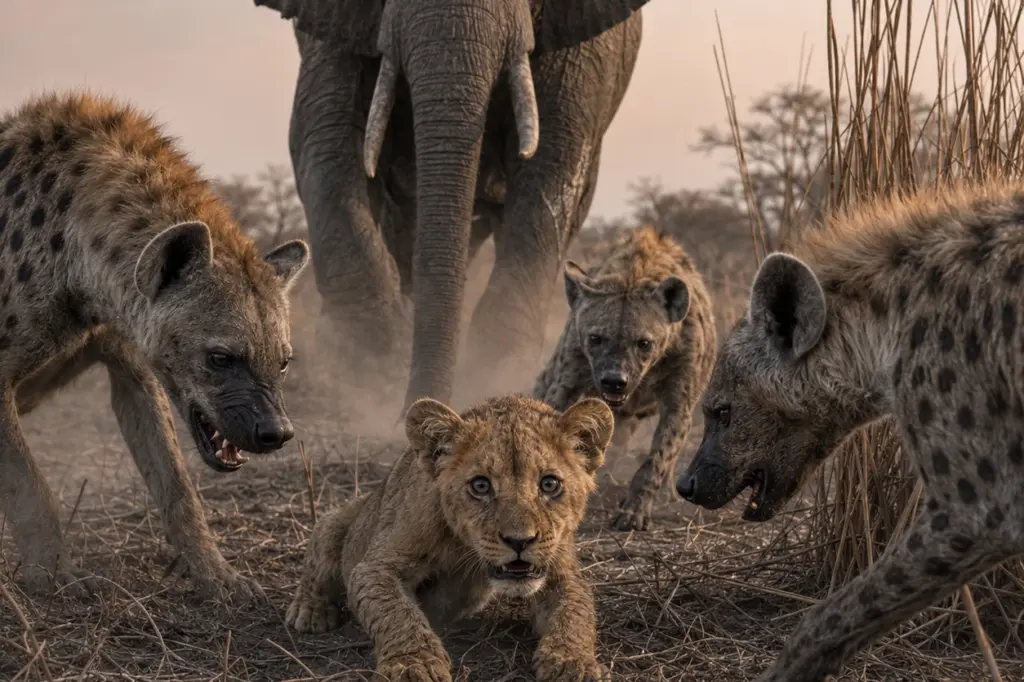
Near sunset, they reached a belt of taller grass along the old channel. Baraka crossed it first. The cub reached the edge, stared into the stems, and stopped. Spotted hyenas had begun calling from the south.
One appeared on a bare rise, then a second. Their rounded ears showed above the grass as they descended. A third came from behind the cub, head low, shoulders rolling. None paid attention to the Land Cruiser. Their focus had tightened to the small, exhausted animal standing alone at the channel’s edge.
Neema’s hand went to the radio. “We can push them off.”
“Not yet.” Asha started the engine anyway.
“His mother is gone. You know she is.”
“I know we haven’t found her.”
The first hyena broke into a loping run. The cub spat and backed into the reeds. Ahead of him, Baraka continued west, his broad hindquarters fading in the dust.
Asha shifted into gear. Mawingu’s standing policy was not to disrupt natural predation unless human activity had created the immediate danger or the area manager authorized an exception, and she did not yet have that proof. The rule had protected Mawingu from turning every difficult sight into a rescue and every wild animal into a dependent.
The hyenas spread. One moved to cut off the cub’s retreat while another came straight on. Baraka was almost beyond the last silver-leaf tree when his left ear lifted. He stopped. The old bull stood motionless long enough for the lead hyena to reach the edge of the reeds. Then Baraka turned around…
To read the rest of the story – CLICK the NEXT button 👇👇👇