


The man appeared in Sarah Whitmore’s headlights where Route 4 narrowed past the locked gates of Camp Hawthorne. One moment there was only wet pavement and the white flash of rain; the next, a broad-shouldered figure staggered along the shoulder with a rucksack hanging low on one side.
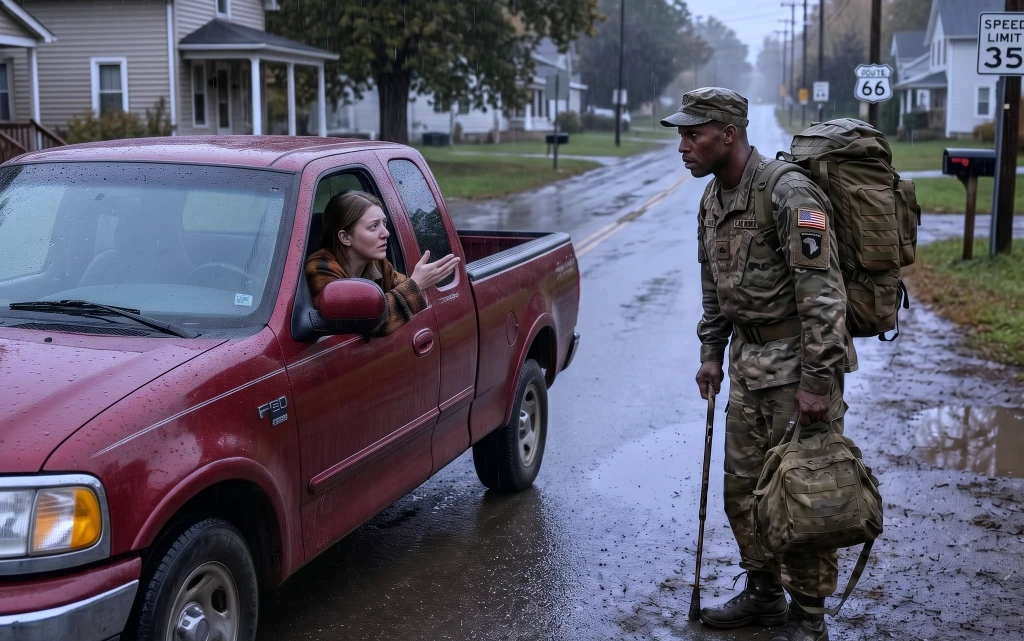
Sarah lifted her foot from the gas. It was after eight, she was alone, and Nora had already texted twice to ask when she would be home to relieve her. A red voicemail icon glowed on the truck’s dashboard—Maple Ridge Credit Union again—but Sarah had spent eleven hours feeding dough into a divider at Valley Bread and had no room left in her head for numbers she could not fix tonight.
The man turned at the sound of the engine. He raised both hands where she could see them and stepped farther into the weeds, giving the truck more room than it needed.
Sarah drove past. In the rearview mirror, he took three more uneven steps. His right knee folded, and he caught himself against the rusted base of the old military sign.
Her father had kept a wool blanket and a tow chain behind the seat of every truck he owned. Henry Whitmore had trusted equipment more than people, but he had never passed a stranded car. Sarah could hear him complaining about the price of alternators as clearly as she could see the man disappearing behind the rain.
She braked, swore under her breath, and reversed along the empty road. The passenger window came down six inches, and cold water blew across the bench seat.
“Are you hurt?” she called.
He stayed several feet from the door. Rain ran off the edge of his hood and down a long scar beside his right eye.
“Old injury,” he said. His voice was rough but steady. “I’m all right.”
“You’re limping in forty-degree rain.”
“Still all right.”
Sarah almost laughed, because she had used the same lie with Nora that afternoon when the dough hook had slipped and bruised two of her fingers. Instead she asked where he was going.
“Cedar House. Wilton.”
“That’s fourteen miles.”
“I know.”
He had dark skin, a military haircut grown out by a few weeks, and the watchfulness of someone who counted doors without turning his head. Sarah hated how quickly the old Brayfield warnings lined up in her mind: woman alone, strange man, back road. Black man, in a county where that detail would become the first fact in any story told about him. She could not pretend she had not felt the fear, and she put the truck in park with the fear still there.
“Do you have identification?” she asked.
He reached slowly into an inside pocket and held a Pennsylvania driver’s license against the glass. Terrence Hale, thirty-eight. The address belonged to a rehabilitation center outside Pittsburgh.
“My phone died,” he said. “The bus let me off at the old junction before they canceled the connection.”
“Get in before you turn blue.”
Terrence studied her face, then the empty cab. “You sure?”
“No. But I’m cold too, and I’m the one with a heater.”
He opened the door and climbed in carefully, using one hand to lift his right leg. The cab filled with the smell of wet canvas and road mud. He set the rucksack between his boots and kept his hands on top of it while Sarah put the truck in gear.
She did not turn toward Wilton immediately. First she called Nora on speaker.
“I’m on Route 4 with Terrence Hale,” she said. “I’m giving him a ride to Cedar House. His license says Pittsburgh, and I’ll text you a picture when we stop.”
There was a beat of silence.
“That was subtle,” Terrence said.
Nora recovered first. “Liam is fed, homework is mostly done, and your son has explained at length why nine-year-olds should not have to go to bed before adults. Call me in ten minutes.”
“I will.”
Sarah ended the call. “My friend is direct.”
“Your friend is smart.”
“She’ll enjoy hearing that from somebody.”
The exchange loosened something in the cab, though only for a moment. At the Wilton turnoff, reflective barricades blocked the low road. Muddy water moved over both lanes, carrying branches through the beam of Sarah’s headlights. A county sign directed traffic back toward Brayfield; the detour over Miller Ridge would add more than an hour, and sleet had begun to tick against the windshield.
Sarah stopped behind the barricade, called Nora back, and sent the promised photograph of Terrence’s license.
Terrence looked at the water, then at the clock. “You can let me out at the gas station.”
“It closed at seven.”
“There’s an awning.”
“That isn’t a plan.”
He pressed his thumb into the seam of his rucksack. “I’ve had worse nights.”
Sarah believed him. That did not make this one acceptable.
Her father’s old bakehouse stood twenty yards behind her home, linked to the back door by a covered walkway. It had not held a legal batch of bread since Henry got sick, but there was a narrow daybed in the office, a half bath, a hot plate, and a lock on both sides of the door. Sarah described it, along with the fact that Nora would remain until Terrence was settled and that Liam would stay in the main house.
“One night,” she said. “The road should be open by morning.”
“What does it cost?”
“Tonight? Nothing.”
His jaw tightened as if nothing were a price he did not understand. “I can work.”
“I’m not hiring anybody at nine o’clock in a storm.”
Terrence looked back at the flooded road. “One night,” he said.
Nora was waiting on Sarah’s porch in a red raincoat, arms crossed beneath the weak yellow light. She was short, squarely built, and still wore the white cap from Valley Bread over her dark curls. Before Terrence had both feet on the ground, she looked at his face, his leg, and the rucksack, then handed Sarah a flashlight. That was Nora’s version of welcome.
“The breaker in the bakehouse tripped last week,” she said. “I reset it. Don’t run the kettle and the space heater together.”
The bakehouse smelled of cold flour trapped in old floorboards. A steel worktable occupied the center of the room, and Henry’s floor mixer stood in the corner beneath a canvas cover, its bowl still dusted at the rim. Sarah switched on the office lamp and the small space heater. Terrence’s eyes went first to the rear exit, then to the windows and the electrical panel.
“The bathroom door sticks,” Sarah said. “Lift before you pull. The outside door locks from in here, and this key opens it from the porch. Keep it tonight.”
She set the key on the desk instead of pressing it into his hand. He watched her do it.
“Thank you,” he said.
Nora returned to the house to put Liam back in bed while Sarah heated water on the hot plate. Terrence removed his field jacket, revealing a faded gray sweatshirt and a dark brace strapped beneath his jeans. He lowered himself onto the daybed without taking off his boots.
“Chamomile or black tea?” Sarah asked.
“Whichever one doesn’t mean I have to talk.”
“Chamomile, then.”
The corner of his mouth moved. It was not quite a smile, but it changed his face enough to show how young he might have looked before the scar.
Sarah gave him a towel, dry socks that had belonged to Henry, and a bowl of chicken soup from the freezer. Terrence ate slowly, stopping each time the building creaked in the wind. When the old refrigerator compressor kicked on behind the worktable, his spoon struck the bowl. He set it down and placed both palms flat on his thighs until the sound ended.
Sarah kept her attention on the tea bags.
The porch door opened, and Liam slipped in before Nora could catch his shoulder. He wore fox-print pajamas and held a stuffed fox by one ear. Under his other arm was his faded blue blanket.
“This is my son,” Sarah said. “Who is supposed to be in bed.”
“I was,” Liam said. “Then I wasn’t.”
Terrence straightened. “Hello, Liam.”
Liam examined the scar without pretending not to, then looked at Terrence’s wet coat dripping into a bus tub. “Mom says you got stuck.”
“That’s about right.”
“The office gets colder at night.” Liam held out the blanket. A crooked fox-shaped patch covered a tear near one corner. “You can use this one. It’s softer than the brown ones, but don’t pull the patch because Mom sewed it twice already.”
Terrence did not reach for it at once. His gaze went from the blanket to the boy and then to Sarah, as though he expected an adult to explain the terms.
“He’ll want it back,” Sarah said.
“Tomorrow,” Liam added. “Not right now.”
Terrence took the blanket with both hands. “Tomorrow,” he agreed.
Nora guided Liam out by the shoulders. At the door, the boy turned and pointed to the stuffed fox.
“This is Scout. He doesn’t loan his blanket to everybody.”
“Then tell Scout I’ll take care of it.”
After the house went dark, Sarah checked the bakehouse once from her kitchen window. Terrence was seated on the edge of the daybed with the blanket around his shoulders, not sleeping, the untouched key beside him. She left the porch light on and went to bed with her phone on the nightstand.
At six the next morning, the bakehouse door stood open. The daybed had been stripped and remade. The towel hung evenly over the office chair, the mug had been washed, and the key was centered on the desk. Terrence’s rucksack and wet boots were gone.
The blue blanket lay folded on the worktable. Inside it, Sarah found a Purple Heart on a faded ribbon and a piece of paper torn from the back of an intake form.
I can’t carry this. I’m sorry.
Beneath the note was a Cedar House card with an overnight number. Sarah called it from the bakehouse, one hand closed around the cold medal while rainwater dripped from the open door. – “Ms. Whitmore,” the woman at Cedar House said, “Terrence Hale never arrived…”
To read the rest of the story – CLICK the NEXT button 👇👇👇