


The authorization form lay unsigned in the clinic while Maya Torres knelt beside a blind giraffe calf who had stopped standing and feeding. Twelve-day-old June was all folded legs, her spotted neck resting against the padded rail. She had refused every bottle since noon, and two assisted feeds had produced reflux. The fluid line taped above her left hock could slow the damage, but it could not restore her gut motility or persuade her body to keep going.
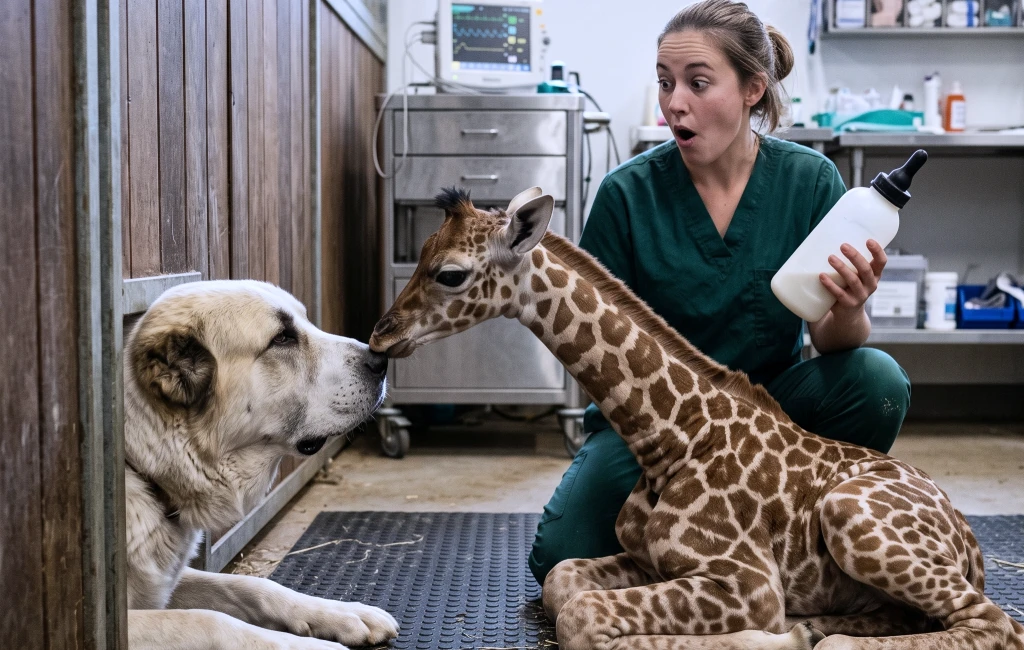
Maya tapped twice on the rubber floor before entering. Everyone on the care team used the same signal so June would never be surprised by hands she could not see.
“It’s Maya.”
June’s left ear turned toward her voice. Nothing else moved. That ear had become Maya’s least scientific measure and the one she trusted most. She had spent fifteen years teaching volunteers not to call stillness calm, a bared tooth a smile, or every approach affection. She knew better than to call the movement hope. But it was repeatable, and it was still there.
Maya laid one palm against the calf’s neck. The skin beneath the fine coat felt cool, and each breath lifted her hand only slightly.
Dr. Ethan Cole came through the service gate wearing scrub pants and an old canvas jacket. At sixty-one, he moved with the economy of someone who had learned that haste around frightened animals usually created a second emergency. He had consulted for the Randall County shelter for years, and for six days Dana Ruiz had been sending him records on a bereaved livestock guardian who would not leave the ward’s service door. He checked June’s catheter, gums, temperature, and heart while Maya remained near her shoulder.
“When did she last get up?” he asked.
“Just after three. She made it halfway and quit.”
“Any milk?”
“She touched the nipple once.”
Ethan listened to June’s chest again. “Her glucose is lower.”
“I know.”
Beyond the mesh, Claire Bennett stood with a blue folder against her ribs. As manager of the High Plains Wildlife Recovery Center outside Amarillo, she knew the formula budget and had attended every end-of-life decision in eight years. Her eyes settled on Maya’s hand against June’s neck.
“The animal-care committee meets at noon,” Claire said. “We need to give them a recommendation.”
June had arrived nine days earlier from a roadside safari park west of Midland. Inspectors had found dry troughs, broken shade structures, and years of missing medical records. June’s mother, Della, was down beside the transport gate when the specialized seizure team entered. She survived the drive north but died before morning.
The emergency custody order allowed High Plains to stabilize the calf for ninety days, not keep an adult giraffe. No one had discussed permanent placement while June was still losing ground by the hour.
The infection that had swollen June’s eyes could be treated. The white scars it left across both corneas could not. Blindness alone did not make a giraffe’s life inhumane, but blindness, orphaning, dehydration, and a refusal to feed had narrowed the choices until the unsigned form in Ethan’s office no longer felt theoretical.
Maya stood and followed him into the service aisle. “Give her one more day.”
“For what?” Claire asked.
It was not unkind. That made the question harder.
“Her ear turned.”
Claire looked through the mesh at the motionless calf. “Maya.”
“I’m not calling it recovery. I’m saying she’s still locating us. There’s something left to work with.”
Ethan took off his glasses and rubbed the bridge of his nose. He had signed euthanasia authorizations before. He never spoke about them afterward, but he kept the old paper charts in a locked cabinet instead of sending them to storage.
“Reassess at noon tomorrow,” he said. “Sooner if her kidneys worsen, her breathing changes, or we lose control of her discomfort. If any of those change, we stop.”
Claire’s mouth tightened. “What measurable change do you expect by tomorrow?”
“I don’t know.”
Maya hated the answer because it was honest. Claire did too, judging by the way she pressed the folder flatter against herself.
“Twenty-four hours,” Claire said. “Only because we all agree where the line is. If she crosses it, we stop.”
Later that morning, Ethan’s phone rang while they were trying another feeding. June smelled the warm formula and turned her face into the rail. Ethan stepped into the aisle to answer, spoke briefly, then returned with the distracted look Maya knew from difficult consults.
“County shelter,” he said. “Dana says the livestock guardian I’ve been following is no better. His owner died in a pasture last week; the dog stayed with him all night. He still won’t leave the service door.”
Maya kept the bottle at June’s muzzle even though the calf had gone still. “Medical?”
“Torn pads are healing. Arthritis is controlled. Bloodwork doesn’t explain it.”
“Then why call you?”
“Because Dana has already run out of people willing to sit on a kennel floor.” Ethan watched June’s nostrils move faintly around the nipple. “The rancher kept sheep.”
Maya understood the thought before she approved of it. Livestock guardian dogs were bred to make decisions near vulnerable animals without waiting for a human command. But June was not a lamb, the dog was bereaved, and pairing two failing animals did not make the idea safe.
“We could assess him,” she said. “Nothing more.”
Ethan looked at her. “I didn’t ask for more.”
“You were about to.”
Two concrete walls separated the Randall County shelter’s quiet ward from the restless barking in the main building. Dana met them at the rear entrance in a faded cap and shoe covers and led them to the last kennel without offering the optimistic version first.
A woman in a navy office dress stood outside the ward with a ranch blanket folded over both arms. Dana introduced her as Lena Hayes, Sam’s daughter and the court-appointed independent executor of his estate. The letters testamentary in Lena’s folder authorized her to place Atlas. She had driven up from Austin to sign the shelter’s temporary-care papers and had spent the morning sorting feed ledgers, livestock registrations, and the last bills from a ranch already being emptied for sale.
“His left hip locks if he stands too fast,” Lena told them. “And don’t reach over his head. Dad never did.”
Atlas lay on a raised cot with his back against the wall. He was a Great Pyrenees–Anatolian mix, nearly a hundred and forty pounds, with a white coat stained red along the legs by ranch soil. One gray ear bore a notch, and an old scar crossed his muzzle. He opened his eyes when the strangers approached but looked past them toward the metal service door.
“Sam had him since he was a pup,” Dana said. “Lena tried taking him to Austin. Second-floor apartment, traffic on both sides. Atlas hit a window when a garbage truck backed up, so she brought him here before he hurt himself.”
Dana unlocked the kennel and sat inside. Atlas accepted a piece of chicken from her fingers, swallowed it, and lowered his head again.
“His owner collapsed in the south pasture,” she continued. “A ranch hand found them the next morning. Atlas had stayed beside him. Since he came here, he keeps waiting for that door to open.”
Maya crouched outside the kennel. She did not call the dog or offer her hand. Atlas’s eyes moved to her, measured, then returned to the exit.
Before leaving High Plains, Maya had put on fresh gloves, rubbed a sterile cotton square along the padded rail where June slept, and sealed it inside a perforated steel scent tin. At the shelter’s isolation-room threshold, she handed it to Dana, who passed it through the feed slot. The tin would remain at the shelter for disinfection.
His nose lifted. The change was so slight Dana might have missed it if she had been looking for a miracle. Atlas raised his head, drew another breath, and shifted his front feet beneath him.
Atlas stood slowly, favoring one rear leg, and crossed the kennel. He smelled the tin from every side before laying one broad paw across it.
When Dana reached toward the tin with long tongs, Atlas did not growl. He lifted his head and looked directly at Maya, then stepped to the gate and waited. Dana later bagged the cotton for disposal and moved the tin to the disinfection bin.
Lena pressed the folded blanket closer to her body. “Where does he think you’re taking him?”
“I don’t know,” Maya said. “I know what he just chose to investigate. If the medical checks are clear, we’d like permission for one controlled visit.”
Lena looked through the gate at the dog who had ignored her car keys, his leash, and every open door that morning. “If he wants to go, let him go.”
That afternoon, Ethan and the county shelter veterinarian reviewed Atlas’s vaccination status, negative parasite and respiratory screens, and six symptom-free days in the shelter’s isolation ward. He would remain there overnight, then be bathed and moved in disinfected transport equipment. Claire approved one controlled assessment for the following morning: Atlas would remain in the outer corridor, with no shared equipment, June’s locked gate, and a solid door between them. There would be no direct contact and no promise of a second visit.
They reached the center shortly after dawn the next morning. Atlas descended from the shelter’s disinfected transport van in a clean, broad chest harness, inspected the fence line, and turned when Maya started toward the quarantine barn. He did not drag Ethan. He put steady pressure into the harness with the certainty of a dog accustomed to people eventually understanding him.
Inside, June lay with her chin against the rail. Maya entered her stall from the far side while Ethan brought Atlas to the closed corridor door. The dog lowered his nose to the gap beneath it.
His aluminum tags touched with a small, bright click, and June lifted her head.
Maya raised the bottle but waited until the calf had oriented toward the sound. On the other side of the door, Atlas settled his weight onto the concrete with a soft thump. June’s nostrils widened at the unfamiliar scent passing through the gap.
“Easy,” Maya whispered, bringing the nipple close.
June’s lips touched it and withdrew. Atlas exhaled, a low, rough huff from deep in his chest. The calf searched again, closed her mouth around the nipple, and swallowed.
Maya felt Ethan watching through the observation window. She did not look up. June took another swallow, then another, until the tension eased from her jaw and the bottle began to empty in slow, uneven pulls.
She drank less than a quarter of what she needed, but when Maya lowered the bottle, she did not turn back to the wall.
Ethan led Atlas a few steps down the corridor to see whether the response would hold. The brass buckle at his collar struck one tag.
Click.
June gathered her front legs under her. Maya reached for the support strap, but the calf pushed before she could fully secure it. Her back legs shook, slid, then found the mat again.
Atlas took one more step beyond the door. His tag clicked, and June stood trembling and moved one hoof toward the sound…
To read the rest of the story – CLICK the NEXT button 👇👇👇