


At first I thought the flowers were for me. It was a foolish thought. Daniel believed cut flowers were an expensive way to watch something die, and after fifteen years of marriage I had stopped expecting him to revise that opinion. But I had come home from Denver a day early, and there he stood beneath the arrivals board at O’Hare with both hands wrapped around a cloud of pale pink peonies.
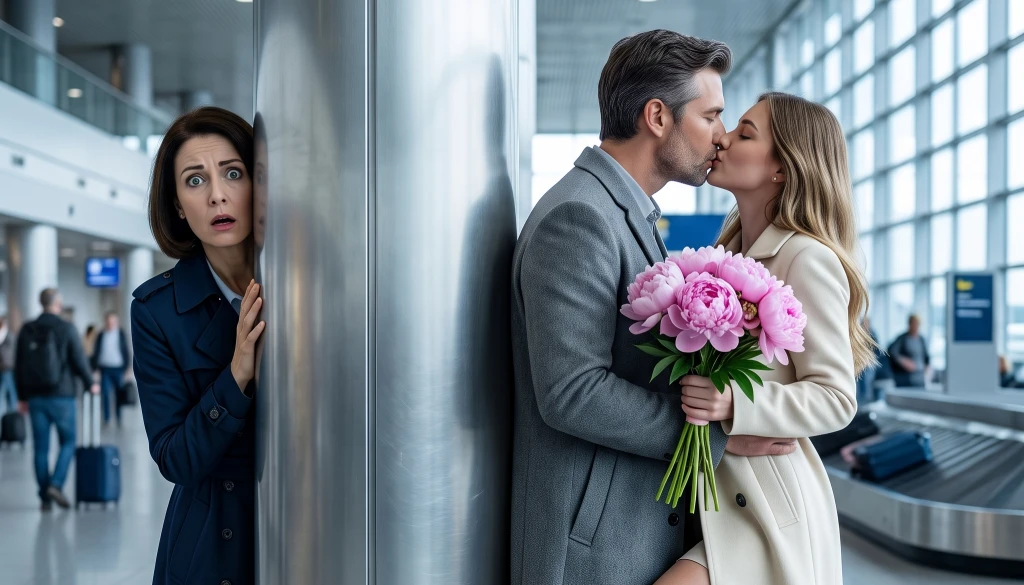
They were greenhouse flowers, flown in from somewhere that had not yet surrendered to winter. I knew because I sourced flowers for a living, and because no Chicago wholesaler had peonies like those in the first week of November without charging enough to make a bride’s father blink.
Daniel also held a piece of white poster board. In his square surgeon’s printing, surrounded by badly drawn stars, he had written WELCOME HOME, BEAUTIFUL.
My carry-on rolled into the back of my heel. Around me, baggage claim performed its usual messy choreography: families leaning over the barrier, drivers holding up name signs, a toddler lying flat on the terrazzo while his mother tried to negotiate with him. I stood beside a column with a case of linen samples under one arm and watched my husband check the arrivals doors for someone who was not me.
He looked good. That registered before I could stop it. His charcoal coat was open over the navy sweater I had given him the previous Christmas, the one he had called too nice for the hospital. He had done something deliberate to his dark hair. On his left wrist was the steel watch I had bought after his first year as an attending, when we were still paying off his medical-school loans and I had to spread the cost over six months.
For one suspended second, my mind offered explanations. A patient. A colleague. His sister making a surprise visit. Daniel had always been awkward with gestures, so perhaps this absurd bouquet was for some hospital reason I did not understand.
Then a woman came through the sliding doors in a cream-colored coat, saw him, and began to run.
Her suitcase fishtailed behind her. She let go of the handle before she reached him, and Daniel dropped the sign against his leg so he could catch her. She went into his arms with the confidence of someone who knew they would be there. He lifted her clear off the floor. They kissed before her shoes touched down.
A baggage cart squealed past. The Wisconsin family began cheering for someone behind the doors, and the carousel kept delivering suitcases. No one looked at me; I was just another traveler stopped beside Carousel Four.
I moved behind a family clustered around three carts of luggage. The father wore a foam cheesehead hat, and one of the daughters was holding a silver balloon that kept drifting across my face. I was grateful for all of them.
Daniel touched the woman’s cheek with the back of his fingers. It was an old gesture. He had done it to me when we were twenty-nine and living over a laundromat in Lakeview, when he came home smelling of antiseptic and I came home smelling of candle wax and rental linens.
He had done it the night Northline Events landed its first corporate account, before Northline had employees or a warehouse or even a name that sounded credible on an invoice. I had not realized he had stopped.
The woman laughed and said something I couldn’t hear. Daniel bent to retrieve the sign. He looked younger than forty-seven, not because his face had changed but because anticipation had returned to it. I remembered that face. Once, it had turned toward me.
I had spent the previous three days at an event-production summit in Denver, listening to panels about immersive guest experience and crisis logistics. The closing keynote had been canceled when the speaker got sick, and my assistant got me a standby seat on an earlier flight home.
I had almost texted Daniel from the gate. Then I imagined surprising him with coffee at the hospital the next morning and decided to keep the earlier flight to myself. According to the itinerary on our kitchen calendar, I was still in a hotel near Union Station, due home at four the following afternoon.
The woman stepped back far enough for Daniel to give her the flowers. She buried her face in them, then rose on her toes and kissed him again. A small black jewelry box peeked from the pocket of his coat before he pushed it deeper inside.
My body had become very practical. My mouth was dry. My right hand had gone numb around the sample case. I noticed that my bag was blocking foot traffic and moved it six inches toward the column. Somewhere behind me, a baggage alarm began to chirp.
I did not cry. Not then.
Instead, I watched Daniel put one hand at the woman’s waist and guide her toward the doors. He had always done that in crowds, a light pressure at my back that said he knew where I was.
The sight of it hurt more than the kiss. A kiss could be hunger or stupidity. That hand was habit.
Their route would take them within twenty feet of me. I turned toward the carousel and pretended to study the same black suitcase each time it came around. In the reflection of the brushed metal, I saw them pass behind me.
The woman’s perfume reached me first, something green and expensive. Daniel was telling her about traffic. His voice had the low, amused warmth he used with frightened patients and small children, a warmth that had become rare at our breakfast table. I knew that voice, too.
For most of our marriage, Daniel and I had been good in a crisis. When Northline’s first outdoor wedding drowned under a thunderstorm, he arrived after a thirty-hour shift and helped me carry two hundred wet chairs into a barn. When my father died, Daniel slept for three nights in the vinyl chair beside my mother’s guest bed because I could not bear to sleep alone. During his trauma fellowship, I brought him clean shirts and learned which vending machine stocked the coffee he could tolerate.
We had not always been this careful, quiet pair who exchanged calendar invitations instead of desires.
I could see the distance now, but Daniel had never asked whether I believed our marriage was over. Whatever had thinned between us, he had stood in our kitchen that morning, kissed my forehead, and told me to have a safe flight.
He had asked me to review the seating plan for the Lakeshore Medical Center gala from Denver because, he said, nobody understood the foundation donors the way I did.
Then he had ordered peonies.
The woman paused near the outer doors to pull on gloves. She turned just enough for the overhead light to catch her face, and I recognized the dark, blunt-cut hair, the small crescent scar beside her mouth, and the silver pendant she had worn at a Lakeshore Foundation lunch in May.
Lauren Avery. Program director for a rehabilitation nonprofit in Milwaukee. She had sat across from me for ninety minutes while Daniel described a mobility program their organizations hoped to build together. When lunch ended, she had shaken my hand and said, with what I had taken for professional warmth, that Lakeshore was lucky to have so much of Daniel’s time.
Now I understood where some of it had gone.
Daniel picked up her suitcase. Lauren carried the peonies. They passed through the doors into the gray Chicago afternoon, leaving the poster board propped for a moment against a trash can. An airport employee picked it up, glanced at the message, and tossed it away.
I stood still until the silver balloon drifted aside and the family around me began to move. Then I took out my phone. The screen lit in my hand. Long day. Miss you. Sleep well in Denver. Love you…
To read the rest of the story – CLICK the NEXT button 👇👇👇