


The man went down between two parked cars just as Mara Bennett was rehearsing the lie she planned to tell at her job interview: that her schedule was completely flexible. It was the answer employers wanted. They did not want to hear about six-year-old Ellie, the neighbor watching her until five, or the fact that Mara had $412 left after groceries. They certainly did not want to hear that she had moved to Chicago nine weeks earlier because staying near her former husband had begun to feel less like stability and more like surrender.
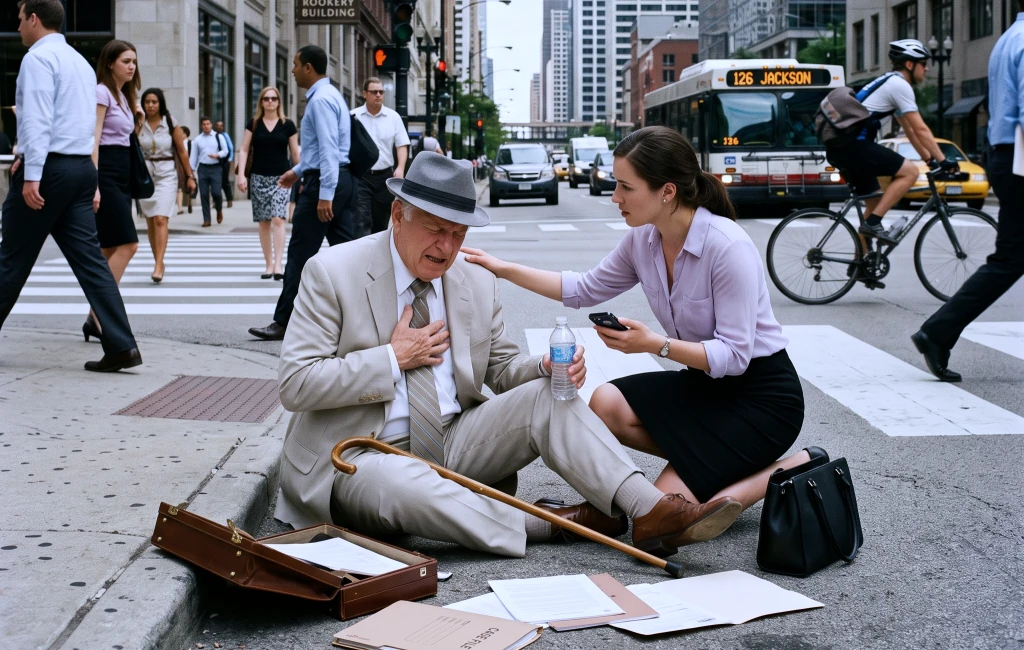
The older man took two uneven steps, caught at his collar, and folded onto the August pavement.
Mara dropped her interview folder and ran.
“Sir? Can you hear me?”
His eyes were open but unfocused. A shallow sound escaped his throat, and then his chest stopped moving in any way she could recognize.
Mara called 911 and put the phone on speaker. The dispatcher began asking questions while Mara pressed two fingers against the man’s neck, uncertain whether the faint movement she felt was a pulse or her own hand shaking.
“He isn’t breathing normally,” she said.
“Begin chest compressions.”
Mara locked her elbows and pushed. She had renewed her CPR certification every year at the produce warehouse in Rockford, treating it as one more box management required employees to check. Now the rhythm returned through her hands with brutal familiarity.
A man in a security uniform appeared at the entrance of the nearest office tower.
“You,” Mara shouted. “There’s an AED inside. Bring it.”
He hesitated only a second before running.
Another passerby stopped, a bike courier with one pant leg rolled above his ankle. Mara told him to take over compressions when her arms began to fail. He knelt without argument while she opened the red plastic case the security guard brought.
The machine gave its flat, calm instructions. Mara cut open the man’s shirt with the scissors inside the kit, fixed the pads to his chest, and made everyone move back.
Shock advised.
The man’s body lifted sharply from the pavement. The courier resumed compressions. Somewhere behind Mara, a horn blared because the open door of a delivery van was blocking traffic.
When the man finally dragged in a ragged breath, Mara nearly collapsed beside him.
The ambulance arrived less than three minutes later. Paramedics took over, fitting an oxygen mask across his face and starting an IV while Mara sat back on her heels. One knee of her navy pants had torn. Blood streaked her palm where a piece of gravel had cut it, although she had no memory of touching the ground.
The older man’s eyes found her as they raised the stretcher.
“You,” he said beneath the mask.
“I’m here.”
His fingers closed weakly around her wrist. “You were going somewhere.”
Only then did Mara see her folder lying open in the street. A tire had passed over one corner. The résumé she had printed at the public library was streaked with dirt, and the silver pen she always carried had rolled beneath a parked sedan.
“It can wait,” she said.
The man looked past her at the blue Northline Foods logo on the interview packet.
A younger man in a gray suit pushed through the gathered crowd. “Mr. Hale.”
The name landed somewhere in Mara’s memory. She had spent the previous night reading Northline’s website, including the short biography of its founder. The photograph had been at least ten years old, taken before Everett Hale’s hair had gone entirely white.
The man on the stretcher was Everett Hale.
His assistant crouched beside him, pale and breathless. Everett lifted one hand toward Mara.
“Make sure she doesn’t lose that interview.”
“Mr. Hale, please don’t talk,” one of the paramedics said.
The ambulance doors closed. Mara remained on the curb as the siren receded into traffic.
Everett’s assistant retrieved her pen from beneath the sedan and handed it to her. “Samuel Crowe. Mr. Hale’s chief of staff.”
“Mara Bennett.”
Samuel glanced at the discarded AED wrappers, the torn knee of her pants, and the folder in the gutter. “The doctors may tell you the same thing later, but you should hear it now. If you hadn’t stopped, he probably wouldn’t have survived until the ambulance arrived.”
Mara slid the pen into its worn loop. “Someone else would have helped.”
Samuel looked at the pedestrians already streaming past the place where Everett had fallen.
“Maybe,” he said.
Mara called Northline’s recruiter from the curb. She expected a polite dismissal, but the interview was rescheduled before she could finish apologizing. The operations director had been pulled into the confusion surrounding Everett’s collapse, the recruiter explained, and no candidate would be penalized.
By the time Mara reached her apartment in Albany Park, Tasha Greene had made boxed macaroni for both children and spread their crayons across the kitchen floor.
Ellie ran to the door wearing one purple sock and one yellow one.
“Did you get the job?”
“I didn’t get to the interview.”
Ellie’s face fell. For two weeks, she had been planning how they would celebrate if Mara was hired. The plan involved a strawberry sundae at the diner on Lawrence Avenue, the kind served in a tall glass with whipped cream piled above the rim.
“But they’re letting me try again,” Mara said. “No sad faces yet.”
Tasha followed from the kitchen, holding two mugs of tea. She was a freelance bookkeeper who worked while her son was at school and traded childcare with Mara when deadlines allowed.
“What happened to your pants?”
Mara told her.
Tasha lowered herself onto the arm of the couch. “You shocked the founder of the company you’re trying to work for?”
“The machine shocked him.”
“You know what I mean.”
Mara did, and the coincidence made her uneasy. She did not want Northline to hire her because Everett had collapsed in front of the one person nearby who knew how to use an AED. Gratitude was not a qualification, and she had spent too many years living with a man who turned every favor into a debt.
That evening, an unfamiliar number appeared on her phone. Samuel told her Everett was awake, alert, and scheduled for a cardiac procedure the next morning. Everett wanted to thank her properly if she was willing to visit.
“This has nothing to do with the vacancy,” Samuel added. “Mr. Hale has already instructed the hiring team to treat your application like every other one.”
“That sounds like it has something to do with the vacancy.”
Samuel was quiet for a moment. “You’re right. I’ll make sure he recuses himself.”
The answer surprised her. Mara agreed to a brief visit the following afternoon, before her rescheduled interview the next day.
Everett’s private hospital room overlooked a strip of Lake Michigan bright enough to hurt the eyes. The procedure had gone well, Samuel said, but Everett looked diminished beneath the white blanket. His voice still carried the force of someone accustomed to being heard the first time.
“My cardiologist says I was extraordinarily lucky.”
“You were standing beside an office tower with an AED.”
“I was standing beside you.”
Mara set a small paper bag on his bedside table. “The café refunded the tea I never drank. I bought you peppermint instead. Samuel says that’s allowed with your diet.”
Everett smiled. “He has become an unpleasantly effective jailer.”
Samuel, seated near the window, did not look up from his tablet. “You tried to negotiate with a cardiac nurse ten minutes after regaining consciousness.”
“I was clarifying.”
“You were losing.”
Mara laughed before she could stop herself. Everett watched her with an expression that softened the hard lines around his mouth.
He asked about the rescue, although Samuel had already told him everything. Mara described the courier, the security guard, and the dispatcher who had kept her focused.
“You keep distributing the credit,” Everett said.
“There was plenty to distribute.”
“Then let me thank you for your portion.”
“You just did.”
He reached toward a leather portfolio on the bedside table. “Northline can offer—”
“No.”
Everett’s hand stopped.
“I’m sorry,” Mara said. “But if you offer me a job, money, or anything else, I’ll spend the rest of my life wondering whether I earned it. I need this interview to be real.”
For an instant, irritation tightened his face. Then he glanced at Samuel, who gave him no help.
“All right,” Everett said. “The interview will be real.”
Mara stood to leave. As she lifted her folder, the silver pen slipped free and rolled across the tray table.
Everett caught it before it fell. His thumb passed over the engraved initials.
D.H.
The color left his face so quickly that Mara reached for the call button.
“Are you in pain?”
Everett turned the pen over. Near the clip was a shallow diagonal groove, darkened by age.
“Where did you get this?”
“It belonged to my father.”
Everett’s eyes rose to hers. “What was his name?”
“Daniel Hale.” Mara took the pen from his unresisting hand. “He died last winter.”
Everett stared at her as if something far more violent than his failing heart had struck him.
“Daniel Hale was my son…”
To read the rest of the story – CLICK the NEXT button 👇👇👇