


The piano bench scraped hard across the floor when Ms. Pike pulled it away from the grand.
Lucy Mercer knew the sound was meant for her before the teacher said her name.
“If you have a different interpretation, Lucy, you may share it with the class.”
Twenty-six fifth graders turned toward the last row. Lucy stopped moving her fingers against her knee.
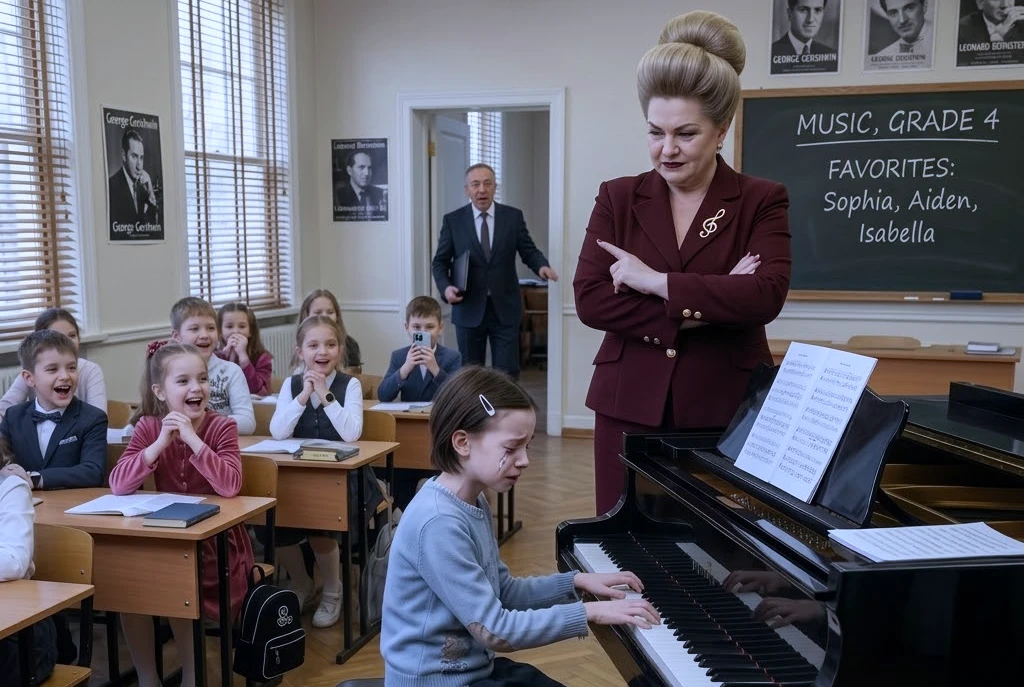
At the piano, Sophie Keene still held both hands above the final chord of her Mozart sonata. Her cheeks were pink. She had rushed the transition again, and Lucy had silently pressed the missing F-sharp against her jeans without realizing Sophie could see.
“I wasn’t correcting her,” Lucy said.
Sophie twisted on the bench. “You do that every time I play.”
Lucy lowered her hands. She had been checking whether she still knew where the notes belonged. Explaining that would require explaining everything before it, so she said nothing.
Ms. Pike waited. She was good at waiting when silence made a child more uncomfortable than an answer would have.
Three weeks at Cedar Ridge Elementary had taught Lucy that the music teacher valued preparation above nearly everything. Ms. Pike kept spare reeds labeled by size, tuned the ukuleles herself, and could hear Dylan Reyes lose the beat beneath twenty other children.
But she also decided quickly who had practiced, who had not, and whose mistakes were worth waiting through.
Lucy had arrived in Millhaven with no instrument case, no private-lesson binder, and a sweatshirt whose right cuff her father, Dan, had repaired with thread that did not quite match. On the music survey, she had left the question about previous training blank.
Ms. Pike folded her arms. “You’ve watched that piano during every class. You touched it after I specifically posted a rule asking students to get permission. Now you’re fingering corrections while Sophie plays.”
“I touched one key.”
“Without asking.”
Lucy looked at the sign taped inside the piano’s raised fallboard.
PLEASE ASK BEFORE PLAYING.
She had known the rule. On her fourth day at Cedar Ridge, she had stayed behind while the others lined up and pressed middle C with one finger. She had wanted to know whether the key would push back. It had, and the note had filled the room before she could stop it.
Ms. Pike had seen her.
“Come up here,” the teacher said.
Lucy kept her hands beneath the desk. “I’d rather not.”
“This is not a punishment. If you hear something the rest of us are missing, demonstrate it.”
“I don’t want to play.”
A few students looked down. Dylan began turning one of his drumsticks between his palms.
Ms. Pike’s voice stayed level. “That wasn’t an invitation.”
The music room had two doors. One opened into the hall. The other led to a storage closet with no exit. Lucy counted the chairs between her desk and the piano: four rows, six steps through the aisle, then three more across the rug.
She could refuse again. Ms. Pike might send her to the office or call Dan away from work. Either would be easier than touching a real piano while everyone watched.
Then Sophie slid off the bench. She looked embarrassed and angry, and Lucy understood that her private checking had not stayed private. Whatever Lucy had intended, Sophie had spent three weeks feeling examined from the back row.
Lucy stood.
“I’ll play only the part I know.”
Ms. Pike moved aside. “Anything simple will be sufficient.”
The grand piano occupied the center of the room, black and polished, with shallow scratches around the music rack and a worn patch on the right pedal. Lucy had noticed all of it on her first morning. She had also noticed that the action was probably heavier than the upright her mother had owned.
Elise Mercer’s piano had stood against the living-room wall in their old house outside Harrisburg. She taught there in the afternoons, accompanied school choirs, and played auditions whenever she could find the work.
She began teaching Lucy at four, first with songs about rabbits and rain, then scales, Bach, and pieces whose titles Lucy learned to pronounce only after her hands knew them.
During Elise’s last winter, lessons became shorter. Some days she could sit beside Lucy for twenty minutes. Other days she lay on the couch and called corrections across the room.
“Don’t strike at it,” she would say when Lucy attacked a difficult note. “Let your hand arrive there.”
Elise died seventeen months before Ms. Pike moved the bench.
The piano stayed another four months. Then two movers wrapped it in quilted blankets and rolled it down the front steps while Dan stood on the lawn signing a receipt. The house went soon afterward.
Lucy and her father moved into an apartment, then a smaller one, and finally to Millhaven when Dan found steady maintenance work at a cold-storage warehouse.
On their first night without the piano, Dan taped six sheets of printer paper across the kitchen table. He used a ruler, a blue ballpoint pen, and measurements copied from a public-library computer. He drew every white key, shaded every black one, erased two crooked octaves, and began again.
The paper made no sound and offered no resistance. It could not teach weight, balance, or pedal. But Lucy could preserve fingerings on it. She could tap rhythms, work through a score, and keep pieces from disappearing completely.
She had not touched a real keyboard in thirteen months.
At Cedar Ridge’s grand, she turned the bench knobs until the height felt close to right. She sat near the front edge and found the pedals with the toes of her repaired sneakers.
The room had become so quiet that she could hear the fluorescent fixture above the guitars.
“Would you prefer a scale?” Ms. Pike asked.
Lucy shook her head.
She placed her fingers over the opening of Debussy’s Clair de Lune. Her hands remembered the distance, but the keys beneath them were no longer flat blue drawings. They pressed upward into her fingertips.
The first chord came out harder than she intended.
Someone shifted in the second row. Lucy lifted her foot from the pedal a fraction too late, and the harmony blurred at the edges.
She nearly stopped.
Then the key rose beneath her finger. That small return steadied her more than the sound had. She adjusted her weight and tried the next phrase.
The melody entered quietly. Her right hand was stiff, and an inner note failed to speak, but the line itself remained where Elise had left it. Lucy followed it through the opening page, listening instead of trying to reproduce the living room she had lost.
The grand’s bass was deeper than the old upright’s. Its middle register had a bright edge she had not expected. Each difference demanded a choice that paper never had.
By the second page, her forearms had begun to tire. Lucy released more weight into the keys and let the phrases lengthen.
She no longer saw Sophie or Ms. Pike, but she did not imagine the classroom gone. Dylan’s drumstick stopped turning. A chair creaked near the windows. The heater clicked once and fell silent.
She reached the passage Elise had taught from the couch, counting aloud when her voice was still strong enough. Lucy missed the top of one broken chord, found the harmony beneath it, and continued without going back.
Then she arrived at the measure where the lessons had ended.
Lucy knew how the rest sounded. She had heard Elise play it many times. But hearing a passage and knowing how to bring it through two hands were different things.
Her wrists tightened above the next chord.
For a moment, she considered guessing. Ms. Pike was standing three feet away, and Sophie knew the piece well enough to recognize where Lucy had stopped. Continuing badly might turn the whole performance into what the teacher had expected.
Lucy took her foot off the pedal and lifted her hands.
The unfinished phrase hung in the room before thinning into the hum of the lights.
No one moved.
Then Dylan put down his drumsticks and clapped twice. A few others joined him. The applause spread unevenly—not a roar, but enough to make Lucy’s face burn.
Sophie rose from the chair beside the piano. She did not clap at first. She looked at Lucy’s hands, then at the open space above the keys where the rest of the piece should have been.
Finally, she brought her palms together.
Ms. Pike’s arms were no longer folded. Her expression had changed, but Lucy could not tell whether the teacher was surprised, angry, or trying not to show either.
“Where did you study?” she asked.
“At home.”
“With whom?”
“My mother.”
“Does she still teach?”
Lucy bent to pick up her backpack. The zipper had caught beneath one strap. When she tugged it free, her music folder slid out, followed by a long strip of folded paper.
It struck the floor and opened across the rug.
Six sheets, joined with yellowing tape. Blue outlines divided the white keys. The most-used notes were gray and soft from Lucy’s fingers, and one seam had been repaired with the clear glue Dan used on her shoes.
Ms. Pike stared at it.
“What is that?”
Lucy knelt and spread the paper flat across the front of the grand.
“This is my piano…”
To read the rest of the story – CLICK the NEXT button 👇👇👇