


By the time Deputy Lena Ortiz admitted the old service road had been a mistake, the smallest puppy had stopped crying. He wore a strip of blue veterinary tape around his temporary collar. Five weeks old, all rib and velvet ear, he lay against Lena’s chest beneath her rain jacket while his two littermates bumped and whimpered inside the carrier hooked over her other arm. A quarter mile downhill, her patrol SUV leaned toward Laurel Creek with its rear tires sunk to the rims and brown water running beneath the chassis.
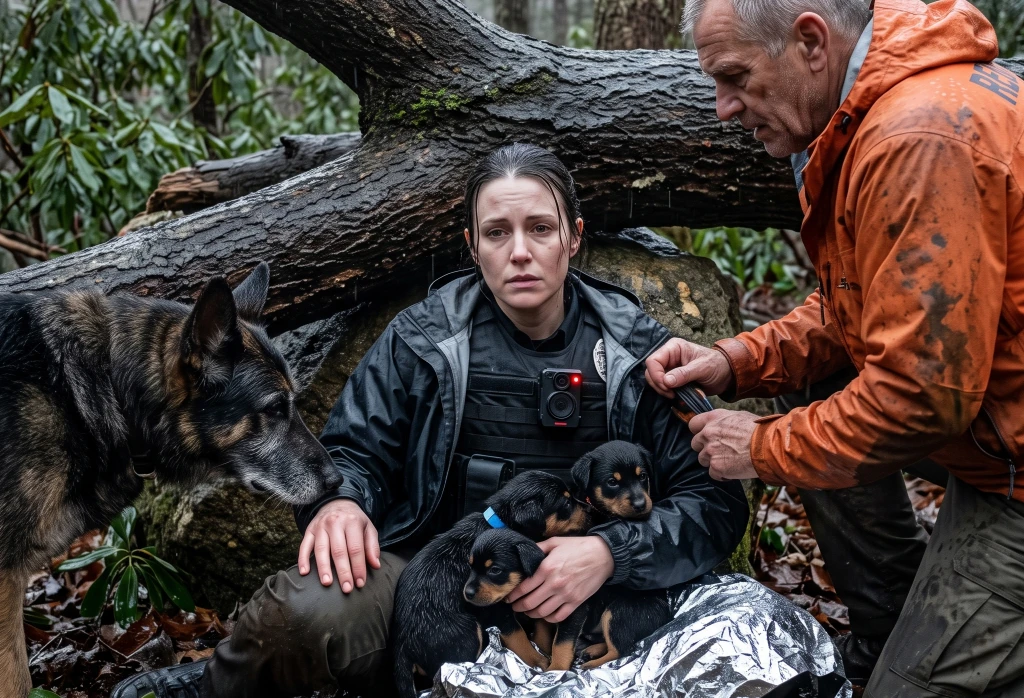
The vehicle had shifted once after she climbed out. It would shift again. At thirty-nine, Lena had been in uniform long enough to know that staying inside had ceased to be the safe choice—and that almost every choice before it had been hers.
She had been told to take the puppies from the county shelter to a veterinary foster on Route 16, where a generator was keeping one room warm. She had been told to wait at the flooded junction for a second unit. Instead, she had watched a Voss Timber truck come through the lower gate at the county watershed with one sawn trunk still carrying the red blaze used on protected boundary trees. She had double-tapped her body camera, felt its confirming vibration, and said the truck’s unit number aloud for the recording. Then she had followed it onto a road Sheriff Dana Keene had specifically ordered her to leave alone.
Lena had not called in the turn. She had known what Dana would say.
Now rain moved through the western North Carolina woods in hard gray bands, and the old connector road had become a creek with tire ruts. Cal Mercer’s cabin was less than a mile uphill if she remembered the forestry map correctly. She had not been there since the first winter after her mother’s death, but she could still picture the porch, the stacked oak by the chimney, and Rook’s muddy nose nudging open the screen door.
The puppy marked blue made a dry clicking sound in his throat. Lena stopped beneath a white oak, tucked the carrier between her boots, and opened her jacket farther. His belly felt cool through her uniform shirt.
“Stay with me,” she said, rubbing him through the fleece square she had taken from the shelter. “I already made this stupid enough. Don’t make it worse.”
One of the other puppies pushed a white forepaw through the carrier door. Lena slipped him under her jacket too, then the third, building a damp, squirming bundle against her ribs. The empty carrier knocked against her knee as she stood.
The sound above her was not thunder. It was slower and rougher, wood fibers separating one by one beneath the wind.
Lena looked up. The oak’s crown moved while the trees around it held still.
She lunged uphill toward the road. Her boot slid, the carrier strap caught her elbow, and a forked limb came through the lower branches in a rush of leaves and water. One fork struck a boulder and took most of the weight. The other pinned Lena’s left leg just above the ankle.
Pain drove the air out of her. She folded over the puppies before the rest of the crown hit, taking twigs across her shoulders and the back of her head. Her portable radio tore from its clip and vanished into wet fern several feet away. She heard dispatch talking through it, close enough to recognize a voice and too far to answer.
For a while she could do nothing but breathe through her teeth.
The puppies moved against her. White Paw squealed. The third, marked yellow, dug blindly at the front of her shirt. Blue remained quiet until Lena pulled an emergency blanket from her belt pouch with shaking fingers and tucked its silver folds around all three. Then he gave one thin complaint.
“That’s better,” she whispered.
Her body camera was still clipped to her vest. A red light blinked beneath a wet leaf, patiently recording the underside of a branch. Lena touched it once, then reached toward the radio. The limb held her too tightly. Pain traveled up her shin in bright waves whenever she stretched.
She had missed her status check by now. The patrol SUV’s locator would show her last position if the storm had not swallowed the signal. It would also show the turn she had chosen not to report.
Instead, Lena pictured Dana reading the locator track and found no comfort in it.
At sixty-one, former Navy corpsman and county paramedic Cal Mercer kept the search frequency turned low enough that voices blurred into the woodstove and the rain. He no longer wore a pager for Ashford Mountain Rescue, but he had never managed to turn the radio off entirely. His wife used to say that he could leave the Navy, the ambulance service, and the rescue roster, yet still arrange a room around the nearest exit.
Lena’s mother, Ana, had been dead nineteen months. The radio remained beside the coffee pot.
When Dana Keene called his cell, Cal watched her name appear until the third ring. Eleven-year-old Rook lifted his gray muzzle from the braided rug.
“Cal, I need your dog.”
No greeting. Dana had always spent words carefully when someone might be dying.
“He’s retired.”
“His certification runs through next month. Is he medically available for a short track? Lena missed two checks. Her unit pinged on the old watershed connector before the signal dropped, and both road teams are below the washout. You’re on the north side.”
Cal looked at the anti-inflammatory tablets lined up beside his own coffee mug. The veterinarian had said short exercises, level ground, no more working slopes. He should have answered no.
“If the terrain allows,” he said.
Cal was already reaching for the orange search pack he had not opened since spring. Rook got to his feet more slowly. His rear legs trembled once before settling beneath him.
“How long?” Cal asked.
“More than forty minutes since her last transmission. She has three young dogs in the vehicle.”
Rook knew Lena’s name. One ear turned toward the phone.
“Two firefighters are coming up from the north station,” Dana said. “Meet them at your lower gate. Their captain has command, and you do not deploy alone. Call every turn.”
The firefighters reached Cal’s lower gate as he buckled Rook’s harness. They rode six minutes down the ridge in Cal’s utility vehicle, then went the last hundred yards on foot. The rescue captain took command at the patrol SUV, which sat canted beside the overtopped culvert with its driver’s door open and rain needling the pale interior. A plastic carrier liner lay in the passenger footwell beside three empty feeding syringes and a shelter form sealed in a zipper bag.
Rook circled once. He sniffed the driver’s seat, the muddy print below the door, then raised his nose toward the uphill woods.
Cal clipped the long line to the dog’s harness. “Find Lena.”
Rook did not lunge. He set off with the economical certainty of age, choosing the firmer edge of the road and pausing where water crossed the scent. Cal reported their direction and followed, keeping slack in the line. The firefighters stayed far enough behind to leave the dog room, marking the route and carrying the medical pack. Cal noticed one small boot slide, then another, the rectangular bite where the carrier had struck mud, and a blackberry cane bent sharply uphill.
They were less than half a mile from the SUV when Rook stopped.
At first Cal heard only water. Then a puppy cried from somewhere below the road, so faint it might have been a hinge moving in the wind. Rook left the track, pushed his muzzle between two dripping rhododendrons, and gave a single bark.
“Rook?” a woman called weakly.
The dog pulled hard enough that Cal had to brace. He followed the line down a short bank and saw a silver emergency blanket trembling beneath the broken crown of the oak. Lena’s face appeared under it, colorless except for a scrape along her cheek. Three small black-and-tan heads were crowded beneath her chin.
Rook reached her first. He lowered himself awkwardly in the mud and pressed his nose to her exposed hand. Lena closed her fingers over his muzzle.
“You got old,” she told him.
Cal dropped beside the limb. The fork had trapped her lower leg, but the heavier branch was bearing against a boulder rather than her body. Her boot was wet and muddy; when he touched the leather over her toes, she felt it. There was no heavy bleeding he could see.
“Leni. Look at me.”
Her eyes found his. For an instant the storm, the uniform, and the years since Ana’s funeral fell away, and he saw the fourteen-year-old who had met him at her mother’s apartment door with a science fair volcano in both hands and asked whether Navy people knew how to fix plaster.
Then Lena’s mouth tightened. “Don’t move the branch.”
“I won’t. Fire-rescue will crib it and lift.”
Cal keyed his radio and gave incident command the coordinates, Lena’s condition, and the equipment the extraction team would need. He waited for the rescue captain to repeat the location. Then he put a dry cap over Lena’s hair, eased a wool blanket around her shoulders, and slid a folded ground pad beneath the puppies without removing them from the heat of her body.
The blue-marked pup finally began to squirm.
“Dana sent you?” Lena asked. “She has a team coming from the north trail.” Lena’s hand shot out and closed around his sleeve. “Then take my body camera before she gets here…”
To read the rest of the story – CLICK the NEXT button 👇👇👇