


Eleven days before Clara Bell’s wedding, Anna Adebayo found the bride kneeling on the executive floor in a spill of champagne, picking a sliver of glass from a young server’s shoe.
“Don’t move,” Clara told him. Her voice was gentler than Anna had ever heard it. “You’ll drive it in deeper.”
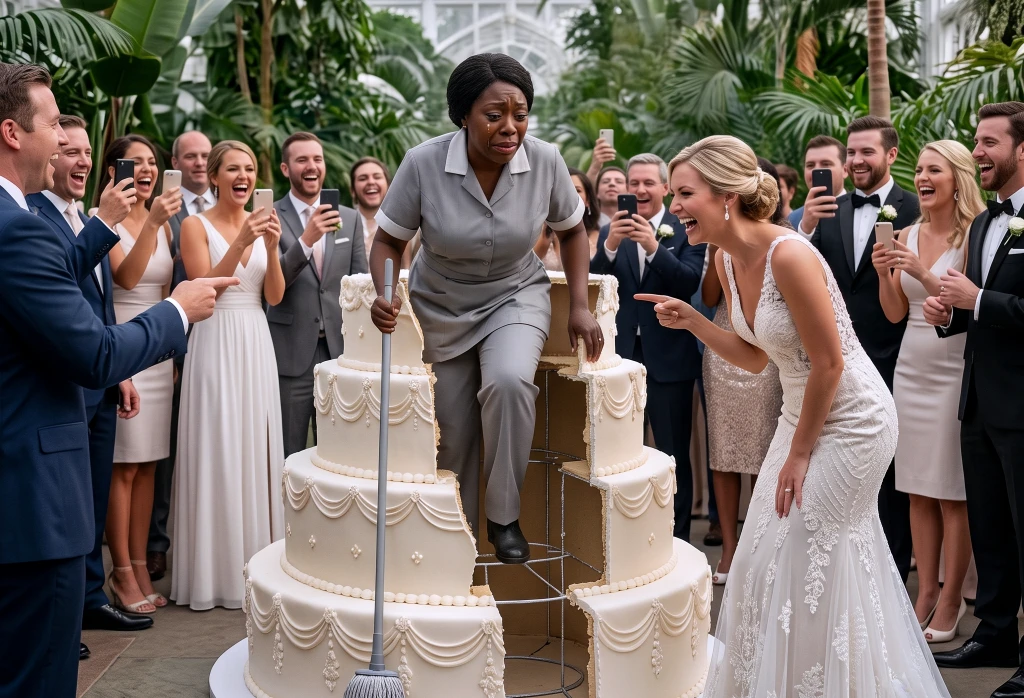
The young man stood rigid, a silver tray pressed to his chest. Around him, the conference room had been arranged for a bridal brunch no one on the cleaning crew had been told about: white roses crowded the credenza, garment bags hung from the coat hooks, and six women in pale silk watched from the safe side of the spill. Beyond the glass wall, downtown Atlanta floated in August haze.
Anna set down her caddy and folded a clean towel into a square. “I’ve got it.”
Clara looked up. For an instant, concern remained on her face. Then she saw the gray Bellwether Tower uniform, the rubber-soled shoes, and the badge that said only ANNA, and the familiar coolness returned.
“He needs first aid.” Anna nodded toward the thin line of blood above the young man’s sock. “The tile can wait.”
One of the women gave a small laugh, as if Anna had corrected the order of a ceremony. Clara did not. She rose and told her assistant, Brooke, to walk the server downstairs. It was a decent decision, quickly made. Anna noticed because Clara was not careless. That was part of what made her cruelty difficult to dismiss as simple stupidity.
By the time Anna had lifted the glass with damp paper and blotted the champagne from the grout, the women had resumed their talk about peonies, weather tents, and whether the string quartet should play through cocktail hour.
Clara stood at the head of the table in a cream pantsuit, answering three questions at once. She knew the florist’s delivery window, the photographer’s backup plan, and which guest could not be seated near Victor’s chief financial officer. At thirty-four, she had the hard polish of someone who believed preparation could keep embarrassment from entering a room.
Clara was Bellwether’s vice president for communications and social impact, a position she had held before she and Victor began dating. The wedding occupied her friends, but the charitable-fund announcement, the production crew, and the language on every screen belonged to her professional territory.
“Anna,” she said suddenly. “Wait.”
Anna had already fitted the wet-floor sign beneath one arm. Clara took a thick envelope from a stack beside the place cards, wrote something across the front, and held it out.
The women went quiet in the particular way people did when they had been waiting for a private joke to become public.
“We had a cancellation,” Clara said. “You should come next Saturday.”
Anna did not take the envelope at first. Gold leaves bordered Clara Bell and Victor Miles’s names. Piedmont Conservatory, five o’clock. Black tie.
“To the wedding?”
“Unless you have somewhere better to be.” Clara smiled, and two of her friends looked down at their phones. “You keep Victor’s building presentable. It feels right that you should see it when the rest of us are presentable too.”
Brooke had returned without the young server. She stopped just inside the glass door, her tablet hugged against her ribs.
The tallest bridesmaid, a woman Anna had once heard complain that the hand soap in the executive restroom smelled cheap, tilted her head. “Do you own anything appropriate for black tie, Anna?”
“Brynn,” Clara said, but the warning came after the smile.
Anna took the invitation. The card stock was heavy enough to hold its shape between them.
“I own clothes,” she said.
Brynn’s mouth twitched. Clara’s did not.
“Of course you do. And please don’t come straight from a shift. I want you to feel like a guest.”
There were answers Anna could have given. Eight years of cleaning offices had taught her that people revealed themselves most completely when they believed the person emptying the trash had no reply.
She could have asked whether invitations were usually delivered in front of women trying not to laugh. She could have reminded Clara about the diamond earring Anna had found in a sink trap and returned before Clara accused the catering staff of taking it. She could have told her exactly what the remark sounded like.
Instead, she slid the envelope into the outer pocket of her cart.
“Thank you,” she said. “I’ll let you know.”
Clara’s disappointment was so brief that anyone not accustomed to watching reflections in dark glass would have missed it.
Anna finished the executive floor by eleven. She checked the supply-closet inventory, replaced the wheel on Marisol’s vacuum, and changed Friday’s schedule so Darnell could take his daughter to an orthodontist appointment without losing four hours’ pay.
At forty-six, Anna had learned not to confuse the logo on a building with the people who kept it functioning. On the executive floors, people read her dark skin, gray uniform, and rubber-soled shoes before they read ANNA.
The company name on her shirt was not Bellwether. Like everyone on the day and night cleaning crews, she worked for a contractor whose supervisors spoke often about family and scheduled as if none of their workers had one.
She had started as a night porter and become a floor lead without asking for the title. The work suited the part of her that trusted visible results. A room was ready or it was not. A key was signed in or missing. If someone spilled coffee at six, no one needed a committee to decide what responsibility looked like.
Near eleven-thirty, she wheeled her cart toward the freight elevator. The wedding invitation seemed to give off heat through the canvas pocket.
She had almost reached the service corridor when Brooke Shaw came through the fire door behind her.
“Anna. Please wait.”
Brooke was twenty-seven and unnervingly competent. She carried Clara’s second phone and spare chargers, remembered allergies, and could locate Victor Miles in a building with forty-two floors by asking two questions. Clara trusted her with everything except the right to disagree. Now Brooke’s face was pale beneath her makeup.
“If this is about the spill, I filed the incident form,” Anna said. “The server should get the cut checked.”
“It isn’t the spill.” Brooke glanced toward the camera above the elevator, then led Anna into the linen room and let the door close. “You can’t go Saturday without knowing why she invited you.”
Anna rested both hands on the cart handle. “I know enough.”
“No, you don’t.” Brooke woke her tablet and opened a reception program. “Clara is announcing a personal fund she and Victor are creating. It’s supposed to offer one-time grants to contract employees who want training or help starting a business. She wanted the first grant to be a surprise.”
The wedding videographer had filmed Bellwether after hours for a short piece about Victor’s work. Clara had recognized Anna in the footage, used the contractor roster to confirm her surname, and found an old foundation portrait online.
Anna looked at Brooke. “A surprise for whom?”
Brooke turned the screen.
There was Anna on the twenty-ninth floor, pushing a mop beneath the blue light of an empty conference room. The photograph had been taken through glass and from behind. Her shoulders were slightly bent; one hand was wrapped around the handle, the other pressed to the small of her back.
She remembered that night. The freight elevator had failed, and she had carried supplies up six flights.
Above the image, gold letters announced THE OPEN DOOR FUND. Below it, a paragraph described “a hardworking woman who had spent years unseen in the halls of power” and would receive twenty thousand dollars for “education, reinvention, and a life beyond service.”
Anna read to the bottom. Beneath a photograph she had not permitted, someone had placed a sentence in quotation marks and signed her first name to it.
For the first time in my life, someone sees me.
The linen-room door opened before Anna could ask who had written it.
Clara stood in the service corridor. Without the bridesmaids behind her, she looked younger and more tired. One hand remained on the door, and for a second nobody spoke.
Then Clara looked at the tablet. “I told you that slide wasn’t ready, Brooke.”
Brooke lowered the screen but did not apologize.
Anna took the wedding invitation from her cart. “You can keep the money. Remove my picture and the words you put in my mouth.”
Something moved across Clara’s face—not embarrassment, as Anna expected, but an old anger finding the shape it had been waiting for.
“You really don’t remember me.”
Anna studied her. Clara’s last name had been printed in business magazines and wedding announcements for months. Bell. Nothing in it opened a door.
Clara gave a short, humorless laugh. “Clara Dawson Bell. I went by Dawson then—my mother’s name. Adebayo Scholars, class of 2012.” She stepped closer. “Your foundation promised to help pay my first year at Spelman. Then the check never came, and nobody from your office would return my mother’s calls.”
The invitation bent slightly in Anna’s hand. “You don’t remember,” Clara said again. “That’s why I want you at the wedding…”
To read the rest of the story – CLICK the NEXT button 👇👇👇