


The trail camera sent the photograph at 5:43 on a February morning, while Walter Briggs was standing at his kitchen sink with one hand under the faucet. A gray wolf sat behind the rusted gate of Caleb Turner’s cabin, squarely in the path where Caleb used to come down the steps before dawn. Snow had collected along the animal’s back. He was not nosing the trash barrel or circling the shed. He faced the dark porch and held still, as though stillness itself were part of an old arrangement.
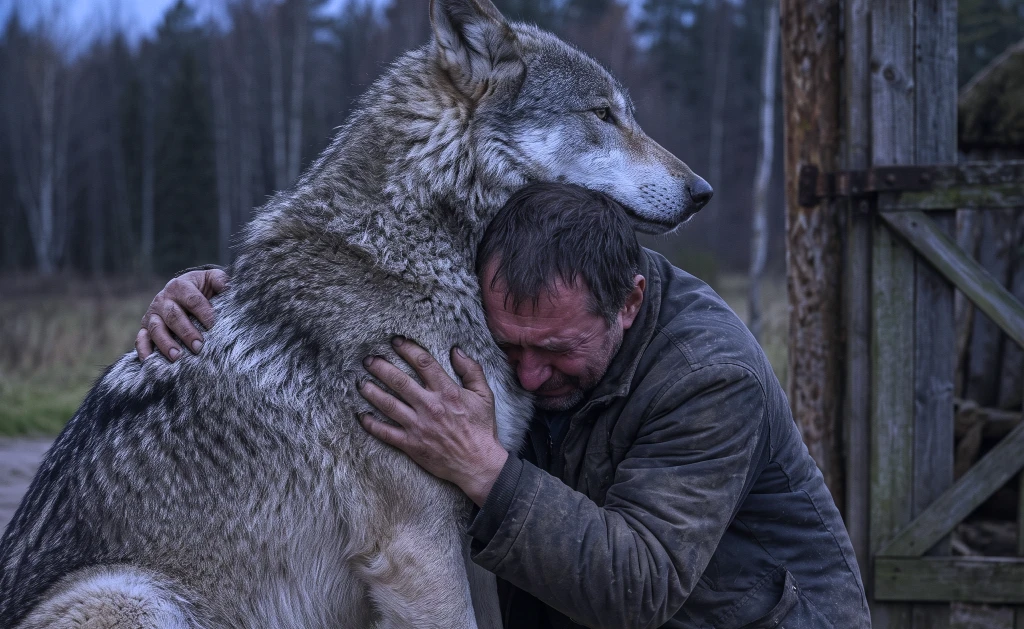
Walter dried his hand on his jeans and enlarged the image. The left foreleg rested a little farther forward than the right. One ear had a shallow notch along its outer edge. Age had lightened the fur around the muzzle, but Walter knew him.
Scout had come back for a fifth winter.
Not every morning, as people later liked to say. Not all year. Wild animals did not keep promises on human calendars. But every winter since Caleb left, the camera had caught the wolf at the gate—sometimes three mornings in a month, sometimes ten—usually in the narrow blue hour before daylight, when Caleb once started his patrol.
Walter had never sent him food. He had never called to him or stepped between him and the timber. The camera was there to make sure the abandoned cabin did not become a den, a poacher’s shelter, or a danger to hikers. After Walter retired, the conservancy gave him a key and asked him to keep servicing it.
The other reason was on his phone.
He drove north before breakfast. The plowed county road ended twelve miles short of the property, so he left his truck by a sand shed and took a snowmobile along the old service track. Fresh powder softened the stumps and filled the ruts, but the cold had hardened the lower drifts enough to carry his weight.
At the last bend, Walter cut the engine. The sudden quiet exposed small sounds: spruce needles ticking in the wind, the cooling machine beneath him, a raven somewhere over the ridge.
The gate stood closed. Beyond it, Caleb’s cabin leaned slightly toward the chimney. A windstorm had peeled two sheets of tin from the roof, and snow had found the opening. The North Woods Land Conservancy planned to dismantle the place in April, when equipment could travel over frozen ground without tearing up the wetland. Nearly five years earlier, Caleb had signed the land over to them and kept only the right to remove his belongings, a right he had never used.
Walter walked the last hundred yards, carrying no rifle and no pack that smelled of meat. He checked the camera, replaced its batteries, and studied the tracks at the gate. The wolf had come from the west, sat for some time, then returned by the same route. There was no circling, no scavenging, no sign that a pack had gathered nearby.
Inside the cabin, cold had flattened every smell except mouse droppings, old ash, and cedar. Caleb’s chipped blue mug still hung from a hook. Field notebooks filled one end of a shelf, their spines labeled by month in his square handwriting. A wool coat Walter had once loaned him remained behind the mudroom door.
Walter had stopped asking for it back before either of them went gray.
He cleared snow from the broken roof brace, set a basin under the drip, and went outside again. The sky had begun to pale. He was fastening the gate when movement among the black spruce made him lower his hands.
The wolf stood thirty yards away.
In person, Scout looked smaller than memory and more completely wild. His winter coat broadened his shoulders, but age showed in the careful way he placed the injured forefoot. He looked at Walter, then past him. His face gave Walter nothing Walter could safely call recognition.
Walter turned slightly sideways and kept his eyes low. He did not speak.
Scout waited. A faint current of air moved from the cabin toward the trees, carrying cedar, old ash, mice, and the cold smell of the empty rooms. The wolf lifted his nose once. Then he crossed behind a screen of spruce and was gone without a branch moving after him.
Walter stood there until the cold reached through his gloves. Back at the snowmobile, he called Caleb. The line rang six times.
“Briggs.” Caleb’s voice was rough with sleep. He worked south now, where farm fields divided the woods and most complaints involved raccoons in attics or deer hit on two-lane roads. “Somebody dead?”
“Not that I know of.”
“Then it’s too early.”
Walter looked toward the bend where the cabin had disappeared. “I saw him.”
The silence changed. Caleb did not ask whom he meant.
“At the camera?”
“At the gate. Close enough to see the old leg.”
Caleb breathed out through his nose. Walter could picture him sitting on the edge of his bed, elbows on his knees, the way he used to sit after a long night call.
“Did he come to you?” Caleb asked.
“No.”
“Good.”
It was the right answer, and Walter disliked him for how much it cost.
He told Caleb about the roof and the conservancy crew coming in April. The gate, porch, and cabin would be removed. The field notebooks could be boxed and mailed, but the warped chest beside the stove and Caleb’s father’s hand plane needed a decision.
“Let them take it all,” Caleb said.
“You haven’t seen the plane.”
“I know what it looks like.”
“That wasn’t my point.”
“It usually isn’t.”
Five years had not restored the easy part of their friendship. They could discuss weather, staffing, and old cases. They could not discuss the week Walter filed the report that ended Caleb’s life at the cabin.
Walter rested one glove on the snowmobile seat. “He’s still checking the place because we left it standing.”
“Then April solves that.”
“You sound relieved.”
“I am.”
Walter looked back at the wolf’s single line of tracks. “I locked that gate after you drove out. He sat in the trees and watched me do it. You never came back, not once, though you knew he kept coming.”
“I knew.” “We’ve talked around it for five years. Say it once. Why did you leave him here…”
To read the rest of the story – CLICK the NEXT button 👇👇👇