


The first motorcycle turned into June Keller’s driveway while her phone was vibrating under a dish towel. She had put it there so she would not have to watch Anna’s name light up again. Her daughter had already left two messages about the storm warning, as if June could not see the bruised sky coming over Bill Williams Mountain or smell rain in the dust. At seventy-three, June trusted her knees, the ants climbing the porch post, and the metallic taste in the wind more than any alert sent from Phoenix.
What she did not trust was the west slope of her roof. The last monsoon had opened a stain above the upstairs hall, and that afternoon the plaster had begun to blister.
The rider coasted to a stop beside the broken third porch step. Behind him, more headlights appeared on old Route 66—first four, then ten, then a long staggered line. The storm was coming behind them, swallowing the ponderosa pines in a gray sheet.
June stepped through the screen door. It scraped the porch boards and hung open at an angle.
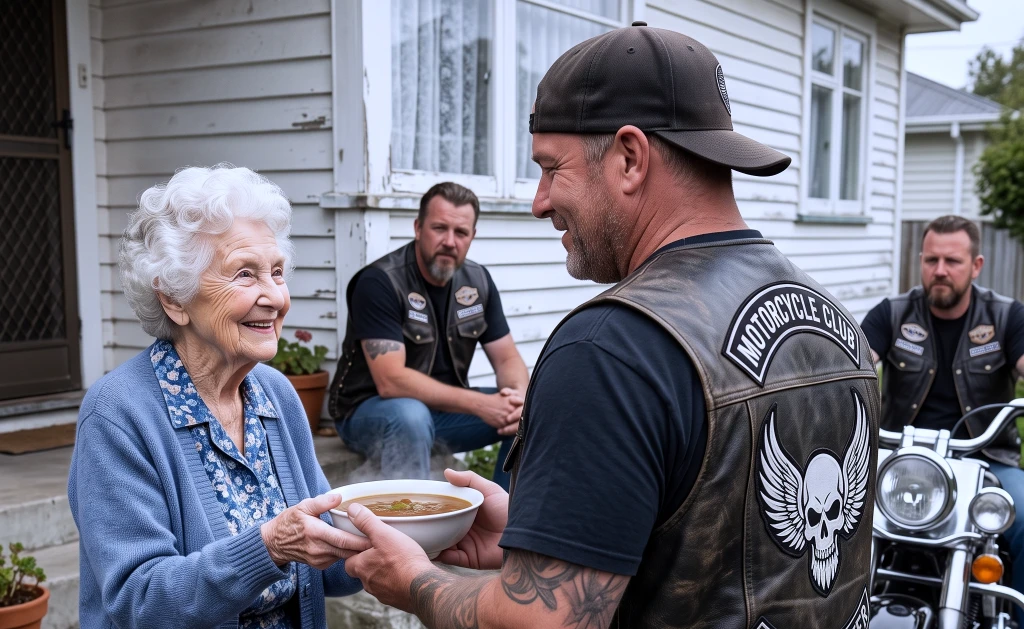
The lead rider removed his helmet. He was broad through the shoulders, with iron-gray hair flattened against his head and rain already darkening the collar of his black vest. A red mesa and a white raven were stitched across the back. RED MESA RIDERS curved above them.
“Ma’am,” he called. “Is that old service station canopy still standing down the road?”
“Standing isn’t the same as safe.”
He looked over his shoulder. The riders behind him had begun turning their bikes sideways against the gusts. June counted fourteen before she lost track.
“We’ve got lightning on both sides of the highway,” he said. “We only need a place to wait.”
The first hard drops struck the porch roof like thrown gravel. June pointed around the house. “There’s a carport out back. Put the bikes in tight and come through the mudroom. Don’t use these steps.”
The man’s eyes moved from the missing stair tread to the sag in the porch, then up to the patched roof.
“There are a lot of us.”
“I can count.”
“You sure?”
Thunder cracked close enough to tremble the loose pane beside June’s front door.
“I’m sure you’re wasting the dry minutes,” she said. “Move.”
He gave one sharp nod. The line came alive.
They wheeled the motorcycles behind the house with more order than June had expected, fitting chrome and black steel beneath Walter’s old carport until the handlebars nearly touched. Two riders stretched tarps over the bikes left outside. Another wedged a folded rag beneath the carport gutter where it had pulled loose. By the time the last rider reached the mudroom, the rain had erased the garden fence thirty feet away.
They entered carefully. Boots came off without June asking. Wet jackets were hung from nails, chair backs, and the rail Walter had installed for winter coats. Nobody commented on the bucket beneath the ceiling stain or the towel stuffed along the kitchen windowsill.
The lead rider stood in his socks on the cracked linoleum and offered his hand. “Cal Mercer.”
“June.”
His grip was dry and brief despite the water running from his sleeves. “You’ve done enough already, ma’am. We have snacks in the saddlebags.”
“Fourteen people can’t sit in my house eating beef sticks while I have a stove.” She opened the freezer. “And it’s June.”
She began taking inventory the way she had in the Williams middle-school cafeteria: not by what was missing, but by what could be made to serve one more table. A pound and a half of ground beef. Four cans of pinto beans. Two cans of tomatoes. Elbow macaroni, an onion, six small zucchini from the garden, half a loaf of bread, and enough coffee if no one expected it strong.
“I need a knife that can still cut and two people who listen,” she said.
A compact woman with a silver streak in her dark braid stepped forward. “I can do both.”
“Name?”
“Denise Shaw.”
“Dice the onion and zucchini. Small.” June pointed to a lanky young rider hovering near the sink. “You—open cans. Rinse the beans first.”
“Yes, ma’am.”
“If you call me ma’am every time, supper will be breakfast.”
The young man smiled despite himself. “I’m Noah.”
Someone retrieved tortillas and two cans of corn from a saddlebag. Another rider produced a vacuum-sealed package of smoked sausage and surrendered it after June inspected the date. Cal tried once more to tell her it was too much work. She handed him the wooden spoon.
“Keep the bottom from scorching.”
Outside, water rushed through the dry wash beyond the garden. Inside, the house filled with chopped onion, damp wool, hot coffee, chair legs scraping, and apologies whenever somebody stepped on a boot.
June had expected noise. What unsettled her was their caution.
A man with tattooed knuckles folded his wet bandanna before setting it on Walter’s piano. Two younger riders spread their own jackets beneath a leaking window. Noah asked before plugging in his phone. When the wind drove rain under the crooked screen door, Cal crouched and laid a towel against the threshold, then tested the loose lower hinge with his thumb.
“Don’t,” June said.
He looked up. “Don’t what?”
“Start fixing things. You’ll never get out of here.”
“Wasn’t fixing. Just looking.”
“That’s how it starts.”
The corner of his mouth moved, but he left the hinge alone. As the macaroni softened, a white flash filled every window. The lights went out. Several voices stopped at once.
June opened the drawer beside the stove and felt for the long wooden matches. Before she found them, small beams appeared around the room—phone lights aimed at the floor, never at her face. Noah brought two battery lanterns from the saddlebags. Denise turned the old gas burner lower; it still worked without electricity.
“You’ve done this before,” June said.
“Storm work,” Denise replied. “Mostly after fires, but water finds the same mistakes.”
She said it while looking at the ceiling above the hall. Her attention rested there a moment too long.
June set mismatched bowls along the counter. “Then you know staring doesn’t dry plaster.”
Denise met her eyes, recognized the boundary, and returned to the zucchini. They ate in every room downstairs. Six people sat at the kitchen table, four on the floor around it, others on the stairs, along the hallway, and beneath the dark piano. June took the smallest bowl and leaned against the counter. Cal noticed and exchanged it for his before she could object.
“I served it,” she said.
“Then you know which one has more meat.”
“Give that back.”
“No.”
It was the first word he had spoken to her without courtesy wrapped around it. June stared at him, then sat down with the larger bowl because thirteen other people had become extremely interested in their food.
Noah found the deck of cards in the living-room cabinet. Somebody knew an old Western swing song and hummed half of it until another rider told him he was in the wrong key. Rain hammered the roof. The bucket in the hall filled by two inches. Yet for the first time in years, the house sounded large enough for what it had once been built to hold.
June’s phone vibrated again beneath the dish towel. She put another bowl on top of it.
After supper, the riders washed and dried every dish. June was wiping the stove when a drop of water struck the back of her hand. She glanced up. A dark seam had appeared across the kitchen ceiling. Cal saw it, too.
“How long has that been spreading?” he asked.
“It hasn’t.”
Denise came over, studied the seam from several angles, and pressed one palm lightly against the plaster near the wall. “The surface is cold. We should keep people out from under this section.”
“It’s a stain,” June said.
“It was a stain,” Denise replied. “Now the plaster’s saturated.”
Denise said it like a measurement. June disliked it anyway. She let Cal move the kitchen table into the living room. She let Noah place a second bucket beneath the seam. She did not let any of them go upstairs.
“That floor is private,” she said.
Cal’s gaze went to the stair rail, where the wood had pulled a half inch from the wall. “Tonight it’s also above our heads.”
“You asked for shelter, not an inspection.”
He held up both hands. “Understood.”
The storm continued past dark. June brought down quilts from the hall closet one armful at a time, refusing help on the stairs. She had made most of them during the winters after Walter died, when sleep rarely came and scraps were easier to arrange than thoughts. The riders spread themselves across the downstairs rooms. Cal took the patch of floor nearest the front door.
June was carrying the last quilt through the kitchen when she found him standing in front of the pantry. An old steel framing square hung there, too scarred for use but too familiar to throw away. W. KELLER had been stamped into the heel. Walter’s fingers had polished the inner edge smooth over forty years.
Cal did not touch it. He stood with his wet hair loose around his face, staring at the letters as if they had spoken first. When he turned, the reserve in his expression was gone. “Was Walter Keller your husband…”
To read the rest of the story – CLICK the NEXT button 👇👇👇