


The first sound Emily Carter heard from Cairo in fourteen years was the dry scrape of his mane against wire. He passed the inner fence without looking at her, broad-shouldered and dark-maned, his paws silent in the pale grass. At twenty-four, Emily understood that a familiar voice was not proof of affection and that a lion’s memory did not make him safe. She had repeated those facts during the four-hour drive from Denver.
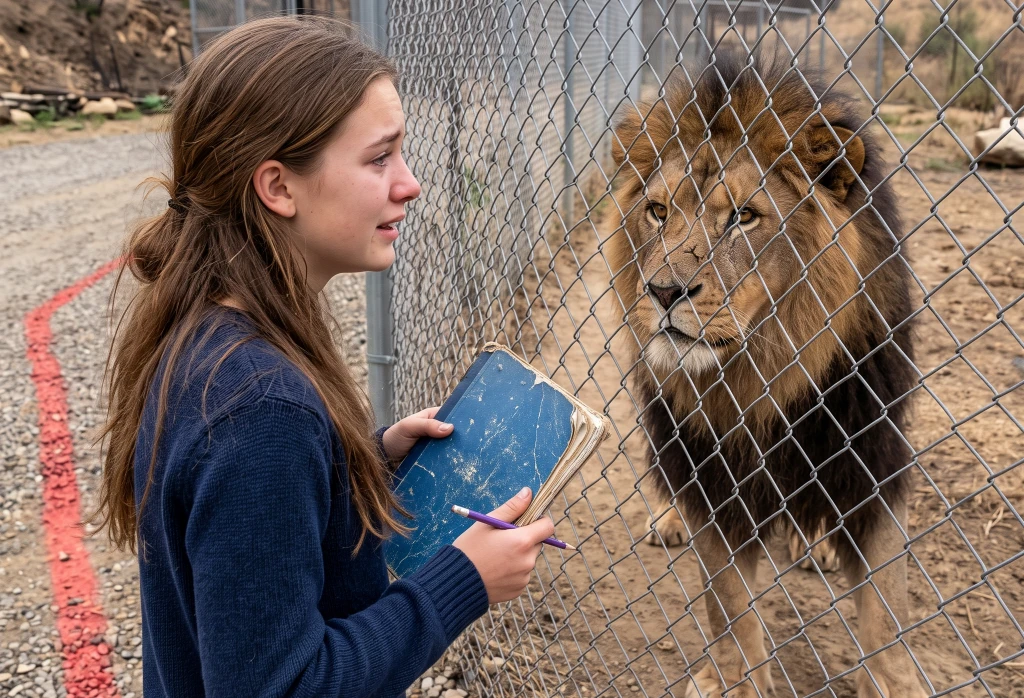
Knowing them did not stop her from wanting him to turn.
“Stay behind the red line,” Dr. Lena Park said. “Even if he comes close. Even if you think he’s asking you to.”
The painted line crossed the concrete service gallery six feet from the first of two barriers. Beyond them lay Cairo’s temporary run, the adjoining shift pens, and the fire-blackened slope where his larger habitat had stood three weeks earlier.
Emily adjusted the headphones around her neck. “I know what protected contact means.”
“I’m sure you do.” Lena’s voice remained neutral. “But people forget things when they get what they came for.”
Emily looked at her. The sanctuary veterinarian was in her early fifties, with sun-browned skin, silver threaded through her black braid, and the watchful stillness of someone accustomed to animals that noticed impatience.
“I came to help him move,” Emily said.
“That’s what I’m trying to establish.”
High Mesa Carnivore Sanctuary had already relocated eleven animals. Its reserves had been shrinking for years, and the grass fire had settled the question its board kept postponing. The remaining habitats were secure under ordinary conditions, but another round of red-flag fire weather was forecast in four days. Cairo had a permanent placement waiting at Cedar Basin Wildlife Sanctuary in New Mexico. The transport crate had been secured to the narrow transfer chute, or shift race, for nearly two weeks.
He would put his head and shoulders inside. Then the metal floor flexed, or a cable moved, or something only Cairo understood changed—and he backed out.
Chemical immobilization remained available, but at nearly sixteen, Cairo was old enough that everyone preferred a voluntary load. High Mesa had contacted Emily because the records from his first year contained repeated references to her voice.
The board had also remembered a photograph that had raised more than two hundred thousand dollars fifteen years ago.
Nine-year-old Emily, a blue knit cap covering her soft new hair, sat behind a quarantine window with an open book. On the other side, a recovering lion cub lay with his chin on his paws. Newspapers had called her the girl who taught an orphaned lion to trust again. Later versions claimed she had raised him in her home, slept beside him after chemotherapy, and saved him from death with nothing but love.
The legend was mostly false. The photograph had been useful, though. Useful things could do damage and remain useful.
A fixed camera had been mounted behind the observation glass that morning. Lena had allowed one recording for the sanctuary’s board, with no live audience and no promise that it would be released. Emily had signed the consent form because the relocation needed money and because she had told herself that Cairo’s welfare mattered more than her dislike of the old story.
She had not admitted the other reason, even to herself.
Caleb Ruiz stood at the shift controls twenty feet away. He had been a veterinary technician at Front Range Wildlife Recovery Center when Cairo arrived as a six-week-old cub. When the lion transferred to High Mesa, Caleb moved with him and eventually became the sanctuary’s director of animal care.
His beard had gone gray, but he still watched animals by lowering his chin and looking slightly to the side, as if direct attention might alter what he hoped to observe.
“He’s tracking the west fence,” Caleb said. “That’s his usual route this time of day.”
Cairo reached the far corner, turned, and paced back.
Emily had prepared herself for his size. She had studied recent photographs and measured his shoulder height against the fence posts. None of it had accounted for the weight of him in motion, or the way his mane made the face she remembered seem buried inside another animal.
A shallow scar crossed his muzzle. His left ear carried a notch that had not been there when he was young. He moved with a slight stiffness through the hips, but his eyes were clear and his coat was dense.
He passed Emily again.
Nothing changed.
Behind her, the camera’s cooling fan made a thin mechanical whine. The sound bothered Emily more than Cairo’s indifference. She made her living recording natural sound for documentaries and public-radio projects—prairie chickens before dawn, elk crossing frozen creeks, wind moving through stands of burned lodgepole pine. She usually worked outside the picture.
The camera placed her back inside one she had been trying to leave since childhood.
“Don’t call him yet,” Caleb said.
“I wasn’t going to.”
“You’re tapping the notebook.”
Emily looked down. Her right index finger rested against the worn blue cover. The graph-paper notebook had once been bright enough to match her hospital cap. Now its corners had softened, and a crescent of dried formula still marked the back.
She stopped tapping.
Cairo reached the gate connecting his run to the empty habitat beside it. He lowered his head and inhaled along the bottom rail. Then he made a low call that seemed to begin below the range of Emily’s hearing. She felt it through the soles of her boots before the microphone registered it.
He waited.
Nothing answered.
“That was Sage’s side,” Caleb said. “They shared the larger habitat for almost eleven years.”
Emily knew Cairo had lived beside a lioness. She had read it in the file Lena sent. She had not known how many years, or that Sage had been euthanized ten weeks earlier after her kidneys failed.
“Has he been doing that since she died?”
“Most mornings. Sometimes before meals.”
The story circulating online said Cairo had stopped eating because he missed the sick child who had saved him. In reality, he had eaten less after losing the lioness who had slept beside him for more than a decade. Then fire had driven him from their habitat into a smaller run filled with new sounds and new routines.
His life had continued without Emily. His grief had, too.
Cairo turned from the empty gate and began another pass along the fence.
Caleb glanced at Lena. She nodded once.
“You can speak,” he told Emily. “Keep it low. Don’t repeat his name if he doesn’t respond.”
Emily opened the notebook. The first pages held numbers written in purple pencil because that was what a nurse had handed her during an infusion. Weight. Formula intake. Medication times copied from what the keepers told her. Beneath them she had recorded whatever she read aloud.
Her adult voice would not resemble the thin, breathless voice of a nine-year-old. She knew that. She also knew cadence survived changes that pitch did not.
She lifted the pencil and tapped the cover three times.
Cairo kept walking.
Emily found an entry dated fifteen years earlier.
“April seventeenth,” she read. “Weight, seventeen pounds and six ounces. Finished the six o’clock bottle. Bit Caleb’s glove, then hid under the blanket.”
Caleb’s mouth moved, almost a smile.
Cairo’s left ear turned.
Emily stopped after the sentence. The childhood routine had always contained silence. Three taps. A few lines of reading. A pause long enough for the cub to swallow or settle.
The adult lion took two more steps and stood still.
Emily’s fingertips tightened around the notebook, but she did not move closer. Cairo turned his head first, then his body. He looked toward the gallery, not directly at her but at the space her voice occupied.
She read the next entry.
“Page forty-three. Pronghorn can run within days of birth, which seems unfair to everybody who has to learn slowly.”
That sentence had made Caleb laugh the first time. Emily remembered insisting it belonged in the official record.
Cairo approached at an angle. He paused twice, testing the air, and stopped several feet from the inner barrier. His eyes moved over Lena, the camera, Caleb, and finally Emily.
No one spoke.
Cairo stepped to the mesh and rubbed the side of his mane along it. Wire whispered through coarse hair. Then he lowered himself, first on one foreleg and then the other, his right paw slightly ahead of the left.
Emily had hundreds of childhood photographs of that posture. As a cub, Cairo had rarely lain squarely. One paw always reached farther, as if he had fallen asleep in the middle of going somewhere.
The low sound came again. Not a purr and not a growl. A short, breathy contact grunt, quieter than the camera fan.
Emily’s headphones hung uselessly against her collarbone. She could feel the sound without them.
Lena watched Cairo’s ears, tail, and breathing. “He recognizes a familiar pattern.”
It was careful language, built to carry only what the behavior could support.
Emily nodded. Tears blurred the wire, but she did not wipe them away. “That’s enough.”
For several seconds Cairo remained parallel to the barrier. Then a gust moved over the damaged hillside, bringing the bitter smell of old ash. He raised his head, stood, and walked away from Emily.
He returned to Sage’s gate.
The loss pricked more sharply than she expected, followed at once by embarrassment. She had come prepared to defend Cairo’s wildness and had still wanted his first remembered need to be her.
Caleb left the shift controls and approached the red line.
“He used to respond to your recordings,” he said. “The first winter after the transfer, especially. On storm nights we played two or three minutes while he settled in the den.”
Emily turned toward him. “My mother said he stopped listening.”
Caleb’s expression changed. “He didn’t.”
Cairo called once into Sage’s empty run.
Gravel shifted outside the service gate.
A keeper unlatched it from inside.
Susan Carter stood in the opening, holding a thick archive folder against her chest. She was fifty-nine now, her once-red hair cut short and mostly silver. She looked first at Emily, then at the blue notebook, as if the order mattered.
“He didn’t forget you,” Susan said. “I only told you he did…”
To read the rest of the story – CLICK the NEXT button 👇👇👇