


By the time Mara Bell reached the treatment room, Officer Gabe Nolan had signed the form that would let a veterinarian stop Rook’s heart. The syringe waited on a steel cart beside the oxygen pump. Gabe was bent over his partner, one hand around a paw that had gone slack, when Mara said, “Rook?”
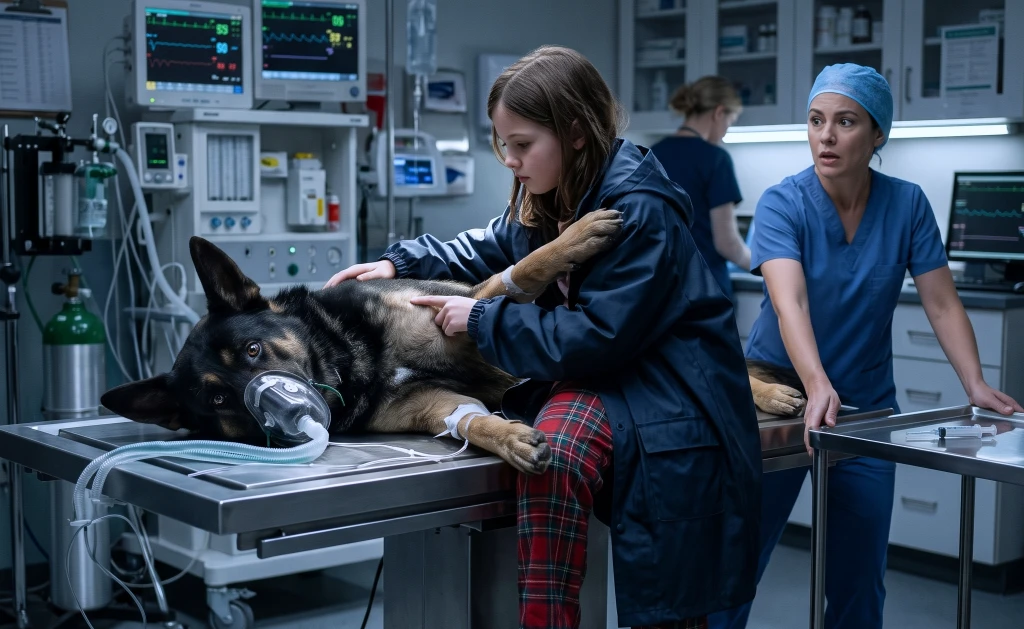
The dog’s right ear lifted. For twenty minutes he had not responded to Gabe’s voice, not even as his fever climbed again and the medication supporting his blood pressure began to fail.
Mara stood between her parents in plaid sleep pants, one high-top untied and her father’s raincoat hanging below her knees. She was ten now, though the sight of her in that coat returned Gabe to the October night when she had been nine and missing in a city park. Her mother, Leah, had one hand around Mara’s shoulder and the other clenched over the strap of her purse; her father, Tom, held the treatment-room door behind them.
Dr. Lena Park, the specialty hospital’s on-call soft-tissue surgeon, drew her hand back from the syringe and waited.
“You made it,” Gabe said.
Mara stared past him at the shaved patches in Rook’s black-and-tan coat, the IV lines and the tube carrying cloudy fluid from his chest. “Why is he on a table?” Gabe had found words for witnesses in shock, for grieving families, and once for a rookie who had never seen anyone die. None came now, so he looked toward Dr. Park.
She pulled a rolling stool closer to Mara but remained standing, so the girl would not have another adult between her and the dog. “Rook has a very bad infection around his lungs. We’ve drained it and given him medicine, but we haven’t found where it started. His body is getting too tired to keep fighting.”
“Can he hear me?”
“I think so.”
Mara slipped out from under her mother’s hand. Leah caught the loose sleeve of the raincoat.
“You can say goodbye from here, honey.”
“He didn’t find me from across a room.”
Leah’s face tightened. Gabe knew that look. Seven months of counseling had not made her afraid of Mara’s memories; it had made her careful about who decided when Mara had to use them.
“Only if you want to,” Leah said. “And you can stop whenever you want.”
Mara nodded and approached the table. Rook lay on his right side beneath a gray warming blanket. Without his patrol harness he looked smaller than the eighty-odd pounds Gabe had carried out of a flood-control channel that morning after Rook’s legs folded during a routine scent drill. The trail had been too narrow for the cruiser, and Gabe had carried him nearly a quarter mile while another officer ran ahead with the gear bag, Rook’s breath stopping and starting against his forearm.
At Crestview Veterinary Specialty Hospital, the emergency team found infected fluid filling part of Rook’s chest and his blood pressure low enough to threaten his organs. They placed a drain, started antibiotics and gave him oxygen. For an hour, the numbers improved. By nightfall the fluid had returned, and even after ultrasound and repeat X-rays, no one could tell Gabe what was feeding the infection.
A CT scan might have shown more, but moving Rook to the scanner required sedation he was unlikely to survive. Opening his chest without a target would have traded a quick death for a longer one. Dr. Park had said that without softness, and Gabe had been grateful to her for it.
Captain Nora Velez, the department’s authorized representative for Rook, had signed the hospital’s emergency form naming Gabe as Rook’s medical decision-maker for the night. The legal authority had been delegated to him, along with the choice Dr. Park was waiting to carry out. Six years earlier, the city had put Rook’s leash in his hand; tonight the captain had left it there.
Mara reached the table. She held her fingers near Rook’s nose but did not touch him until he made a faint effort to sniff.
“I brought the other one,” she told him.
Mara pushed back the cuff of the raincoat and showed him a blue braid tied around her wrist. At a school safety day in November, she had tied its twin to the ring on Rook’s public-visit collar. Rook stole the loose end twice while she was knotting it, and afterward Gabe kept it in the glove box so it would not snag during work. Mara had worn the matching braid around her own wrist every Thursday she visited the station.
On Thursdays, Rook began waiting by the lobby door before three-thirty. Mara brought carrots cut into coins because the crunch made her laugh. She never asked him to reenact the search or sit beside her for pictures. For the first few months she always sat on his right, away from the scar where she remembered seeing blood; by spring she had stopped asking Gabe whether it still hurt. Some days she read to Rook. On difficult days she sat with both feet tucked under her and counted each breath that moved his ribs.
Gabe had believed those visits belonged to both of them. When Dr. Park told him Rook had minutes or perhaps an hour, calling Leah had seemed like the last useful thing he could do.
Now Mara laid her wrist beside Rook’s paw. “You’re supposed to steal it.” His toes moved against the steel.
She drew in a breath that shuddered on the way down. “See? He knows the game.”
No one corrected her. Rook’s heart rhythm stumbled on the monitor, then settled into its weak, hurried pattern.
Mara smoothed the fur between his ears. “I’m here. You don’t have to go looking.”
The words made Gabe turn his face away. Through the glass wall, three officers from the night shift stood in the hall with their duty belts still on. One of them studied the floor. Captain Velez had gone outside to call the chief, giving Gabe privacy that a room full of uniforms could not provide.
Mara leaned carefully over the table. “Can I hug him?”
Dr. Park checked the lines along Rook’s neck and chest. “Not around his middle. You can put your cheek by his shoulder.”
Gabe slid one hand under Rook’s foreleg. “I’ll hold his paw.” Mara pressed her cheek into the thick fur below Rook’s ear, and Gabe began lifting the leg across her shoulder, expecting to carry all its weight.
Rook pulled.
The movement was weak but unmistakably his. His claws caught in the raincoat, and his paw settled against Mara’s back. She closed her arms around his neck without touching the mask.
“Okay,” she whispered. “You can stop working now.”
Rook breathed against her hair. The sound was wet and shallow, but his ear stayed angled toward her voice.
His paw began to slide. Keeping it in her left hand, Mara shifted closer and slipped her right hand beneath the blanket toward the place she had once been afraid to touch. Her fingers settled below his shoulder.
Rook’s abdomen tightened. His eyes opened, and a rough sound pushed against the oxygen mask.
Dr. Park pushed the medication cart away from the table. “Keep your hand still. Tell me exactly where it is.”
Mara froze. “Did I hurt him?”
“You didn’t injure him. Point to the place with one finger, but don’t press.”
Mara separated the fur until her fingertip hovered over a pale seam between two ribs. The scar was narrow and smooth, easy to miss under the regrown coat. Dr. Park took Mara’s place and palpated beside it; Rook’s abdomen tightened again.
Gabe knew the scar. He had washed mud from it, checked the stitches twice a day and watched it close without swelling. “That’s from Foundry Park.”
Mara lifted her head. “The fence poked him there.”
Leah came closer. “What do you mean, poked him?”
“When he broke it.” Mara touched the sleeve of the raincoat as if the old blood might still be there. “The broken end went into him, then pulled back out when he jumped. I saw the blood when he stood over me.”
Gabe remembered two rotted cedar boards splitting as Rook drove through the locked maintenance fence. He remembered the man who had lured Mara from the harvest fair backing against a shed while Rook held position between them. He remembered Mara gripping the dog’s coat and the dark patch below Rook’s shoulder that Gabe had found only after another officer led her away.
Dr. Park looked at Gabe. “The October report calls it a superficial puncture to the left chest wall. It doesn’t say the board went in.”
“I didn’t see it happen,” Gabe said. “By the time I reached him, there was only blood in his coat.”
The emergency clinic had clipped the fur around the puncture, explored and irrigated the wound, removed visible debris and taken X-rays. It found no deep tract, fracture or visible foreign material. Rook had finished antibiotics, passed his return-to-duty exam and gone back to work.
Dr. Park rolled a smaller ultrasound unit to the table. “Wood doesn’t always show on a standard X-ray. If a piece went in lengthwise, the skin could have closed over it.”
“For seven months?” Gabe asked.
“Seven months would be unusual.” She spread gel along the scar. “Hold him still for me.”
The probe pressed between Rook’s ribs. On the screen, gray layers shifted with each labored breath. Dr. Park changed the angle, found a dark pocket beneath the old wound and followed a narrow channel inward. A bright straight edge appeared, vanished, then returned when she turned the probe.
Her mouth tightened. “There’s a tract. It runs toward the diaphragm.”
A nurse carried the medication tray out while another increased Rook’s oxygen. A third removed more infected fluid through the existing chest drain, and Dr. Park adjusted the medication supporting his blood pressure. Rook’s blood pressure rose enough for the staff to bring in the padded CT transfer board.
Dr. Park kept her eyes on the screen. “Has he been coughing after work? Hesitating to jump?”
Gabe looked at Rook’s folded back legs. In January, after a tracking exercise in bitter cold, Rook had coughed twice. The department veterinarian found clear lungs and told Gabe to report any recurrence. In March, Rook stopped jumping into the cargo bay and waited for help. Gabe had blamed an old hip strain and lifted him in.
The cough had come back once. Gabe had left it out of the weekly log because Rook ate, ran and completed every task put in front of him.
“Yes,” he said. “Both.”
Dr. Park looked up. “How long?”
“Four months, off and on.”
She closed her eyes for the length of one breath. “The drainage and medication have bought us a narrow window. We can induce anesthesia once, scan him quickly and, if the scan confirms a foreign body, take him straight into surgery without waking him. He may still die under anesthesia.”
Her hand stayed on the probe above the dark tract. “Do I have permission to try?” “Yes,” Gabe said. The blood-pressure alarm sounded. Dr. Park pulled the probe away. “Move him…”
To read the rest of the story – CLICK the NEXT button 👇👇👇