


At 2:17 in the morning, Mabel made the two-note call Ellen Mercer had not heard in thirteen years. It was not the deep complaint the old Brown Swiss used when her water trough ran low. It was softer and stranger—a rising note followed by a low, throaty answer, the sound she had once made for a calf that could not come to her.
Ellen opened her eyes in the dark.
The call came again from the calving barn.
Since her husband’s death, she had learned every night sound on the farm: the scrape of pecan branches against the roof, coyotes calling from the Ouachita foothills, the loose strip of flashing above the kitchen that clicked whenever the wind shifted east. This did not belong to the night.
She reached for the jeans folded over a chair and pulled them on beneath her nightshirt. Her phone said it was eighty-two degrees outside, but Tom’s small flashlight and the barn keys still lived in the pockets of his old canvas jacket. She pulled it on despite the heat.
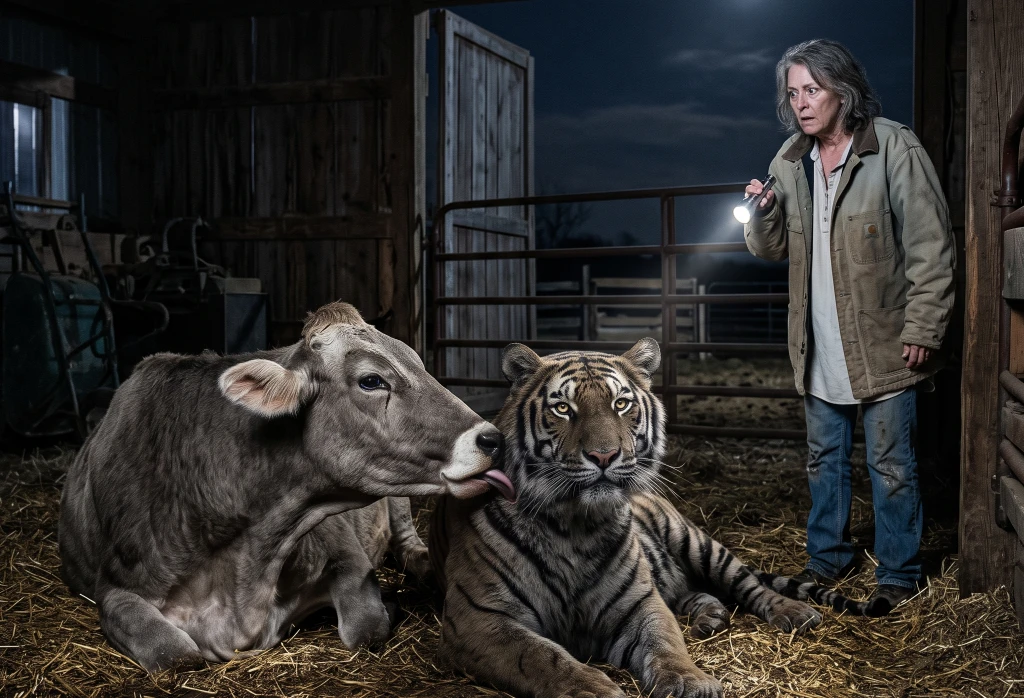
Mabel stood in the last open stall of the barn, where moonlight slanted through a gap in the siding. At sixteen, she was the only cow Ellen still owned. The rest of the herd had been sold after Tom died, and the lower pasture was leased to a neighbor whose black Angus cattle looked like dropped stones against the summer grass.
Ellen raised her flashlight.
At first, she saw Mabel’s pale muzzle and one large brown ear. Then something moved behind her.
A striped tail lay across the straw.
Ellen’s mind tried to turn it into a hose, a fallen branch, a trick of shadow. The tail lifted once, struck the bedding with a heavy, unhurried thump, and settled again.
A full-grown tiger was lying beside her cow.
Even lying down, his head reached nearly to Mabel’s chest. Black stripes curved over a coat darkened by mud, and one forepaw—broad enough to cover a dinner plate—rested inches from the cow’s front hoof. The barn smelled of hay, manure, and the hot, musky presence of an animal that did not belong on any Oklahoma farm.
Ellen stopped breathing.
Mabel was not trapped. The outer gate stood open to the pasture, just as Ellen had left it. She could have moved away.
Instead, she bent her head and dragged her tongue over the tiger’s neck.
The tiger closed his eyes.
Ellen took one step backward. Her boot found a loose horseshoe beside the wall and nudged it across the concrete.
The scrape sounded deafening.
The tiger’s head rose.
His eyes caught the flashlight and flashed pale gold. He looked directly at Ellen, not with the hazy curiosity of a house cat but with a stillness that made the distance between them feel much shorter than twenty feet.
The barn door was six steps behind her. The tiger could cross twenty feet before she reached it.
Mabel gave the two-note call.
The tiger’s ears shifted toward her. He looked away from Ellen, pressed his forehead beneath Mabel’s jaw, and released a breath that sounded almost like a cough.
A chuff.
Ellen knew that sound.
Her hands began to shake. She backed toward the barn door without turning. At the threshold, with one hand braced against the frame, she eased her phone from Tom’s jacket and took a single photograph. If the tiger moved before help came, she wanted proof of what she had seen.
Then she crossed the yard. Once inside the house, she locked the door, closed the curtains, and stood in the kitchen listening to her own breath.
Ellen keyed 911 into her phone. Then she saw again the frightened cougar beside a county road, four deputies lined up with rifles, and one of the men afterward saying there had been no other choice.
She closed the screen and called her daughter instead.
Claire answered on the fifth ring. “Mom?”
“There’s a tiger in the calving barn.”
Silence followed. Ellen pictured her daughter sitting up in her apartment in Tulsa, pushing dark hair from her face and deciding whether this was a joke, a dream, or evidence that her mother should no longer live alone.
“Say that again.”
“A tiger is lying beside Mabel.”
“Are you in the house?”
“Yes.”
“Are the doors locked?”
“Yes.”
“Move away from the windows.”
“He isn’t near the house.”
“Mom, move away from the windows.”
Ellen stepped into the hallway.
Claire was a veterinarian for an emergency network that assisted with seized and displaced exotic animals. The work had taken her to flooded sanctuaries, bankrupt roadside zoos, and private properties where people kept animals they had neither the money nor judgment to manage. She knew what an adult tiger could do.
It was also the reason Ellen had called her before anyone else.
“Did you actually see stripes?” Claire asked. “Not a mountain lion in shadow?”
“I know what a tiger looks like.”
“Did you take a picture?”
“One.” Ellen opened it. The edges were blurred and the frame tilted sharply, but Mabel stood in moonlight while the tiger rested against her forelegs, his head turned toward the camera.
Ellen sent it.
Claire stopped speaking.
“Are you there?” Ellen asked.
“I’m looking.”
“He could have killed her.”
“Yes.”
“But he didn’t.”
“That does not make him safe.”
“I didn’t say it did.”
“The picture breaks apart when I enlarge it,” Claire said. Then Ellen heard her breathing change.
“What?” Ellen asked.
“His left ear.”
Ellen had noticed it in the barn: a crescent missing from the outer edge, as clean and recognizable as a bite taken from a cookie.
“He already had that tear,” Ellen said.
“Mom, we cannot know that.”
Above the tiger’s right eye, three narrow stripes rose together. The middle one broke halfway up, leaving a small amber gap. Tom had called it the broken ladder.
Claire had once sketched those stripes in the margin of her veterinary-school notes.
Thirteen years earlier, she had slept on a cot in the same calving barn beside a six-week-old tiger cub. He had arrived in a secure transport crate after a winter seizure, dehydrated, underweight, and screaming for a mother who was not coming.
They had called him August.
Ellen returned to the kitchen window despite Claire’s warning. Through the curtain, she could see the dark rectangle of the barn.
“I think it’s him,” she said.
“It cannot be.”
“Mabel thinks it is.”
Claire’s voice sharpened. “Do not go outside again. I’m leaving now, and I’m calling the sheriff’s office.”
“Wait until you get here.”
“I won’t.”
“They’ll come with rifles.”
“They’ll come because there is a tiger loose near homes.”
“He came to Mabel.”
“He passed homes to reach her.”
That silenced Ellen.
Claire spoke more gently. “August was transferred to a sanctuary in Arizona nine years ago.”
The two-note call drifted across the yard once more.
Ellen held the curtain aside and watched the barn until she saw a striped body pass through a blade of moonlight.
“Then somebody had better explain,” she said, “why he’s sleeping on my farm…”
To read the rest of the story – CLICK the NEXT button 👇👇👇