


The sound came from beneath the wind: one hoarse, unfinished bark. Maren Holt stopped halfway up the old logging road and listened. Snow ticked against the hood of her coat. Above her, lodgepole pines crowded the slope; below, her rented Subaru was already disappearing on the road that dropped into Tamarack Valley in western Montana.
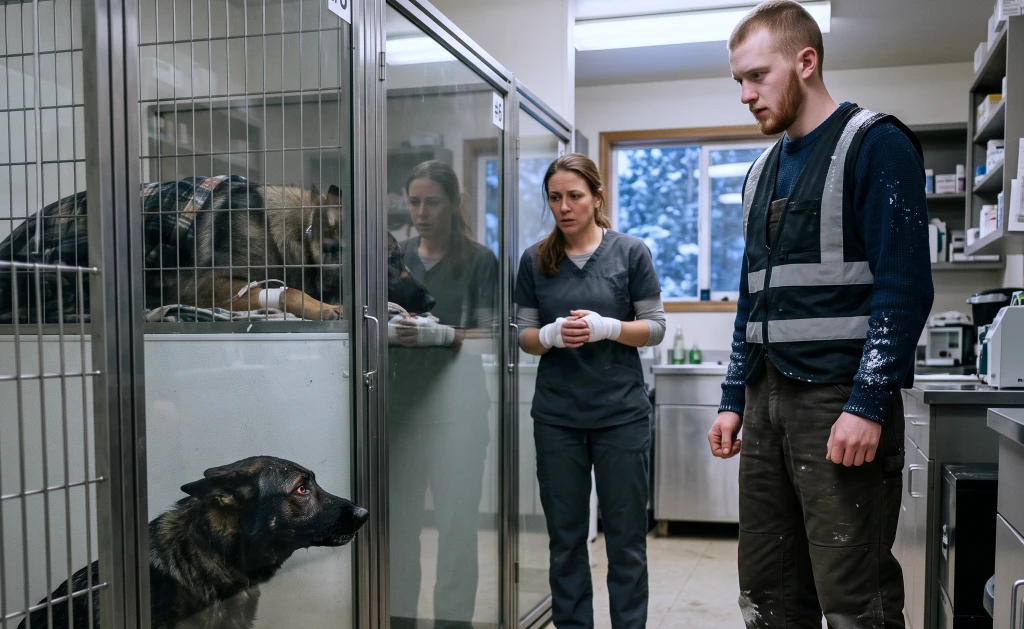
The bark did not come again. What followed was worse—a thin whine, cut short as if the animal had run out of breath.
Maren unclipped the satellite messenger from her shoulder strap but did not trigger it yet. Eli Mercer had told her to meet him at the east gate at eight. His truck was there, angled beside the chain stretched between two cedar posts; the driver’s door stood ajar, and a dented stainless-steel thermos lay in the snow with its cap several feet away. Eli was not.
She had walked uphill because his last message contained a set of coordinates and six words: If I’m late, use the logging road. At the time, it had sounded like the caution of a man who had spent fourteen months refusing interviews. He had agreed to this one only after she found the expired timber license in the county archive and sent him the page number without asking for a quote. Now the sentence looked different in her mind.
“Mr. Mercer?” she called.
The trees returned her voice in pieces. Then came the whine again, farther left.
Maren left the road and pushed through knee-deep powder. A dark dog lay beside a spruce less than fifty yards away, his front legs cinched together with orange utility cord. His muzzle was wet with snow. When he saw her, he tried to lift his head and managed only a scrape of his jaw against the ground.
“Easy,” she said, already dropping to her knees. “I see you.”
The clearing opened behind him. A second German shepherd lay on his side near a man in a brown canvas coat. The man had been forced onto his knees and tied from wrists to ankles; when he collapsed, the ropes had kept him folded forward. Snow covered one shoulder and half his hair. A narrow line of blood had frozen from his temple to the edge of his beard. His phone lay facedown several feet beyond his left shoulder.
For one second Maren’s right hand went to her camera. It was an old reflex: establish the scene before people moved through it, before weather and fear rearranged the facts. She framed one wide shot on the cracked rear screen and pressed the shutter. Then she set the camera facedown in the snow and reached for Eli’s neck.
His pulse was slow but present. His breathing was shallow, and the skin above his collar felt frighteningly cold.
Maren pressed the SOS button. She gave the response center the coordinates, the number of victims, the head wound, the bound dogs, the access gate below. The replies came in clipped lines on the small screen. The county dispatcher had been notified. Search and rescue was mobilizing a tracked vehicle. She was to insulate them from the ground, shelter them from the wind, monitor breathing, and avoid unnecessary movement unless exposure made staying more dangerous.
Exposure was already dangerous. The wind had begun filling the depressions around Eli’s legs.
The darker shepherd watched her cut the cord around his front legs. He did not snap or growl. He tried to stand, folded at the shoulder, and let out the same broken sound that had brought her off the road.
“Ranger?” Maren guessed, remembering the names from her notes. “Are you Ranger?”
His ears moved at the name. The larger sable dog had to be Kodiak.
Both animals’ eyes streamed, and the fur around their faces carried a sharp, peppery odor. Someone had used an irritant before binding them. Kodiak’s left front leg lay awkwardly beneath him; Ranger had rubbed one wrist raw against the cord.
Maren cut Kodiak’s cords away from the knots, freeing his legs without trying to make him stand. Then she cut the line around Eli’s chest so he could breathe more freely and the rope fixing his wrists to his ankles. She left every knotted section where it fell and photographed it without touching the knots. Her fingertips had begun to lose feeling inside her gloves.
“Eli.” She leaned close enough that her braid brushed his coat. “My name is Maren Holt. We were supposed to meet. Help is coming.”
His eyelids moved. A sound came from him, too low to understand.
“Don’t try to get up.”
“Dogs.”
“They’re alive.”
His eyes opened a fraction. They were gray and unfocused, but they moved past her at once, looking for the shepherds. Ranger had dragged himself close enough to press his nose against Eli’s boot.
“Kodiak?” Eli asked.
“Alive. He can’t stand yet.”
Eli tried to push one hand beneath him. His arm failed, and his head dipped.
“No.” Maren caught his shoulder without pulling him upright. “You have a head injury, and you’re too cold. Stay with me.”
He looked at her then. Even confused, he was assessing rather than merely seeing: her face, her coat, the camera in the snow, the messenger clipped to her strap.
“Reporter.”
“Yes.”
His mouth tightened, whether from pain or recognition she could not tell. Thirty yards beyond the clearing stood a line shack she had mistaken for a pile of deadfall. Its roof was low but intact, and a stovepipe rose above it. Under the rear eave hung a narrow plastic freight sled, sun-faded and webbed with old rope.
Maren told the dispatcher what she saw. The rescue team was still close to an hour away; the storm had closed the upper county road. She described the distance, the slope, and Eli’s partial consciousness. The dispatcher could not choose for her, only explain how to keep his head and neck aligned if she moved him.
She pulled the sled down, lined it with the foam pad and emergency bivy from her pack, and dragged it to Eli. He was conscious enough to follow simple instructions but not strong enough to help much. She rolled him with the care the dispatcher had described, keeping his head and neck aligned, and used the old sled rope as a hauling harness across her hips.
The thirty yards to the shack felt like three hundred. Twice the sled caught on roots buried under the snow. The second time, Maren’s feet went out and she landed on one knee hard enough to see white sparks behind her eyes.
Eli said something she did not hear. “What?”
“Leave me. Take Kodiak.”
“No.”
“You can’t make three trips.”
Maren reset the rope across her hips. “Watch me.”
The shack held split wood, a rusted barrel stove, two bunks, and the smell of mice. A dented battery lantern hung from a nail, and a wooden door bar leaned beside its iron brackets. She switched on the lantern, got Eli onto the lower bunk, wrapped him in the emergency bivy, and returned for the dogs. Ranger followed her in an uneven three-legged stumble. She hauled Kodiak on the sled, one gloved hand resting on his ribs whenever she stopped.
By the time she set the bar in its brackets and coaxed a flame from the stove, her wet hair had frozen against her cheek. She peeled off her outer gloves and found the skin across both palms rubbed open where the towrope had shifted.
Eli watched her from the bunk. Color had begun to return unevenly to his face, but his shivering had grown violent. Maren tucked dry wool blankets around him without putting direct heat against his skin, then sat on the floor between the dogs and read each new dispatcher message aloud.
“Tracked rescue unit is on the lower road,” she said. “About fifteen minutes.”
Kodiak lay under one of the bunks with his head in Eli’s reach. Eli kept two fingers buried in the dog’s neck fur as if counting something there.
“Who did this?” Maren asked.
He closed his eyes. “Cal Voss.”
She knew the name. Voss Site Services had the grading contract for Alder Basin, the proposed lodge and housing development that had divided the valley for two years. The application described the logging track across Mercer land as an existing access road. Eli said it had never been one—not legally, not after his father ended the timber license in 1981.
“Was Voss alone?”
“One younger man.” Eli swallowed. “Face covered. Didn’t talk much.”
“They came for the easement?”
“Came to pull the survey stakes and move the grader.” His words were slow and sometimes blurred. “The grader was past the boundary. I took out my phone. Voss knocked it away and told me to delete the pictures. Kodiak moved between us. Voss sprayed him. When I reached for Ranger, Voss hit me.”
His hand moved toward the cut at his temple and stopped when Maren caught his wrist.
“Don’t touch it.”
“They knew.”
“Knew what?”
His gaze settled on her. It was clearer now, and the anger in it was not for Voss.
“They said the Denver reporter wouldn’t get much of an interview if I couldn’t talk.”
The stove popped behind Maren. She could hear her own breathing above it. At 7:17 that morning, parked outside the only coffee shop open in town, she had called Dana Whitcomb, Alder Basin’s development manager. Grace, her editor, wanted the company to have a fair chance to respond before Maren went into the field. Eli had asked her to wait until noon, after he showed her the road work. Maren had decided that request was another attempt by a difficult source to control the reporting.
She had told Whitcomb the parcel number. She had also said she was on her way to meet the owner at the east gate.
“I called Alder Basin,” Maren said. Eli’s fingers went still in Kodiak’s fur. “When?” “Seven seventeen.” He stared at her for a long time. The stove clicked as its metal warmed, and Ranger pressed closer against Maren’s leg. “Voss got there just after seven thirty,” Eli said. “You gave them the east gate. That’s how they knew where I’d be…”
To read the rest of the story – CLICK the NEXT button 👇👇👇