


By the time Danny Kowalski’s motorcycle went down, snow had erased the yellow line and filled the grooves in Jack Callahan’s gloves. Far below the road, a pin of amber appeared between the pines and vanished before he was sure he had seen it. Danny slid at walking speed, the bike settling onto its crash bar with a tired metallic scrape. Jack and Earl Boone got it upright, but none of the six men pretended they were riding farther. The road over Wolf Creek Pass had gone from wet to white in less than twenty minutes, and the wind was shoving loose snow sideways through the pines.
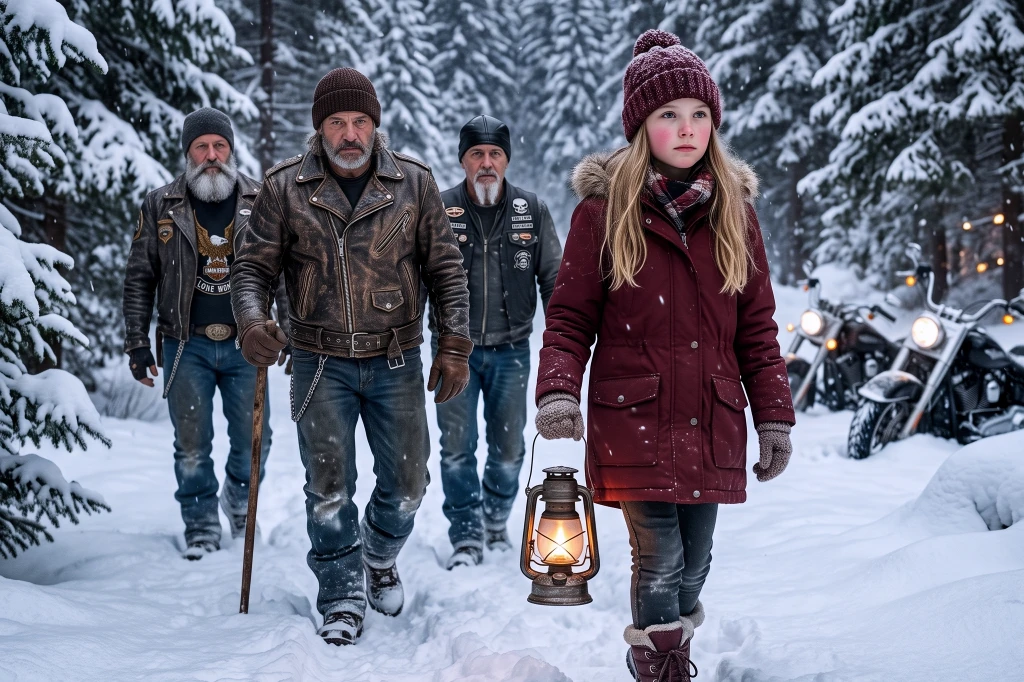
“Should’ve stayed in Pagosa,” Danny said. Ice clung to his beard. Everybody in the Black Pine Riders called him Church.
Jack heard the accusation beneath the weather report. Church had pointed at the advisory before they left the diner. Jack had looked at the sky, looked at the miles remaining, and said they could beat it east. He owned a motorcycle shop in Pueblo and had spent thirty years making decisions while other people waited.
Now Marco Ruiz could not stop shaking, and twenty-three-year-old Tom Beck was flexing his hands as if he had misplaced them.
Jack helped push the bikes beneath a stand of spruce just off the road. Church’s crash-side pannier had buckled around the satellite phone and first-aid kit; with Marco shaking and Tom losing feeling in his hands, Jack stopped Church from fighting the latch in the whiteout. They covered the seats and instrument panels with the two tarps they carried, took the emergency blankets and whatever food they could reach, then started downhill on foot. A road marker they had passed five minutes earlier pointed toward a Forest Service maintenance shed with an exterior emergency radio, but Jack could no longer tell which hollow held it.
They made perhaps three hundred yards before Earl caught Jack’s sleeve. Earl was sixty, broad as a refrigerator, and usually moved with the economical care of a man who had spent his life around lumber and gravity.
“Light,” he said.
At first Jack saw only blowing snow. Then an amber point appeared between two trunks, vanished, and appeared again. It was too low to be a road light and too unsteady to be electric.
They angled toward it. The ground dropped sharply, and Marco went to one knee. Jack hauled him up by the back of his coat. The light became a small square window, then a cabin crouched against the slope with snow packed along one wall. Its stovepipe gave off a thin thread of smoke.
Jack knocked hard enough to hurt his knuckles. “Hello? We need shelter.”
Something moved inside. A chair leg scraped. The door opened the width of a boot, stopped against a chain, and a child’s face appeared above a candle flame.
She was small, with a dark braid pulled over one shoulder and a red knit cap that had lost its pom-pom. In her other hand she held a fireplace poker. Her gray-green eyes moved from Jack to the five men behind him and paused long enough to count.
“Is anybody hurt?” she asked.
“Not yet.”
She looked at Marco’s shaking shoulders. “You will be.”
The chain dropped. She opened the door and stepped back. “Come in. Wet jackets stay by the door. Two of you have to bring wood from the lean-to before you sit down.”
Jack had expected fear, questions, perhaps a slammed door. Instead he found himself obeying an eleven-year-old girl because she was plainly the only person present who knew what the next five minutes required.
The cabin was one room, no more than sixteen feet on its long side. A narrow cot stood beneath the window. Shelves held canned food, chipped dishes, homeschool workbooks, and a row of jars labeled in a child’s handwriting. A hand pump beside the washstand drew from a covered spring, and Jack could see a privy through the rear window. Flattened cardboard had been tacked behind old quilts along the north wall. The iron stove in the center gave more light than heat.
“Earl, Tom, wood,” Jack said.
“She already assigned it,” Earl answered, and ducked through a low rear hatch with Tom behind him.
The girl pointed the poker at a hook beside the door. “Jackets there. Boots near the stove, not against it. If you heat your hands too fast, they’ll hurt worse.”
Church peeled off his soaked gloves. “You run a strict establishment.”
“The roof leaks over the cot, so don’t put anything there.”
It was such an ordinary complaint that Jack looked toward the cot before he looked back at her. A cooking pot sat on the blanket beneath a dark patch in the ceiling. Earl shifted the cot toward the dry wall and rigged a sloping scrap of oilcloth to drain the leak into the pot.
“What’s your name?” he asked.
“Nora Avery.”
“I’m Jack. That’s Church, Marco, and Liam. The two stealing all your firewood are Earl and Tom.”
“They’re not stealing it if I told them to bring it in.”
Church gave Jack a look that might have become a laugh if his teeth had not been chattering. Jack unfolded the foil emergency blankets and wrapped one around Marco, another around Liam Shaw. Nora dragged a crate closer to the stove for Tom, who had begun fumbling with the buckles on his boots.
Earl returned with split pine stacked from his wrists to his chin. He stopped beside the southeast corner and glanced up. The wall leaned just enough that a carpenter would notice.
“I can’t tell what the sill is doing in this light,” he said to Nora, “but that corner’s carrying more roof than it should.”
“My dad rebuilt it. He said the old hunting cabin was barely a shed when he got it. You can tell which corners are his because he wasn’t a carpenter.”
“I am a carpenter,” Earl said. “That’s why I’m looking.”
She studied him, deciding whether the distinction helped. “Don’t push on it.”
“Wouldn’t dream of it.”
With dry wood, the stove recovered. Iron ticked as it warmed, and the men’s wet clothing began to steam. Jack divided three protein bars from his saddlebag among all seven of them and opened a bag of peanuts Church had found in his coat. Nora accepted her share only after she watched him make the portions even.
“There’s soup,” she said. “Tomato.”
“Keep it,” Jack told her.
“Three protein bars aren’t dinner for seven people.”
“Neither is one can of soup.”
“Then put it all together.”
Jack glanced at Earl. “Inventory.”
Earl emptied them onto the crate: two packets of crackers, a bruised apple, a handful of wrapped peppermints, a tape measure, and three carpenter pencils.
Nora touched one pencil with a fingertip. “Why do you need three?”
“Because every man I work with steals two.”
For the first time, her mouth bent at one corner. She looked eleven.
She took a can from the shelf. Church received it from her with both hands, found the opener, and set the soup to heat. They added water, crumbled in Earl’s crackers, and divided the result among two tin cups and five mismatched bowls. The portions were thin, but steam rose into their faces.
Jack watched Nora drink last. She held the cup after it was empty, both palms fitted around the remaining warmth. On the shelf behind her sat a field guide with a faded green cloth cover. Pressed leaves stuck out between its pages.
“You know a lot about cold,” Church said.
“My mom did wilderness first aid for the trail crews. She made me practice the rules every winter.” Nora nodded toward the guide. “That was hers too. It’s mostly plants, but she wrote other things in the back.”
“Where is she?”
Nora’s eyes went to the east wall. “She died in May.”
Church lowered his spoon. “I’m sorry.”
Nora nodded once. “Her grave is past the aspen on the east side. Dad said she’d want morning sun.”
The wind struck the cabin broadside. The crooked corner gave a dry creak, and seven people looked toward it. Earl rose, checked the joint without touching it, then wedged a short brace beneath a roof beam.
“Temporary,” he told Nora. “Nothing changed.”
She examined the brace and nodded.
Jack had been waiting for an adult’s footsteps, for an engine outside, for any sign that Nora was merely first to the door. He saw one pair of work boots beneath the cot, too large for her. A man’s coat hung on the far peg, dry and dusted along the shoulders. Two toothbrushes stood in a jar by the washbasin. Dust had settled across one handle.
Nora noticed him noticing.
“Your father at work?” he asked.
“He went to Del Norte.”
“In this weather?”
“It wasn’t snowing when he left.”
The room became quiet around the stove. Jack set his bowl down. “When is he due back?”
“He said before dark.”
“Tonight?”
Nora drew one thumb along the dent in her tin cup. She had finished the soup, but she still held the cup as if it were a small private stove.
“How long has he been gone?” Jack asked.
She watched the flame through the iron vent. “Nine days.” Then she looked at the six men she had just pulled out of the storm. “I was going to ask if you could help me find him…”
To read the rest of the story – CLICK the NEXT button 👇👇👇