


At 4:31 on a Thursday afternoon, Elias Carter sat outside Meridian National Bank with a three-million-dollar check in a soft leather folder and a voice mail telling him not to carry it through the lobby.
“Call me when you get there,” Adrian Wells had said. “I’ll have someone from nonprofit banking meet you at the side entrance. No reason for you to stand in line.”
Elias deleted the message and looked through the windshield at the Ashford branch. He had stood in that line for twenty-seven years. The nonprofit account for the Grace Carter Opportunity Fund had been approved there the week before, with Elias listed as its authorized signer. At his written direction, First Piedmont Bank had issued the cashier’s check from the sale of Carter Flow Systems directly to the fund. It did not require a side door. It required identification, a receipt, and whatever hold the bank lawfully needed to place on it.
That distinction mattered to him more than Adrian understood. Elias had spent thirty-four years as a Black business owner, long enough to know how quickly a convenient side entrance could become the only door somebody thought he should use.
Soft jazz leaked through the tired speakers of Elias’s Buick. Grace used to complain that the station played the same twelve songs in a different order, then hum along before the first chorus. Her gardening gloves still lay in the pocket behind the passenger seat. Since her funeral nine months earlier, Elias had told himself that he would move them.
He slid the folder beneath his arm and got out. His charcoal jacket had gone shiny at the elbows, and the right cuff was held by a short run of blue thread Grace had put there years ago. The repair was not elegant. Neither of them had cared.
Inside the bank, the air smelled of lemon cleaner and overheated copier paper. The air-conditioning blower started, stopped, and started again; a relay was short-cycling somewhere above the ceiling. The branch had four teller windows, two open, with one security guard beside the doors, a camera dome above the deposit counter, three customers ahead of him, and a little more than twenty minutes before five.
At a glass desk near the center of the lobby, the branch manager was speaking to an elderly woman with a white handbag clenched against her ribs.
“You did the right thing by stopping,” the manager said. Her voice was low and patient. “Your grandson did not send that text. We’re going to call him from the number you already have, and nobody is wiring anything today.”
The woman’s eyes filled. The manager came around the desk, pulled a chair closer, and waited while she found the number in her phone. Her badge read REBECCA VALE, BRANCH MANAGER.
Elias watched long enough to revise his first impression of her. She was not careless. She knew how fear changed a person’s hearing, and she knew how to give instructions without making the frightened person feel foolish. When the old woman finally left, Rebecca carried the white handbag to the door for her.
Then she noticed Elias. Her gaze moved from his worn jacket to his polished but cracked shoes, then to the leather folder. Nothing overt changed in her face. The patience simply went out of it.
At the nearest teller window, a broad-shouldered man in a golf shirt finished his transaction and stepped away. The teller, a woman near fifty with dark hair cut at her jaw, gave Elias the same practiced greeting she had given the man before him.
“Good afternoon. How can I help?”
Her badge said EMMA DELANEY. A small orange strip beneath her name read IN TRAINING.
“I need to deposit an official check into a nonprofit account.”
“I can help with that.” Emma took the folder when he offered it and waited while he removed the check himself. The pale-green paper covered most of the narrow counter. She glanced at the amount, looked again, and kept her expression under control. “I’ll need your identification and the account number, please.”
Elias gave her his driver’s license, a second photo ID, and the account card. Emma compared the names, entered the number, then turned to a small binder beside her terminal. She did not stare at him. She did not announce the amount.
“This needs a supervisor review and an extended hold,” she said. “That’s normal for an item this large.”
“I expected both.”
Her shoulders eased a fraction. “Do you have the closing statement or remittance letter?”
He opened the folder to the tab marked FIRST PIEDMONT and slid the documents beneath the check.
Rebecca appeared at Emma’s shoulder before Emma could call her. “What do we have?”
Emma angled the screen away from the lobby. “Cashier’s check payable to the Grace Carter Opportunity Fund. Mr. Carter is listed as an authorized signer. The account was opened through nonprofit banking last Friday.”
Rebecca looked at the check, then at Elias. “Three million dollars?” She said it loudly enough that the man in the golf shirt paused near the brochure rack.
“That’s what it says,” Elias replied.
“Where did you get it?”
“The supporting letter is under your hand.”
Her fingers remained on the letter, but she did not read it. “I asked you.”
“Proceeds from a business sale.”
“Your business?”
“Yes.”
Rebecca’s eyes traveled to his cuff. Elias saw the moment she tried to make the jacket, the age of the account, the nonprofit authorization papers, and the number on the check belong to one coherent man. He also saw her decide that they did not.
“Mr. Carter, transactions of this size are not handled as ordinary lobby deposits.”
“Your teller just explained the review and the hold. I consent to both.”
“That is not the same as our accepting the item.”
“Then verify it through your official directory. First Piedmont has an issuance desk.”
Rebecca’s mouth tightened. “We do not take verification instructions from the person presenting a check.”
“I did not give you a telephone number. I told you to use yours.”
Emma lowered her eyes to her keyboard. The skin above the neck of her blouse had turned pink.
Rebecca picked up Elias’s driver’s license. She held it beside his face longer than comparison required, turned it under the pendant light, and rubbed one thumbnail over the edge.
“Do you have anything with your current address?”
“That is my current address.”
“It’s a house in West Briar.”
“It has been my house since 1998.”
“And this nonprofit account was just opened.”
“You have the organizing documents.”
“Documents can be manufactured.”
The man by the brochures had stopped pretending to choose a pamphlet. A younger couple near the doors turned toward the counter.
He kept both palms in sight on the counter. His father had taught him that before Elias was old enough to drive: no sudden reaching, no hand in a pocket, and a level voice even when the other person raised theirs.
Emma spoke without looking at Rebecca. “The account notes say to use the authenticated second-review channel before an adverse action.”
“I can read my own screen,” Rebecca said.
“Yes, ma’am.”
“Then go count your drawer.”
Emma did not move. “I’m the receiving teller. I should complete the referral.”
Rebecca turned her head. Until then, her expression had been reserved for Elias. Now he saw something else in it—a manager’s surprise that a subordinate had made her authority visible in front of a customer.
“Count your drawer, Emma.”
Emma stepped to the next terminal. She appeared to begin closing procedures, but Elias heard the soft double tone of an internal call connecting.
Rebecca placed the check on her side of the counter. “I’m retaining this for suspected fraud.”
“On what basis?”
“The size, the new account, the manner of presentation, inconsistencies in the customer profile.”
“Name one inconsistency.”
“Most customers moving this kind of money do not arrive unannounced at closing in—” She stopped.
Elias looked down at the blue thread in his cuff. “In this jacket?”
“That is not what I said.”
“You did not finish.”
“Your transaction does not fit your profile.”
“My account has my age, address, signature, identification, and signer authority. The rest of this profile seems to be coming from where you’re standing.”
The younger couple near the doors stopped whispering. The security guard straightened from the wall. His badge gave only his first name: LEON.
Rebecca’s composure thinned. “You will need to leave.”
“Return my check and documents.”
“The check stays.”
“Give me a written receipt showing that you seized the original.”
“I am not issuing a receipt for a fraudulent instrument.”
“Then return it.”
Elias reached only for the leather folder, leaving the check untouched. Rebecca put her palm over the paper anyway.
From the next terminal Emma said, “Ms. Vale.”
Rebecca ignored her. Emma continued, “The issuance desk confirmed the check number, amount, payee, and status. It remains outstanding. Deposit Operations is on the line.”
Rebecca could still have handed the verified item to Deposit Operations for acceptance under an extended hold.
Instead she looked at Emma, then at the customers who had stopped pretending not to listen.
“You had no authority to make that call.”
“The account note required it.”
Rebecca stepped to Emma’s terminal and clicked Cancel on the pending referral. The screen returned to the account page.
“Give me my check,” Elias said.
Rebecca lifted it with both hands. “Clients with accounts like this call ahead. They don’t walk in off the street five minutes before closing.”
Elias looked at the blue thread in his cuff. “Clients with accounts like this?”
Rebecca seemed to hear her own sentence only after he gave it back to her.
Elias held out the folder. “Put it down.”
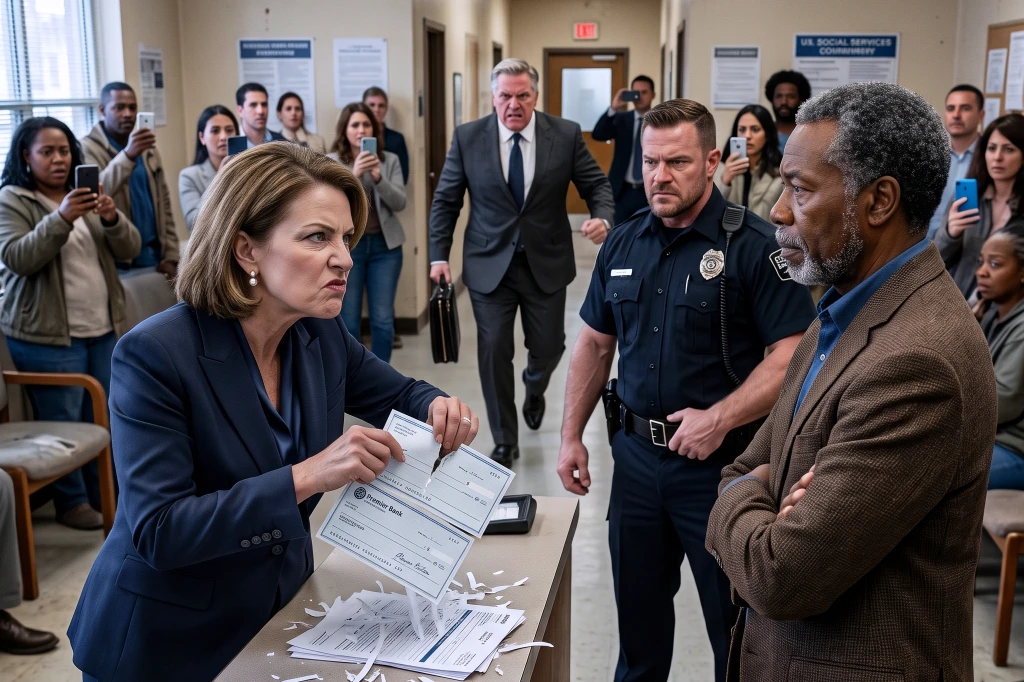
She folded the check once across the center and tore it. The sound was no louder than cloth giving way at a seam. Then she tore the halves again and tossed the pieces toward the counter. One struck Elias’s lapel. Another landed faceup beside his shoe, with GRACE CARTER OPPORTUNITY FUND still visible on the payee line.
Leon crossed the lobby. “Sir, let’s step away.”
His hand closed around Elias’s upper arm. The blue repair thread at the cuff pulled tight and snapped.
Elias did not resist. “Take your hand off me.” “You heard him threatening me,” Rebecca said. “I heard him ask for his property,” Emma replied. Rebecca shoved the desk phone toward her. “Call 911. Tell them he grabbed me…”
To read the rest of the story – CLICK the NEXT button 👇👇👇