


At ten after six on the second morning after Ben died, Nell Hartwell’s phone began to vibrate across the kitchen table. It bumped once against his coffee mug and stopped beside the unsigned funeral-home form she had been pretending to read. The message was from Mara Ortiz, Red Clay’s director of elephant care. Nell opened it with both thumbs.
Ada’s Oak Basin group left the north range. Nine animals. Moving south.
Nell read it twice. The elephants had water, shade, and nearly two thousand acres on the north range. They had not taken the six-mile trail through Red Clay’s linked habitats toward the farmhouse in almost two years. A washout had closed one section for six months; the facilities crew repaired it the previous fall, but the elephants had not chosen it since. She called Mara.
“How fast?”
“Not fast. That’s what’s strange.” Wind rubbed against Mara’s phone. In the background, a utility vehicle idled. “They passed the west pond without stopping. Ada’s leading. Belle has the two youngest calves boxed between her and Della.”
Nell looked through the screen door toward the wooded rise beyond Ben’s empty chair. “Are you following them?”
“From the service road. We haven’t called them, and we’re not pushing. I’ve closed the south service loop.”
“Good. Keep everyone outside the inner fence.”
Mara was silent for half a beat before saying, “Nell, I know.”
It was the first correction anyone had offered her since the hospital called. She put her thumb against the edge of the table and felt the shallow groove Ben had worn there with his pocketknife, despite being told for twenty-three years not to carve indoors.
“I’m sorry,” she said.
“I’ll call when they cross Mill Creek.”
The line went dead. Nell remained at the table with the phone in her hand and the refrigerator humming behind her.
Ben had collapsed after a conservation dinner in Nashville. By the time an ambulance reached the hotel, his heart had stopped once and been restarted. It stopped again in the emergency room. Nell had made the two-hour drive with one shoe half fastened and arrived in time to see a nurse remove his wedding band.
At sixty-four, Ben had been the public face of Red Clay Elephant Refuge for most of its existence: the former large-animal veterinarian who could make a ballroom quiet by describing the first time Ada chose not to charge a gate. Nell, a civil engineer who served as Red Clay’s facilities and finance director, had designed that gate. She had designed every receiving yard, drainage trench, protected-contact wall, and reinforced hinge on thirty-six hundred acres of Tennessee limestone and red dirt. But when donors came, Ben told the stories and Nell showed them the balance sheet.
At first, the division had felt fair. Later, Nell noticed that donors remembered Ben’s name and asked her where to park.
On the table beside the funeral form lay a six-page contingency authorization from Red Clay’s board. She had signed the last page at three that morning. The document allowed the two partner facilities named in Red Clay’s standing succession plan to review emergency capacity and assess compatible-group placements if the refuge could not prove stable leadership after Ben’s death.
It did not order the elephants moved. Nell had underlined not order twice and still could not make it feel honest.
At nine, a camera on the Mill Creek crossing caught Ada stepping out of the trees. She was an African elephant in her late forties, broad-headed and dark along the shoulders where she had sprayed herself with mud. Her left ear carried a triangular tear from a life before Red Clay. Behind her came Belle, Della, four other females, and the two youngest calves, born after their mothers arrived at the refuge already pregnant.
Nine animals passed the camera in a loose procession. No caregiver guided them. At Red Clay, people worked through barriers and from protected lanes; the elephants decided whether to participate. Ada paused over the buried culvert, one forefoot resting on the concrete as if she had felt something below it, then moved on.
By eleven, the six females from West Woods and the six from Birch Range had also turned south through gates already open for seasonal access. The three compatible groups often shared space, though they browsed and rested in their own familiar clusters. All twenty-one residents were now moving toward the farmhouse by different branches of the same internal trail.
By noon, the staff had closed the county road entrance and stationed vehicles at the outer gates. Nell changed into work boots because grief did not excuse a person from copperheads, loose gravel, or poor decisions. She carried Ben’s faded canvas cap out to the porch, then brought it back inside. She did not know what she meant to do with it.
Mara arrived shortly after one in a dust-coated utility vehicle. She was forty-seven, with silver beginning at her temples and two radios clipped to her belt even when one would do.
“They’re in the south corridor,” she said. “No signs of agitation. They ignored the browse we put near Gate Six.”
“How long until they reach the house fence?”
“An hour. Maybe less.”
Nell glanced at the sky. Thin cloud had softened an unusually warm March afternoon, but the air was heavy enough to hold every sound close to the ground. “Set a temporary trough by the lower station. No crowding if they don’t use it.”
Mara nodded but did not leave. “Tess is on her way.”
Nell turned fully toward her. “Who called her?”
“Ruth Givens. Tess is the family contact in Ben’s succession file.”
Of course. Ruth would have sent her the family notice and the contingency summary. Their daughter worked in an emergency department outside Knoxville and could read a bad outcome while other people were still explaining the symptoms.
“She said she’d be here by three,” Mara added.
“Did she sound angry?”
“She sounded like Tess.”
Tess went quiet when she was angriest.
The elephants reached the meadow at two-twenty. Nell watched from behind the farmhouse’s secondary fence with Mara, two caregivers, and the refuge veterinarian. Ada emerged first, brushing sumac from her face. The groups spread briefly across the grass, gray bodies appearing between cedar trunks until the number became difficult to take in.
Then they gathered again and came on.
The staff had prepared for noise—contact rumbles, trumpeting calves, perhaps a challenge at an unfamiliar vehicle. Instead, the elephants crossed the meadow almost silently. Their feet pressed dark circles into the grass. A calf swung her trunk at a grasshopper and was nudged back into line by Belle.
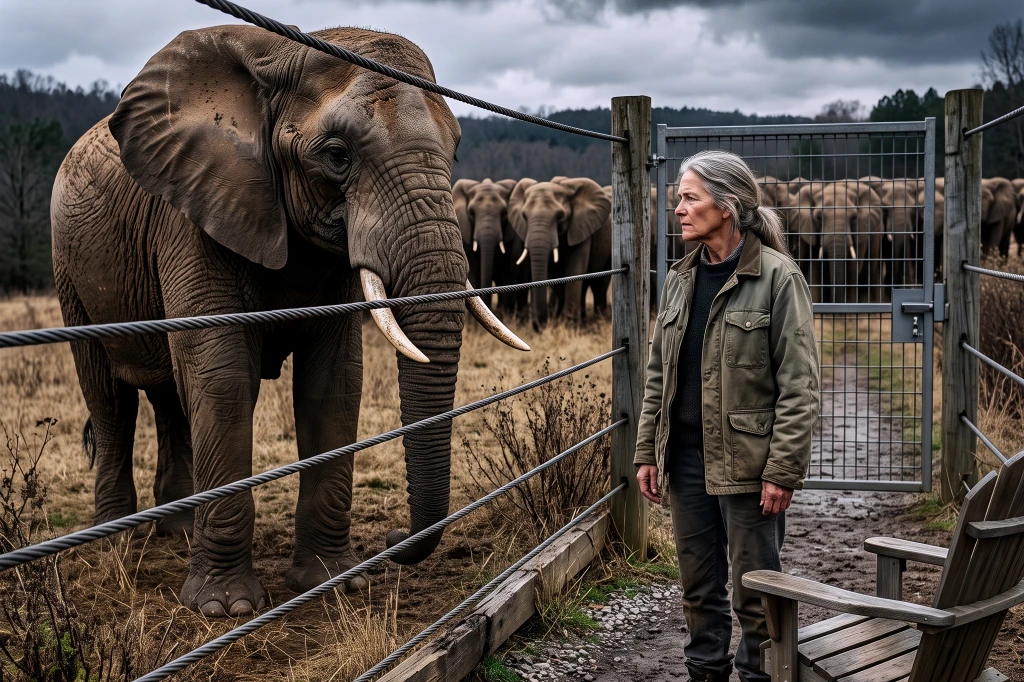
Ada stopped sixty feet from the house at the heavy cable fence Ben and Nell had installed after the original group began visiting. The others arranged themselves behind and beside her in three familiar clusters, not in a perfect row but with the compact order of animals making room for one another.
Nell had seen Ada wait for Ben there dozens of times. Ben would come down from the porch talking before he reached the gate, as if continuing a conversation interrupted the day before. He never carried food. He said food made a bargain of things that should remain voluntary.
Now his chair was empty, and Ada faced it.
Minutes passed. A low vibration rose through the soles of Nell’s boots. She heard almost nothing at first, only felt it—a pressure too steady to be machinery. One of the younger females answered, then another, and the sound moved through the herd in overlapping rumbles.
“Could they have known something happened?” one caregiver whispered.
“Ben was in Nashville, and they were on the north range,” Mara said quietly. “Maybe they noticed he stopped making his rounds. Maybe they noticed us. We don’t know.” Nell was grateful for the last three words and held on to them.
Ada lifted her trunk and sampled the air. It traveled toward the porch, lowered, then rose again. She took three measured steps toward the lower protected-contact station, and Mara looked at Nell.
“She’s at the contact panel.”
“You go.”
“It’s the station where she used to hear you and Ben.”
The station was a concrete alcove built into the inner barrier. Vertical steel rails and a close inner mesh separated the human side from the elephant side; an elephant could smell, see, and breathe through it but could not pass her trunk into human space. A caregiver could step away behind another locked door at any time. Nell had inspected it every quarter. She had not stood inside it with Ada waiting on the other side for eleven years.
Nell hesitated, then went into the house and returned with Ben’s cap.
“That may not mean anything to her,” Mara said.
“It means something to me.”
Mara checked both doors herself, then let Nell into the station. The air inside smelled of sun-warmed steel and the sweet hay stored in the adjoining shed. Ada approached until her forehead filled the spaces between the rails.
Nell held the cap near the mesh. Ada’s trunk followed the shape of the brim from the other side, drew a slow breath, and released it. Warm air moved through the small openings across Nell’s knuckles. The trunk withdrew, leaving the cap exactly where it was.
“All right,” Nell said, though no one had asked a question.
Ada reached toward the mesh again. This time she passed the cap and placed the tip of her trunk against the steel opposite the inside of Nell’s wrist.
The vibration was light enough that Nell could have mistaken it for air if she had closed her eyes. Beneath her palm was the small white scar she had carried since the first receiving gate at Red Clay slipped its track.
Nell’s right knee unlocked. She braced one hand against the concrete wall and let Ada choose when to pull away.
A car door slammed near the outer lot. Tess came down the service path still wearing navy hospital scrubs, her hair twisted into a knot that had come loose on one side. She stopped outside the station when she saw Ada, then looked from the elephant’s trunk to her mother’s face.
Before speaking, Tess checked the rear-door indicator and pressed once against the seated latch, the same two-part safety check Nell had taught her at thirteen. Then she looked through the secondary rail.
“Your knees?”
“Working.”
“That isn’t what I asked.”
Nell adjusted her stance against the concrete. Tess moved closer to the outside rail, ready if she was needed but careful not to crowd Mara’s exit path. For a few seconds, anger left her. Nell saw the child who used to fall asleep on rolled fencing plans while her parents argued over gate widths. Then Tess noticed Ben’s cap in Nell’s hand.
“Tell me,” she said, “you didn’t authorize them to break up the herd…”
To read the rest of the story – CLICK the NEXT button 👇👇👇