


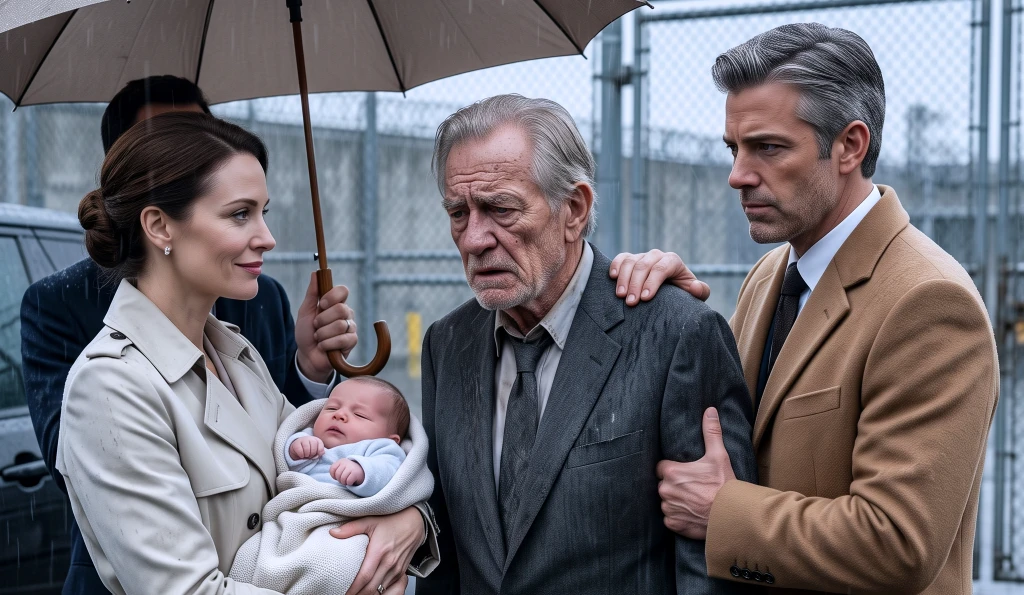
The first thing I noticed beyond the prison gate was Graham’s black Range Rover idling at the curb. Rain came sideways across the prison parking lot, needling my face and turning the charcoal suit I had worn to sentencing two years earlier almost black at the shoulders. The suit had gone into a property bag when I became an inmate and come back smelling of plastic, dust, and the cedar block my wife used to keep in our closet.
June had been dead four years. Even so, when I put the jacket on that morning, the faint scent of cedar made me look over my shoulder.
The release officer handed me a white envelope containing forty-three dollars, an expired driver’s license, and my wedding ring, which the prison had not allowed me to keep. He asked me to sign beneath a line confirming that everything was there.
“Everything they took from me?” I asked.
He had probably heard some version of that a hundred times. He waited with his pen resting on the counter until I signed.
I was seventy-one years old, twenty-four pounds lighter than I had been at trial, and had completed the executed portion of a sentence for battery resulting in serious bodily injury. One year of probation remained. The conviction remained too, printed in public records and repeated in every article that described me as the founder of Quinn Cold Freight.
The gate rolled shut behind me. Its steel wheels made a low, laboring sound, less like thunder than a delivery truck backing into a dock.
My son stood beside the Range Rover with one hand in the pocket of a camel-colored coat, his dark hair silvering at the temples in a way that made him look more like me than either of us would have wanted. Camille stood a few feet away, protected from the rain by an assistant holding a wide umbrella.
She had a baby in her arms.
Owen was nine months old. I knew that from the company website, where his birth had been announced beneath a photograph of Graham and Camille in a hospital suite. I had seen it on a library computer while an officer stood behind me waiting for me to finish.
“Dad,” Graham called.
His voice carried the warmth of a man greeting someone he loved. Then I saw the photographer crouched near the front of the Range Rover, his long lens pointed at the gate, and the warmth acquired a price.
Graham crossed the pavement and embraced me. I could feel how carefully he arranged his body for the camera: face turned outward, hand high on my shoulder, both of us squarely in the frame.
“Just stand still for a second,” he murmured. “This will make things easier.”
“For whom?”
His jaw tightened against my cheek. “For all of us.”
He stepped back before the photograph could record his expression. Camille came forward with Owen, her pale raincoat open at the throat and her face composed into something that was not quite sorrow.
Two years earlier, she had sat in a Marion County courtroom and told twelve jurors that I had shoved her down the bottom half of my own staircase. She said she had been twelve weeks pregnant. She said the fall had killed her baby and caused the internal bleeding that nearly killed her.
I had gripped her wrist during an argument. I had shouted at her. I had not pushed her, and I had not known until that week that she claimed to be pregnant.
The jury believed the bruises, the blood, and my son.
Owen woke as Camille approached. His eyes opened slowly, gray and unfocused, and one small fist worked free of the blanket.
“Your grandfather is home,” she told him.
She offered him to me with both arms. The photographer shifted closer.
I did not take the baby, but I brushed a knuckle against his fist. Owen closed his hand around it with surprising strength.
“He shouldn’t have to do public relations before breakfast,” I said.
Camille’s mouth remained curved, though the smile left her eyes. Graham moved between us and produced a slim leather folder from inside his coat.
“The house is ready for you,” he said. “Your old room has been made comfortable, and we’ve arranged a physician and a counselor. There are just a few practical matters.”
Inside the folder was a family reconciliation statement. Beneath that lay an agreement not to discuss the trial, the company, or any member of the Quinn family with the press. A third document affirmed that Graham’s authority over the Quinn family voting trust would continue indefinitely.
I read the first page twice, partly because prison had trained me to distrust any paper placed in front of me and partly because I wanted my hands to stop shaking before I gave it back.
“You brought a baby and a notary to a prison gate,” I said. “That’s efficient.”
“We brought you a home.”
“A room,” I said. “Homes don’t usually come with nondisclosure agreements.”
For a moment I saw the boy Graham had been: nine years old, furious because I would not let him quit piano lessons; seventeen, waiting in the parking lot after I had forgotten the regional swim final; twenty-eight, standing beside me at his first board meeting while I corrected him in front of everyone. Then the moment closed.
“If you make a scene now, every lender we have will know by noon,” he said quietly. “People’s jobs are attached to your behavior.”
It was an argument he had learned from me. I had used payroll, tuition, mortgages, and the family name as weights on a scale for most of his life.
Camille drew Owen closer. “We are offering peace, Everett.”
“No,” I said. “You’re offering supervision.”
A blue Subaru wagon turned into the lot. It had a dent above the rear wheel and one headlight clouded with condensation, but I knew the woman driving it before she stopped.
Mara Keene climbed out carrying two paper cups and no umbrella. She was fifty-two, compact, dark-haired, and dressed in the same navy suit she had worn at my sentencing. She had represented me through the appeal, the post-conviction petition, and every prison disciplinary appeal caused by my refusal to pretend I was grateful.
“Morning,” she said. “I’d apologize for being late, but the people who designed I-69 have already received enough profanity.”
The photographer lowered his camera. Graham stared at her with open dislike.
“This is a family matter, Mara.”
“Then stop photographing it.”
She opened the passenger door for me. Graham took one step forward, then stopped when Mara held up her phone and aimed it at the photographer.
“My client has declined,” she said. “Everyone here has heard him. If you use his image to imply endorsement of a statement he hasn’t signed, I’ll spend my afternoon making your afternoon expensive.”
I walked toward her car. Behind me, Graham called my name once, not loudly.
I turned. Rain ran off his hair and into the collar of his coat while Camille and the baby remained beneath the umbrella.
“You have nowhere else to go,” he said.
There was no triumph in his face. That would have been easier. What I saw was fear, and beneath it an old expectation that however far he went, I would eventually come back and put the world in order.
“That used to be true,” I said.
Mara drove us west toward Indianapolis. She handed me one of the coffees, then apologized when she remembered I had not taken sugar in thirty years.
The city rose gradually out of the wet morning: warehouse roofs, church spires, highway signs, the pale block of the airport control tower in the distance. For four decades I had measured Indianapolis by delivery times. From the old produce district to the airport in twelve minutes before dawn; from the south-side cold store to the interstate in seven if the lights cooperated.
Now every mile felt borrowed.
“You’re quiet,” Mara said.
“I’ve been living with one hundred and twelve men. I’m enjoying the novelty.”
“That isn’t what I meant.”
I watched a refrigerated trailer pass us in the opposite lane. Beneath the road grime I could still make out the blue QCF compass I had sketched on a napkin before Graham could walk, when Quinn Cold Freight was one used truck and June was doing invoices at the kitchen table.
“Tell me about the company,” I said.
Mara kept both hands on the wheel. “Graham refinanced the fleet last year. Fuel costs rose, two hospital contracts were lost, and a speculative expansion into pharmaceutical storage went over budget. Crossroads Commercial Bank gave them a temporary waiver, but it expires Friday.”
“He’ll sell South Meridian.”
“He intends to. The board packet calls it a sale and leaseback, but the buyer can close the terminal after eighteen months. There are a hundred and eighty employees attached to that facility.”
South Meridian was the first warehouse June and I had owned instead of rented. I knew which loading bay flooded in a hard spring storm and where the night crew hid a coffeemaker from the fire inspector.
“Who is the buyer?”
“An investment group called Alder Ridge. One of Camille’s brothers receives a success fee if the deal closes.”
I looked at her. “And the board approved that?”
“Not yet. The employee trust has two directors, the family has two, and there are three independents. Graham has been using the family’s high-vote shares to remind the independents who can replace them.”
“Those shares are mine.”
“You are the voting trustee and beneficial owner, yes. Voting control passed to Graham under the proxy you signed before sentencing. The proxy expired this morning, but he amended the trust afterward to claim continuing authority. We can challenge those amendments, but not by walking into headquarters and announcing that the king has returned.”
The word king embarrassed me, although I had encouraged people to treat me like one for years. I sipped the coffee. It was too sweet and too hot, and I drank it anyway.
“How long before I can get in front of a judge?”
“On the trust, weeks. On your conviction, longer.”
I turned toward her. For eleven months Mara had pursued a post-conviction claim based on ineffective counsel, missing hospital records, and inconsistencies in Camille’s medical history. The court had authorized limited discovery six weeks before my release, but the hospital system had delayed production while it migrated an old records server.
Mara reached behind my seat at a red light and pulled a padded envelope from her briefcase.
“This arrived at six twelve this morning,” she said. “The hospital’s integrity office recovered an audit archive that never made it into the trial production.”
My fingers had opened thousands of manifests, contracts, and inspection reports. None had felt as heavy as that envelope.
Inside were laboratory results, timestamps, ultrasound images, a radiology report, and a log showing every person who had opened or altered Camille’s chart. Mara had marked three entries with yellow tabs.
“Read the serum test,” she said.
I found the line. The terminology meant little, but the result was printed in ordinary language beside it: negative.
“Now the ultrasound.”
No gestational sac. Hemorrhagic ovarian cyst. Findings consistent with rupture.
The final page showed that Dr. Malcolm Voss had added the words pregnancy loss secondary to reported fall thirty-six hours after Camille’s discharge. The original version had contained no pregnancy and no fall.
I read the dates again, then looked at the test taken when she entered the emergency department. Another negative result. A test from an outpatient visit three weeks earlier was negative too.
The driver behind us honked when the light changed. Mara drove on while I held the papers against my knees and felt two years rearrange themselves inside my chest.
Every laboratory test and every original image said the same thing. Camille Quinn had never been pregnant…
To read the rest of the story – CLICK the NEXT button 👇👇👇