


The man on Maya Turner’s porch had arranged himself so carefully that, at first, she mistook him for a bundle of wet coats. He sat on the lowest step beyond the reach of the porch light, one hand resting on a suitcase banded with gray tape. When she came through the gate after her cleaning shift, he stood too fast and caught the rail.
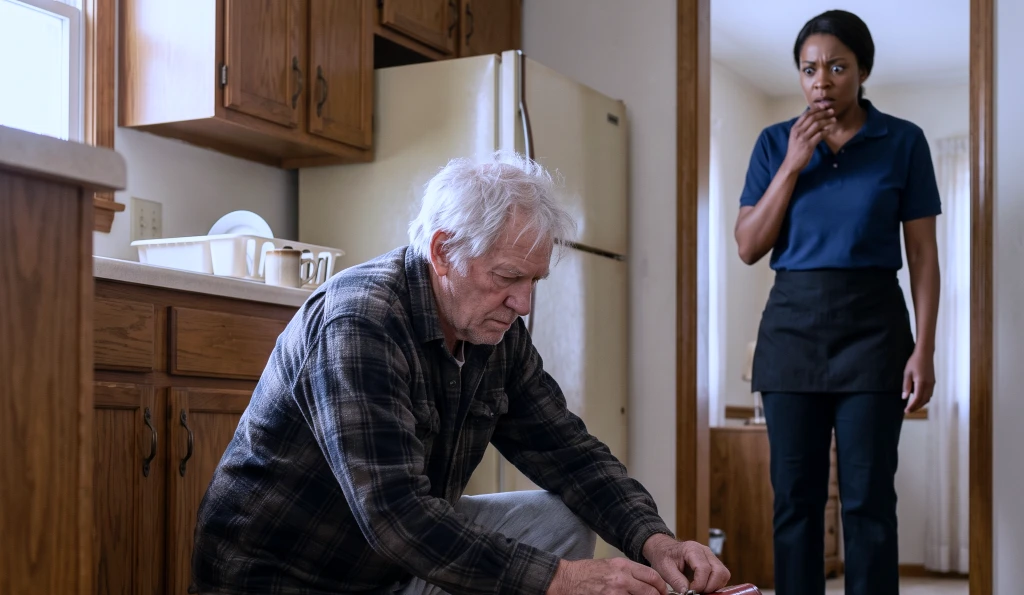
“I’m sorry, ma’am.” Cold March rain ran from his white hair into the hollows beside his mouth. “The shelter gave out its last mat. Could I stay under your roof until the buses start? Just the porch. I won’t knock again.”
Maya kept the gate between them. June was asleep upstairs, and Gloria Hayes next door had gone home less than twenty minutes ago after babysitting. In Maya’s tote were forty-two dollars in tips, a mortgage letter she had not opened, and a photograph on her phone of a planning map she had not been meant to see.
“What’s your name?”
“Arthur Mercer.”
“You been drinking, Mr. Mercer?”
“Not tonight.”
It was not the same as no, and Maya noticed. She also noticed the split sole of his left shoe and the way his fingers slid along the rail because they would not close around it.
“Why Juniper Street?”
“Saw a notice about the mill at the day center. Came to look before the hearing. Then I missed the last bus.”
She called the winter shelter. Arthur had told the truth; every bed and overflow mat was taken. Then she texted Gloria: Old man on my porch. Shelter full. Keep your phone on.
Gloria’s answer came before Maya had put her phone away. I am awake. Chain the inside door.
Maya opened the gate. “You can come onto the screened porch. Your suitcase stays by the outer door. My neighbor knows you’re here.”
“That’s more than I asked.”
“It’s what I’m offering.”
The screened porch had once been her grandmother’s summer room. Its beadboard walls held the smell of dust and old lavender, and the narrow daybed sagged toward the middle. Maya switched on the space heater, then went into the kitchen and ladled the last of the chicken-and-rice soup into her grandmother Ruth’s yellow bowl, the one with a chip shaped like a thumbnail.
Arthur tried to take it with one hand. The spoon struck the rim twice before he steadied the bowl against his chest.
“Come to the table,” Maya said.
He looked toward the stairs. “My daughter’s asleep,” Maya said.
“Kitchen only. I’m locking the porch door behind you when you go back out.”
She pulled the chair away from the inner-door knob, opened the door, and kept the key in her fist while Arthur left his wet coat on the porch. At the table, he held the bowl in both hands without eating. Steam blurred his glasses.
Maya found herself opening the bottom drawer of Andre’s dresser. She had not touched the work clothes since the funeral except to move them from one side to the other. The socks were thick wool, bought for winter concrete pours. She took one pair and a pair of gray sweatpants, then shut the drawer before the smell of cedar and Andre’s soap could rise any farther.
Arthur accepted them without asking whose they were. If he had asked, Maya would have had to say Andre’s name.
He ate slowly. Maya opened the mortgage letter while he did. The servicer wanted documents for a loss-mitigation review—bank statements, pay stubs, proof of June’s survivor benefit, a list of expenses—and warned that her account was now more than four months delinquent. Ruth had left Maya the house; Maya and Andre later borrowed against it to replace the roof, signing the loan together. Westmark’s carrier was contesting Maya’s claim for workers’ compensation death benefits, arguing that Andre had been an independent contractor; her appeal was still pending nine months after his fall.
She folded the letter into thirds. “Bad?” Arthur asked.
“Private.”
He lowered his eyes to the soup. “Yes, ma’am.” When he finished, he washed Ruth’s bowl and dried the sink with a care that made the constant drip from the cold-water tap seem louder. He did not ask about it.
He returned to the porch with the dry clothes under one arm. Maya left him to change. When he knocked on the glass, his wet pants hung over the back of a chair and Andre’s sweatpants gathered around his ankles. She unplugged the heater once the room had warmed, then watched him lie down in Andre’s socks beneath two quilts.
Maya locked the inner door and pushed a chair under the knob anyway.
At six, Gloria arrived wearing a rain bonnet and carrying biscuits in a foil packet. She was sixty-three, retired from the elementary-school office, and had spent thirty years remembering which child belonged on which bus when every adult around her was confused. She looked through the glass at Arthur, then at Maya.
“You going to work?”
“I have to.”
“Then I’ll sit here until you’re back. He doesn’t go upstairs, and June doesn’t come out here without me.”
Arthur, awake on the daybed, raised two fingers to show he had heard. Maya gave him coffee in a travel mug and left for Lula’s Grill on the first bus.
Luis Ortega took his usual counter stool near the end of Maya’s shift. He had been Andre’s crew lead until six months before the fatal Westmark job, when he left to start a small licensed repair business of his own. He still asked about the loose porch rail each time he saw her.
“I can look Saturday,” he said. “Looking doesn’t cost you.”
“I have it handled.”
Luis glanced at the diner window, where rain trembled against the glass. “All right.” He slid his business card beneath the sugar caddy. “You call when you do.”
He also asked whether she had started Andre’s old pickup lately. It had been sitting under a tarp behind the house since the week of the funeral. Maya said the battery was probably dead and carried his plate away.
By the time she came home after lunch, the rain had thinned to mist. She heard June laughing before she opened the door—not the pleased little hum June made for cartoons, but a loose, hiccupping laugh Maya had not heard since Andre used to balance toast on his head.
Gloria sat at the kitchen table doing a crossword. June was beside Arthur on the floor, holding a picture book while he gave a red fox the voice of a county judge. The faucet had stopped dripping.
Maya set down her bag. “Who fixed that?”
Arthur’s fox voice disappeared. “I did.”
“With what?”
He pointed toward the pantry. Andre’s red metal toolbox sat open on the counter.
The adjustable wrench lay on a dish towel, wiped clean. Maya had not opened that box since the accident. For a moment she could see Andre’s hand on the latch, two knuckles scarred white, and hear him telling June that every tool went back where it slept.
“You went through my husband’s things?”
Gloria put down her pencil. Arthur got to his feet, slower than he had the night before.
“The shutoff was sticking,” he said. “I asked Mrs. Hayes where the tools were. I should have asked you.”
“Yes. You should have.”
He did not tell her the repair had helped. He did not explain that he had meant well. He closed the toolbox and placed it exactly where it had been.
“The washer will hold for a while,” he said. “The valve seat is pitted. Don’t force the handle.”
June looked from one adult to the other. “The kitchen stopped counting.” She had been falling asleep to that drip for months, Maya realized—one, then another, then another, filling the dark after Andre was gone.
Maya took a breath. “Mr. Mercer, you ask before you touch anything else.”
“I will.”
“And you have three nights. Gloria found an outreach office that can help you replace your ID and get on the senior-housing list. We’ll go tomorrow.”
Arthur glanced at the porch, then at June, who had left the fox book open where he had been sitting. “Three nights,” he said.
That afternoon Maya spread the mortgage papers across the table. June drew beside her, making one of her cutaway houses: upstairs bedrooms floating over a kitchen, each room outlined with a different crayon. Andre had taught her to draw walls with the small carpenter’s square he kept in a kitchen drawer. Since his death, she represented him as a pair of brown work boots beside the back door.
Arthur stayed on the far side of the room.
Maya opened the photograph from City Hall. She had found the map facedown beside the copier while cleaning the planning suite. JUNIPER—HOLLIS YARD REDEVELOPMENT, the title read. The abandoned textile mill occupied most of the page, but a blue crosshatch spread across the eight occupied houses on the east side of Juniper Street, including Maya’s corner lot.
Arthur leaned forward, then stopped with both hands on the back of a chair. “May I?”
Maya slid the phone toward him.
He enlarged the crosshatch. “That base drawing is old.”
“How can you tell?”
“Drainage line behind Gloria’s house. They filled it after the flood. This was drawn before that.”
“You know this street?”
“I knew maps like this.”
Arthur’s eyes left the map and settled on the loose joint in the nearest kitchen chair. Maya waited, but he offered nothing else.
“Which flood?”
Arthur looked at the eight shaded houses again. “The one in ’ninety-six.”
The public library kept the city’s older planning records on a basement computer that wheezed each time it opened a scan. Gloria came with them and took June to the children’s floor while Maya searched dates Arthur supplied. After half an hour, they found a report called JUNIPER STREET HOUSING REHABILITATION SURVEY.
The first page carried the same drainage line, lot shapes, and blue crosshatch as the map on Maya’s phone. In the old legend, the crosshatch meant FLOOD-SURVEY AREA, not clearance or acquisition. Within it, seven of the eight houses were marked R—repairable. The eighth was marked for further inspection; none was marked for clearance. The modern proposal had removed that legend and used the same shaded area as Phase Two.
Maya scrolled to the final page.
At the bottom, below the names of the city engineer and grant administrator, was a typed credit:
FIELD SURVEY SUPERVISOR — ARTHUR MERCER.
She turned the monitor toward him. “Why is your name on the paper they’re using to take my house…”
To read the rest of the story – CLICK the NEXT button 👇👇👇