


The wolf left a child’s mitten on Walter Mercer’s porch at 1:38 in the morning. Walt saw it first: red wool against the fresh snow, small enough to fit inside his palm. Then the porch light caught the animal standing beyond it. The gray wolf had stopped at the edge of the steps, close enough that Walt could see ice on his whiskers and the notch missing from his left ear.
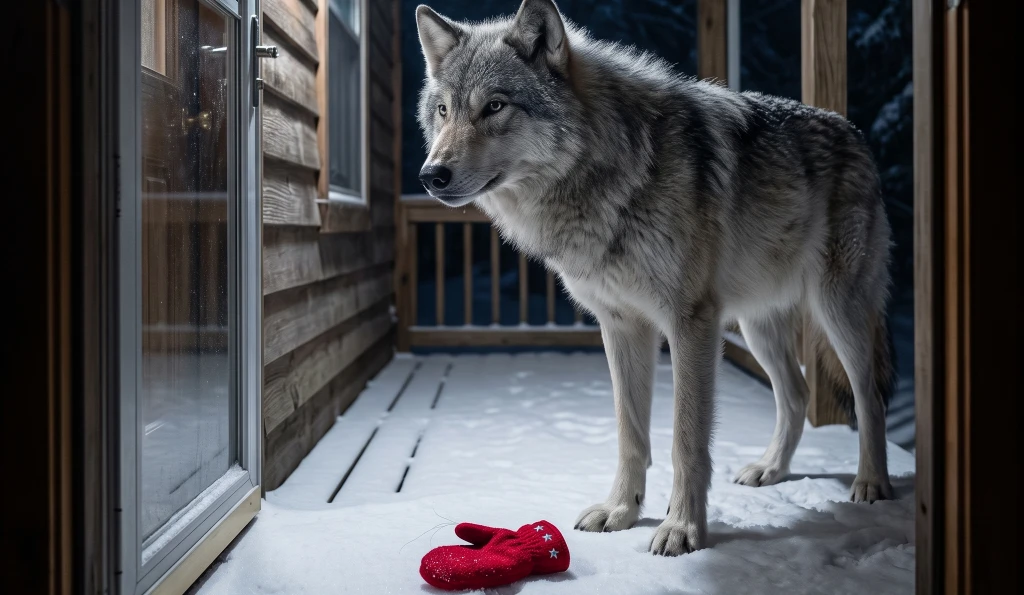
For nearly two years, Walt had watched that wolf move along the far side of his property outside Alder Ridge, Minnesota. Sometimes it appeared at dusk. Once it had crossed the frozen beaver pond while Walt split wood. It had never come onto the porch, never looked through the glass, and certainly never carried him anything.
Walt opened the inner door but kept the storm door between them. Wind flung powder against the screen.
“Where did you get that?”
The wolf stared at him, then turned toward the black spruce. After three steps, it looked back.
Walt’s gaze dropped to the mitten. Silver stars had been sewn around the cuff. The wool was wet on the inside, not stiff with old ice, and a strand of pale hair clung to the thumb.
Somewhere nearby, a child had lost it recently.
He lifted the wall phone. The line gave him nothing. The blizzard had already taken the power twice and brought down a jack pine across County Road 16. His cell phone showed no service, which was ordinary at his cabin and unforgivable tonight.
The wolf crossed the yard, stopped again, and waited.
“Flint,” Walt said under his breath.
The wildlife officers who had freed the animal from a cable snare two winters earlier had warned Walt not to name a wild thing. Naming encouraged a man to imagine a relationship where none existed. Walt had agreed with them and then privately called the wolf Flint anyway, after the hard gray stone his late wife, Anne, used to line her garden beds.
That night in the snare, Flint had been young, exhausted, and bleeding from his left foreleg into the snow. Walt had done little more than cover him with a tarp, keep curious snowmobilers back, and talk until the Department of Natural Resources veterinarian arrived. The wolf had survived because professionals handled him, not because he had become grateful in some human way.
Walt knew all of that. He also knew the animal had just brought him a mitten.
He went to the hall closet and took down the orange rescue coat he had not worn since his retirement. His medical bag sat beneath it, faded almost pink along the seams. At seventy-one, Walt no longer trusted his knees on ice or his heart on steep ground, but thirty-six years in county emergency services had left him unable to see evidence of trouble and wait for someone younger to notice.
He packed chemical warming pads, dry blankets, a flashlight, bottled water, and the satellite messenger his niece insisted he carry. The device blinked while it searched for a signal through the storm. Walt clipped it to his coat, pocketed the red mitten, pulled on his boots, and rolled his old snowmobile from the shed.
Flint was already halfway to the trees.
The wolf did not follow a trail Walt knew. He ran north along the cedar swamp, angled across an old timber cut, and stopped whenever the snowmobile fell too far behind. Walt kept the headlight low. In the blowing snow, the trunks appeared without warning, white on one side and black on the other. Twice Flint vanished completely, only to materialize farther ahead with his head turned toward Walt.
They traveled nearly four miles before Walt recognized the broken sign at Balsam Cut.
The place had been a church camp when Walt was a young EMT. Children once slept in green cabins along the lake and sang around a stone fire ring. Nolan Calder’s family foundation had bought the property eight years ago, announcing plans for a wilderness program for children recovering from surgery. The program never opened. A fence went up, the old cabins sagged, and the land disappeared behind a row of signs that said PRIVATE REDEVELOPMENT SITE.
Tonight, the chain on the gate lay in the snow.
Walt cut the engine. Within the firs, the storm fell to a hush; somewhere ahead, loose metal tapped at uneven intervals.
Three taps. Silence. Two more.
Flint slipped past the gate.
Walt sent a message from the satellite device: CHILD POSSIBLY IN DISTRESS. BALSAM CUT CAMP. SEND EMS. REQUEST STATE PATROL. LOCAL PHONE DOWN. The screen read SEARCHING.
He followed on foot.
The old dining hall was dark. So were the cabins. Behind the infirmary, however, fresh tire tracks ended beside a plastic fuel tank, and an electrical cord ran through the snow to a basement vent. The portable generator attached to it was silent. Walt touched the metal housing. Cold.
The tapping came again from below him.
Flint stood beside a low window well packed with drifting snow. The wolf pawed once at the grate, then backed away. Caught between two iron bars was the matching red mitten.
Walt dropped to his knees and cleared the snow with both hands. “Can you hear me?”
The tapping stopped.
He aimed his flashlight through the grate. At first he saw only the edge of a mattress and a pale blanket. Then something moved beneath it.
“My name is Walt. I used to work on an ambulance. I’m going to find the door.”
A sound came through the vent, thin and rough. It might have been a word. It might have been breath dragged across a damaged throat.
Walt found the basement entrance on the other side of the infirmary. It was an insulated steel door set at an angle into the ground, with a new padlock on the outside. Above it, a small cellular trail camera pointed toward the drive. Its indicator was dark, but Walt could not tell whether the cold had killed it or whether it had already sent someone his picture.
He photographed the lock, the camera, and the tire tracks. Then he used the heavy cutters from his snowmobile kit. The shackle gave after the second try.
Warm air should have risen when he opened the door. Instead, damp cold rolled up the steps.
The basement had once been the camp infirmary’s storm shelter. Someone had turned it into a room without making it a place any child should live. A narrow bed stood against one wall. Plastic bins held crackers, shelf-stable milk, clean pajamas, and sealed medication. A bucket with a lid served as a toilet. There were coloring books but no crayons, a small television but no remote, and a camera in the ceiling corner.
The girl on the mattress watched Walt enter.
She appeared to be six, though hunger made age difficult to judge. Pale hair had been cut unevenly at her jaw. She wore thermal pajamas and one red mitten. A faint vertical scar showed at the base of her throat. Her eyes moved from Walt to the open door behind him, measuring both as dangers.
“You don’t have to come to me,” Walt said. He set his bag down where she could see his hands. “The heater stopped. I need to get you somewhere warm.”
Her lips moved. No sound came.
Walt opened a dry blanket and laid it on the floor between them. He explained each motion before he made it, the way he used to talk frightened accident victims through the minutes before pain medicine arrived. Her breathing was quick but clear. She was alert, badly chilled, dehydrated, and far too thin, but she did not look as if she would collapse in the next few seconds. That gave him time to be gentle.
A shadow passed across the open stairwell.
The girl’s face changed. She pushed herself upright so quickly that the blanket fell from her shoulders.
Flint had come as far as the threshold. He did not enter. He lowered his head and looked down the steps.
The girl lifted her bare hand toward him. “Gray,” she rasped.
Flint settled on the snow outside the door.
The girl’s raised shoulders eased slightly.
“He’s been coming here?” Walt asked.
She nodded. On the floor beside the bed, Walt noticed cracker crumbs gathered beneath a narrow gap around the vent. She had been feeding the wolf, or trying to. Perhaps Flint had slept near the warm exhaust when the generator worked. Perhaps, when it stopped, he had heard the tapping and carried away the only thing she could push through the grate.
Walt warmed a blanket with two covered heat packs and placed it around her torso. When he checked her fingers, he eased off the damp mitten and set it beside the mattress. Only after she followed his instructions and swallowed without coughing did he give her a small sip of water.
“What’s your name?”
Her fingers went to the collar of her pajamas. Pinned beneath it was a small enamel bluebird. Walt turned it carefully without removing it. Engraved on the back were five words.
For my brave bird — Dad.
The bins supplied the rest. A box of sterile nebulizer tubing bore a pharmacy label: SOPHIE CALDER. A discharge envelope from North Range Airway Center had the same name, along with a birth date six years earlier. Walt photographed the labels, the silent generator, and the camera inside the room. He slipped the discharge envelope and one sealed, labeled medication carton into a clear pouch in his medical bag.
Walt recognized the name from campaign ads that had run all winter.
Nolan Calder owned the mining-service trucks that crowded half the county roads. The Calder Children’s Fund had paid for playgrounds, school vans, and the new family wing at North Range Medical Center. For three months, Nolan’s face had appeared in campaign ads for the open state senate seat, usually with a child beside him and the words NO FAMILY LEFT BEHIND.
Publicly, his daughter Sophie was receiving specialized care in Colorado. Walt remembered the explanation because Anne had once clipped a photograph of the Calders from the newspaper and said the little girl looked frightened by the flash.
He looked around the locked basement. The stocked food, the medical packaging, the camera, the outside padlock—none of it could be explained as a child wandering away or a parent making one bad decision in panic.
Sophie touched his sleeve. “Go,” she whispered.
The word cost her. Walt leaned closer. “I’m taking you with me.”
She shook her head and pointed toward the ceiling.
Above them, the broken padlock scraped across concrete.
Walt killed his flashlight. A man’s boots scraped snow from the steps, and a radio crackled beyond the door.
“Pike?” another man’s voice said through the speaker. “The camera shows the lock is cut. Is somebody in there with her?” The steel door began to move…
To read the rest of the story – CLICK the NEXT button 👇👇👇